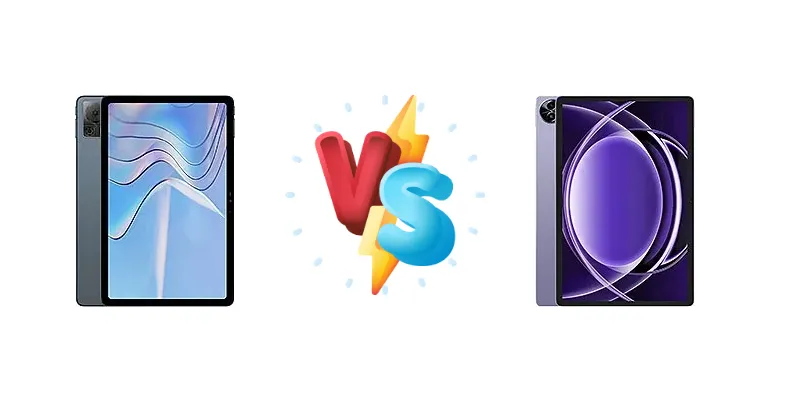
The budget tablet market is heating up, with options like the Doogee T20S and Realme Pad 2 Lite vying for attention. Both aim to deliver a capable Android experience without breaking the bank, but they take different approaches to achieving this. The core difference lies in their chipsets: the Doogee utilizes the Unisoc Tiger T616, while the Realme opts for the MediaTek Helio G99. This comparison will dissect these key components and other features to determine which tablet offers the best value.
🏆 Quick Verdict
For the average user prioritizing overall performance and efficiency, the Realme Pad 2 Lite is the better choice. Its MediaTek Helio G99, built on a 6nm process, provides a noticeable performance advantage over the Doogee T20S’s 12nm Unisoc Tiger T616, translating to smoother multitasking and gaming. While the Doogee may offer a larger display, the Realme’s efficiency and slightly faster CPU cores make it the winner.
| Network |
|---|
| 2G bands | GSM 850 / 900 / 1800 / 1900 | GSM 850 / 900 / 1800 / 1900 |
| 3G bands | HSDPA 850 / 900 / 1900 / 2100 | HSDPA 850 / 900 / 2100 |
| 4G bands | LTE | 1, 3, 5, 7, 8, 20, 28, 38, 40, 41 |
| Speed | HSPA, LTE | HSPA, LTE |
| Technology | GSM / HSPA / LTE | GSM / HSPA / LTE |
| Launch |
|---|
| Announced | 2023, July 01 | 2024, September 13 |
| Status | Available. Released 2023, July 01 | Available. Released 2024, September 26 |
| Body |
|---|
| Build | Glass front, aluminum frame, aluminum back | - |
| Dimensions | 7.9 mm thickness | 258 x 169.5 x 8.3 mm (10.16 x 6.67 x 0.33 in) |
| SIM | Nano-SIM + Nano-SIM | No |
| Weight | - | 525 g (1.16 lb) |
| Display |
|---|
| Resolution | 1200 x 1920 pixels, 16:10 ratio (~218 ppi density) | 1200 x 1920 pixels, 16:10 ratio (~207 ppi density) |
| Size | 10.4 inches, 313.6 cm2 | 10.95 inches, 347.7 cm2 (~79.5% screen-to-body ratio) |
| Type | IPS LCD | IPS LCD, 1B colors, 90Hz, 450 nits (peak) |
| Platform |
|---|
| CPU | Octa-core (2x2.0 GHz Cortex-A75 & 6x1.8 GHz Cortex-A55) | Octa-core (2x2.2 GHz Cortex-A76 & 6x2.0 GHz Cortex-A55) |
| Chipset | Unisoc Tiger T616 (12 nm) | Mediatek Helio G99 (6 nm) |
| GPU | Mali-G57 MP1 | Mali-G57 MC2 |
| OS | Android 13 | Android 14, Realme UI 5.0 for Pad |
| Memory |
|---|
| Card slot | microSDXC (uses shared SIM slot) | Unspecified |
| Internal | 128GB 8GB RAM | 128GB 4GB RAM, 128GB 8GB RAM |
| Main Camera |
|---|
| Dual | 13 MP
secondary unspecified camera | - |
| Features | LED flash, HDR, panorama | Panorama |
| Single | - | 8 MP, f/2.0 |
| Video | 1080p@30fps | 1080p@30fps |
| Selfie camera |
|---|
| Features | - | Panorama |
| Single | 5 MP | 5 MP, f/2.2 |
| Video | Yes | 1080p@30fps |
| Sound |
|---|
| 35mm jack | Yes | No |
| Loudspeaker | Yes | Yes, with stereo speakers (4 speakers) |
| Comms |
|---|
| Bluetooth | Yes | 5.2, A2DP, LE |
| NFC | No | No |
| Positioning | Unspecified | GPS, GALILEO, GLONASS, BDS |
| Radio | Unspecified | No |
| USB | USB Type-C | USB Type-C |
| WLAN | Yes | Wi-Fi 802.11 a/b/g/n/ac, dual-band |
| Features |
|---|
| Sensors | Unspecified | Accelerometer |
| Battery |
|---|
| Charging | - | 15W wired |
| Type | 7500 mAh | 8300 mAh |
| Misc |
|---|
| Colors | Green, Gray, Black | Nebula Purple, Space Grey |
| Models | - | RMP2402 |
| Price | About 270 EUR | About 160 EUR |
Doogee T20S
- Potentially larger display for immersive media consumption
- May offer a more affordable price point
- Larger screen can be better for accessibility
- Less efficient Unisoc Tiger T616 chipset
- Likely lower performance in demanding tasks
- Potentially shorter battery life
Realme Pad 2 Lite
- More efficient MediaTek Helio G99 chipset
- Faster CPU cores for smoother performance
- 15W fast charging support
- Better thermal management
- May have a smaller display size
- Potentially higher price compared to Doogee T20S
- Limited RAM options may hinder multitasking
Display Comparison
Neither device boasts a particularly high-end display, but details are limited. Assuming both utilize IPS LCD panels (typical for this price bracket), the key differentiator will be resolution and brightness. Without specific nit ratings, it's difficult to declare a clear winner. However, a larger display size on the Doogee T20S could be beneficial for media viewing, but this comes at the cost of potentially lower pixel density. Bezels are likely to be substantial on both devices, impacting the overall immersive experience.
Camera Comparison
Camera performance is unlikely to be a major selling point for either tablet. Details are limited, but focusing on the main sensors is crucial. Without specific megapixel counts or aperture information, it’s difficult to make a definitive judgment. However, the image signal processor (ISP) within the Helio G99 likely offers better image processing capabilities, potentially resulting in slightly more detailed and vibrant photos on the Realme Pad 2 Lite. The presence of any OIS (Optical Image Stabilization) would be a significant advantage, but is unlikely on either device.
Performance
The MediaTek Helio G99 in the Realme Pad 2 Lite is the clear performance champion. Built on a 6nm process, it offers superior power efficiency and thermal management compared to the Unisoc Tiger T616’s 12nm node. The Helio G99’s CPU features 2x2.2 GHz Cortex-A76 cores, a step up from the Doogee’s 2x2.0 GHz Cortex-A75 cores. This translates to faster app launch times, smoother multitasking, and improved gaming performance. While both have an octa-core configuration, the architectural improvements in the Helio G99 provide a tangible advantage. The Realme Pad 2 Lite will likely exhibit less throttling under sustained load.
Battery Life
The Realme Pad 2 Lite includes 15W wired charging, a standard offering in this segment. While the battery capacity isn't specified, the Helio G99’s 6nm efficiency will contribute to longer battery life compared to the Doogee T20S. The Unisoc Tiger T616, being less efficient, will likely require more frequent charging. The 15W charging on the Realme Pad 2 Lite should provide a reasonable 0-100% charge time, but it won’t be exceptionally fast. The Doogee T20S’s charging speed is unknown, but a slower rate is probable given the less efficient chipset.
Buying Guide
Buy the Doogee T20S if you prioritize a larger screen real estate for media consumption and don't heavily rely on demanding applications. It's a suitable option for casual users who primarily browse the web, stream videos, and engage in light productivity tasks. Buy the Realme Pad 2 Lite if you value performance, efficiency, and a more responsive user experience. It’s ideal for students, gamers, and anyone who needs a tablet that can handle multitasking and moderately demanding apps without significant slowdowns.
Frequently Asked Questions
❓ Will the Realme Pad 2 Lite handle graphically intensive games like PUBG Mobile smoothly?
The MediaTek Helio G99 is capable of running PUBG Mobile at medium settings with reasonable frame rates. While it won't deliver a flagship gaming experience, it provides a significantly smoother experience than the Unisoc Tiger T616 in the Doogee T20S, especially during prolonged gaming sessions due to better thermal management.
❓ Is the 15W charging on the Realme Pad 2 Lite slow compared to other tablets?
15W charging is standard for tablets in this price range. While it's not the fastest charging available, it's sufficient for overnight charging or topping up the battery during downtime. The Helio G99’s efficiency also means you won’t need to charge as frequently.
❓ Does the Unisoc Tiger T616 in the Doogee T20S struggle with multitasking?
Yes, the Unisoc Tiger T616 is less capable at multitasking compared to the Helio G99. Running multiple apps simultaneously may result in noticeable slowdowns and lag, especially with demanding applications. The Doogee T20S is better suited for single-app usage.