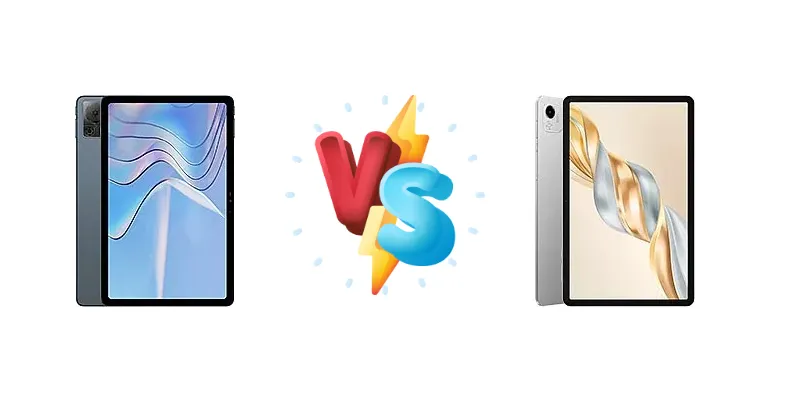
The tablet market is brimming with affordable options, but finding the right balance of performance and battery life can be tricky. We pit the Doogee T20S, powered by a Unisoc processor, against the Honor Pad X9a, featuring a Qualcomm Snapdragon chipset, to determine which tablet delivers the best experience for everyday tasks and entertainment.
🏆 Quick Verdict
For most users, the Honor Pad X9a emerges as the better choice. Its Snapdragon 685 chipset, built on a more efficient 6nm process, provides a noticeable performance advantage over the Doogee T20S’s Unisoc T616, coupled with exceptional 92-hour battery endurance and 35W fast charging.
| Network |
|---|
| 2G bands | GSM 850 / 900 / 1800 / 1900 | N/A |
| 3G bands | HSDPA 850 / 900 / 1900 / 2100 | N/A |
| 4G bands | LTE | N/A |
| EDGE | - | No |
| GPRS | - | No |
| Speed | HSPA, LTE | - |
| Technology | GSM / HSPA / LTE | No cellular connectivity |
| Launch |
|---|
| Announced | 2023, July 01 | 2025, March 21 |
| Status | Available. Released 2023, July 01 | Available. Released 2025, March 26 |
| Body |
|---|
| Build | Glass front, aluminum frame, aluminum back | Glass front, aluminum frame, aluminum back |
| Dimensions | 7.9 mm thickness | 267.3 x 167.4 x 6.8 mm (10.52 x 6.59 x 0.27 in) |
| SIM | Nano-SIM + Nano-SIM | No |
| Weight | - | 475 g (1.05 lb) |
| Display |
|---|
| Protection | - | Mohs level 4 |
| Resolution | 1200 x 1920 pixels, 16:10 ratio (~218 ppi density) | 1504 x 2508 pixels, 5:3 ratio (~254 ppi density) |
| Size | 10.4 inches, 313.6 cm2 | 11.5 inches, 376.3 cm2 (~84.1% screen-to-body ratio) |
| Type | IPS LCD | TFT LCD, 120Hz, 400 nits (peak) |
| Platform |
|---|
| CPU | Octa-core (2x2.0 GHz Cortex-A75 & 6x1.8 GHz Cortex-A55) | Octa-core (4x2.8 GHz Cortex-A73 & 4x1.9 GHz Cortex-A53) |
| Chipset | Unisoc Tiger T616 (12 nm) | Qualcomm SM6225 Snapdragon 685 (6 nm) |
| GPU | Mali-G57 MP1 | Adreno 610 |
| OS | Android 13 | Android 15, MagicOS 9 |
| Memory |
|---|
| Card slot | microSDXC (uses shared SIM slot) | No |
| Internal | 128GB 8GB RAM | 128GB 6GB RAM, 128GB 8GB RAM |
| Main Camera |
|---|
| Dual | 13 MP
secondary unspecified camera | - |
| Features | LED flash, HDR, panorama | - |
| Single | - | 8 MP, f/2.0, (wide), 1/5.0" |
| Video | 1080p@30fps | 1080p@30fps |
| Selfie camera |
|---|
| Single | 5 MP | 5 MP, f/2.2 |
| Video | Yes | 1080p@30fps |
| Sound |
|---|
| 35mm jack | Yes | No |
| Loudspeaker | Yes | Yes, with stereo speakers (4 speakers) |
| Comms |
|---|
| Bluetooth | Yes | 5.1, A2DP, LE |
| NFC | No | No |
| Positioning | Unspecified | No |
| Radio | Unspecified | No |
| USB | USB Type-C | USB Type-C |
| WLAN | Yes | Wi-Fi 802.11 a/b/g/n/ac, dual-band |
| Features |
|---|
| Sensors | Unspecified | Accelerometer |
| Battery |
|---|
| Charging | - | 35W wired |
| Type | 7500 mAh | Li-Ion 8300 mAh |
| Misc |
|---|
| Colors | Green, Gray, Black | Gray |
| Models | - | ELN2-W29 |
| Price | About 270 EUR | About 210 EUR |
| EU LABEL |
|---|
| Battery | - | 92:29h endurance, 1200 cycles |
| Energy | - | Class F |
| Free fall | - | Class E (10 falls) |
| Repairability | - | Class C |
Doogee T20S
- Potentially lower price point
- Acceptable for basic tasks
- May offer expandable storage (spec not confirmed)
- Less powerful processor
- Less efficient chipset
- Likely shorter battery life
- Slower charging (spec not confirmed)
Honor Pad X9a
- Superior processor performance
- Excellent battery life (92:29h endurance)
- Fast 35W charging
- Long-lasting battery (1200 charge cycles)
- Potentially higher price
- Camera performance likely similar to Doogee T20S
- May lack expandable storage (spec not confirmed)
Display Comparison
Neither device boasts a premium display. Details regarding panel type (IPS, TFT) and resolution are missing, but both likely target the 1080p range common in this price bracket. The key difference lies under the hood: processing power impacts UI smoothness. While both will likely suffice for video playback, the Snapdragon 685 in the Honor Pad X9a will contribute to a more fluid experience when scrolling and navigating menus.
Camera Comparison
Camera performance is likely to be similar on both devices, given their target price point. Details on sensor sizes and apertures are unavailable, but it’s safe to assume both feature basic camera setups geared towards casual snapshots. The absence of information suggests neither device will excel in low-light photography or offer advanced features like optical image stabilization (OIS). Focusing on the processor’s image signal processing (ISP) capabilities, the Snapdragon 685 likely offers slightly better image processing algorithms, potentially resulting in more vibrant and detailed photos.
Performance
The Honor Pad X9a’s Qualcomm Snapdragon 685 (6nm) significantly outperforms the Doogee T20S’s Unisoc Tiger T616 (12nm). The 6nm process node inherently offers better power efficiency and thermal characteristics, meaning the X9a can sustain peak performance for longer periods. The Snapdragon 685’s Cortex-A73 cores (4x2.8 GHz) are also architecturally superior to the T616’s Cortex-A75 cores (2x2.0 GHz), resulting in faster single-core performance, crucial for app launch times and responsiveness. The T616’s Cortex-A55 cores (6x1.8 GHz) are paired with the A73’s A53 cores (4x1.9 GHz) in the X9a, but the architectural advantage still favors the Honor device.
Battery Life
The Honor Pad X9a dominates in battery life, boasting a remarkable 92:29h endurance and supporting 1200 charge cycles. This suggests significantly longer lifespan and usability compared to the Doogee T20S, for which battery details are missing. The 35W wired charging on the X9a further enhances its convenience, allowing for quicker top-ups. While the T20S may have a comparable mAh capacity, the Snapdragon 685’s superior power efficiency will translate to longer real-world usage.
Buying Guide
Buy the Doogee T20S if you prioritize a lower upfront cost and are primarily focused on basic tasks like web browsing and light media consumption. Buy the Honor Pad X9a if you value smoother multitasking, longer battery life, faster charging, and a more responsive user experience, even if it means spending a bit more.
Frequently Asked Questions
❓ Does the Snapdragon 685 in the Honor Pad X9a handle multitasking well compared to the Unisoc T616?
Yes, the Snapdragon 685 is significantly better suited for multitasking. Its more powerful CPU cores and efficient architecture allow for smoother switching between apps and handling multiple tasks simultaneously without noticeable lag, a common issue with the Unisoc T616 under heavy load.
❓ How does the 92-hour battery endurance of the Honor Pad X9a translate to real-world usage?
The 92-hour endurance rating suggests the Honor Pad X9a can easily last through several days of moderate use, such as web browsing, video streaming, and light gaming. Expect around 8-10 hours of continuous video playback, making it ideal for travel or extended use without access to a power outlet.
❓ Is the lack of detailed camera specifications a concern for both tablets?
Yes, the absence of specific camera details indicates that neither tablet is likely to excel in photography. Both are geared towards casual users who prioritize convenience over image quality. Don't expect flagship-level camera performance from either device.
❓ Will the Honor Pad X9a’s 35W charging significantly reduce charging times compared to a standard charger?
Absolutely. 35W charging will dramatically reduce charging times compared to a standard 5W or 10W charger. You can expect to go from 0% to 50% in around 30-45 minutes, and a full charge in approximately 1.5-2 hours, offering a significant convenience factor.