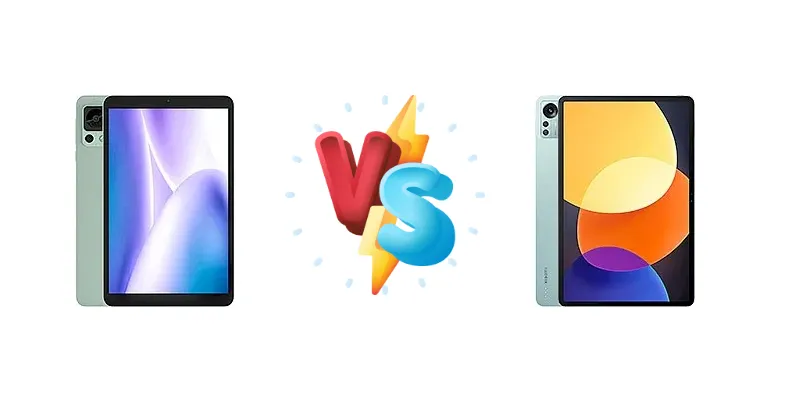
The tablet market offers a wide spectrum of choices, from ultra-affordable options to premium performance devices. We're pitting the Doogee T20mini, a budget-focused tablet, against the Xiaomi Pad 5 Pro 12.4, a device aiming for a more premium experience. This comparison will dissect their key differences to help you determine which tablet best suits your needs and budget.
🏆 Quick Verdict
For the average user prioritizing performance and fast charging, the Xiaomi Pad 5 Pro 12.4 is the clear winner. Its Snapdragon 870 chipset delivers significantly more processing power. However, the Doogee T20mini provides a compelling option for those on a tight budget who need basic tablet functionality.
| Network |
|---|
| 2G bands | GSM 850 / 900 / 1800 / 1900 | N/A |
| 3G bands | HSDPA 850 / 900 / 1900 / 2100 | N/A |
| 4G bands | 1, 3, 5, 7, 8, 20, 28, 34, 38, 39, 40, 41 | N/A |
| EDGE | - | No |
| GPRS | - | No |
| Speed | HSPA, LTE | - |
| Technology | GSM / HSPA / LTE | No cellular connectivity |
| Launch |
|---|
| Announced | 2023, August 04 | 2022, August 11 |
| Status | Available. Released 2023, August | Available. Released 2022, August 24 |
| Body |
|---|
| Build | - | Glass front (Gorilla Glass 3), aluminum frame, aluminum back |
| Dimensions | 202.5 x 125.8 x 7.4 mm (7.97 x 4.95 x 0.29 in) | 285 x 185.2 x 6.7 mm (11.22 x 7.29 x 0.26 in) |
| SIM | Nano-SIM + Nano-SIM | No |
| Weight | 330 g (11.64 oz) | 620 g (1.37 lb) |
| | - | Stylus support (magnetic) |
| Display |
|---|
| Protection | - | Corning Gorilla Glass 3 |
| Resolution | 1200 x 1920 pixels, 16:10 ratio (~270 ppi density) | 1600 x 2560 pixels, 16:10 ratio (~243 ppi density) |
| Size | 8.4 inches, 204.6 cm2 (~80.3% screen-to-body ratio) | 12.4 inches, 445.8 cm2 (~84.5% screen-to-body ratio) |
| Type | IPS LCD, 350 nits | IPS LCD, 120Hz, HDR10, Dolby Vision, 500 nits |
| Platform |
|---|
| CPU | Octa-core (2x1.6 GHz Cortex-A75 & 6x1.6 GHz Cortex-A55) | Octa-core (1x3.2 GHz Kryo 585 & 3x2.42 GHz Kryo 585 & 4x1.80 GHz Kryo 585) |
| Chipset | Unisoc T606 (12 nm) | Qualcomm SM8250-AC Snapdragon 870 5G (7 nm) |
| GPU | Mali-G57 MP1 | Adreno 650 |
| OS | Android 13 | Android 12, MIUI Pad 13 |
| Memory |
|---|
| Card slot | microSDXC (uses shared SIM slot) | No |
| Internal | 128GB 4GB RAM | 128GB 6GB RAM, 256GB 8GB RAM, 512GB 12GB RAM |
| | - | UFS 3.1 |
| Main Camera |
|---|
| Dual | - | 50 MP, f/1.8, 1/2.76", 0.64µm, PDAF
Auxiliary lens |
| Features | LED flash | Color spectrum sensor, LED flash, panorama, HDR |
| Single | 13 MP | - |
| Video | 1080p@30/60fps | 4K@30fps, 1080p@30/60fps |
| Selfie camera |
|---|
| Single | 5 MP | 20 MP, f/2.2, 1/3.4", 0.8µm |
| Video | Yes | 1080p@30/60fps |
| Sound |
|---|
| 3.5mm jack | - | No |
| 35mm jack | Yes | No |
| Loudspeaker | Yes, with stereo speakers | Yes, with stereo speakers (4 speakers) |
| Comms |
|---|
| Bluetooth | 5.0, A2DP, LE | 5.2, A2DP, LE |
| NFC | No | No |
| Positioning | GPS, GLONASS, GALILEO, BDS | No |
| Radio | FM radio | No |
| USB | USB Type-C 2.0 | USB Type-C 3.2 video output |
| WLAN | Wi-Fi 802.11 a/b/g/n/ac, dual-band | Wi-Fi 802.11 a/b/g/n/ac/6, dual-band, Wi-Fi Direct |
| Features |
|---|
| Sensors | Accelerometer, gyro, compass | Accelerometer, gyro, proximity, compass |
| Battery |
|---|
| Charging | 10W wired | 67W wired, PD3.0, QC4, 60% in 36 min, 100% in 68 min |
| Type | 5060 mAh | Li-Po 10000 mAh |
| Misc |
|---|
| Colors | Moonlit Purple, Mint Green, Midnight Black | Black, Silver, Green |
| Price | About 240 EUR | About 400 EUR |
Doogee T20mini
- Extremely affordable price point
- Suitable for basic tasks like browsing and streaming
- Lightweight and portable
- Slow Unisoc T606 processor
- Slow 10W charging
- Limited performance for demanding apps
Xiaomi Pad 5 Pro 12.4
- Powerful Snapdragon 870 processor
- Ultra-fast 67W charging
- Large, high-quality display
- Higher price tag
- May be overkill for basic users
- Larger size and weight
Display Comparison
While both tablets offer a 10-inch plus display, details beyond size are missing for the Doogee T20mini. The Xiaomi Pad 5 Pro 12.4 boasts a large 12.4-inch display, likely utilizing an IPS LCD panel given its price point. The absence of specifics like resolution and refresh rate for the T20mini makes direct comparison difficult, but the Pro model’s larger size and potential for higher resolution will provide a more immersive viewing experience. The Xiaomi’s display is likely to have better color accuracy and viewing angles, crucial for media consumption.
Camera Comparison
Camera performance is unlikely to be a primary concern for most tablet users. However, the Xiaomi Pad 5 Pro 12.4 likely features a more capable camera system due to its higher-end positioning. Details on the T20mini’s camera are scarce, but it’s reasonable to assume it utilizes budget sensors. The Snapdragon 870’s image signal processor (ISP) will also contribute to better image quality on the Xiaomi, offering improved dynamic range and noise reduction. Without specific sensor details for the Doogee, it’s difficult to make a precise comparison, but the Xiaomi is expected to deliver superior image and video quality.
Performance
The performance gap between these tablets is substantial. The Doogee T20mini’s Unisoc T606, built on a 12nm process, is an entry-level chipset designed for efficiency rather than speed. Its octa-core configuration (2x1.6 GHz Cortex-A75 & 6x1.6 GHz Cortex-A55) will handle basic tasks, but will struggle with demanding games or multitasking. In contrast, the Xiaomi Pad 5 Pro 12.4’s Snapdragon 870 5G, fabricated on a more efficient 7nm process, is a flagship-level chipset. Its octa-core CPU (1x3.2 GHz Kryo 585 & 3x2.42 GHz Kryo 585 & 4x1.80 GHz Kryo 585) delivers significantly faster processing speeds and superior graphics performance. This translates to smoother app launches, faster loading times, and a more enjoyable gaming experience.
Battery Life
Battery capacity details are missing for the Doogee T20mini, making a direct mAh comparison impossible. However, the Xiaomi Pad 5 Pro 12.4’s 67W wired charging is a significant advantage. It can reach 60% charge in just 36 minutes and a full charge in 68 minutes, minimizing downtime. The Doogee T20mini’s 10W charging is considerably slower, requiring significantly longer to reach a full charge. While the Xiaomi’s faster charging doesn’t necessarily equate to a larger battery, it provides a more convenient user experience, especially for those who frequently use their tablet on the go.
Buying Guide
Buy the Doogee T20mini if you need a highly affordable tablet for basic tasks like web browsing, video streaming, and light productivity. It's ideal for users who prioritize cost over raw performance. Buy the Xiaomi Pad 5 Pro 12.4 if you demand a smooth, responsive experience for demanding applications, gaming, and multitasking. It's the better choice for power users and those who value fast charging and a premium feature set.
Frequently Asked Questions
❓ Is the Unisoc T606 in the Doogee T20mini sufficient for playing mobile games?
The Unisoc T606 is an entry-level chipset and will struggle with graphically demanding games. While it can handle simpler titles, you'll likely experience low frame rates and lag in more intensive games. It's best suited for casual gaming or older titles.
❓ How does the 67W charging on the Xiaomi Pad 5 Pro 12.4 compare to standard tablet charging?
67W charging is exceptionally fast for a tablet. Most tablets charge at 18W or 25W. The Xiaomi Pad 5 Pro 12.4 can reach a full charge in under 70 minutes, whereas many tablets take several hours. This is a significant convenience factor for users who need to quickly top up their device.
❓ Does the Xiaomi Pad 5 Pro 12.4 support stylus input or keyboard attachments?
Yes, the Xiaomi Pad 5 Pro 12.4 supports the Xiaomi Smart Pen (sold separately) and can be paired with a dedicated keyboard cover, transforming it into a more productive device. These accessories enhance its versatility beyond basic tablet functionality.