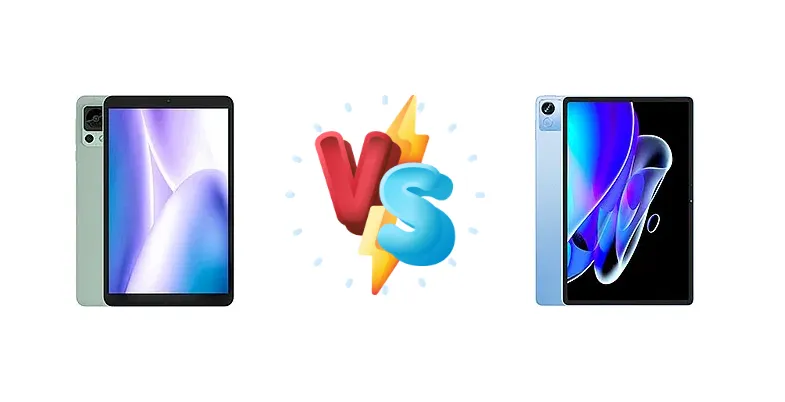
The tablet market offers a wide range of options, but finding the right balance between price and performance can be tricky. We pit the Doogee T20mini, a budget-focused offering, against the Realme Pad X, which aims for a more premium experience within the affordable segment. This comparison will dissect their key specifications to determine which tablet best suits your needs.
🏆 Quick Verdict
For the average user prioritizing performance and fast charging, the Realme Pad X is the clear winner. Its Snapdragon 695 chipset and 33W charging significantly outperform the Doogee T20mini’s Unisoc T606 and 10W charging. However, the T20mini remains a viable option for extremely budget-conscious users.
| Network |
|---|
| 2G bands | GSM 850 / 900 / 1800 / 1900 | GSM 850 / 900 / 1800 / 1900 |
| 3G bands | HSDPA 850 / 900 / 1900 / 2100 | HSDPA 850 / 900 / 2100 |
| 4G bands | 1, 3, 5, 7, 8, 20, 28, 34, 38, 39, 40, 41 | LTE |
| 5G bands | - | SA/NSA |
| Speed | HSPA, LTE | HSPA, LTE, 5G - cellular model only |
| Technology | GSM / HSPA / LTE | GSM / HSPA / LTE / 5G |
| Launch |
|---|
| Announced | 2023, August 04 | 2022, May 25 |
| Status | Available. Released 2023, August | Available. Released 2022, June 12 |
| Body |
|---|
| Build | - | Glass front, plastic frame, plastic back |
| Dimensions | 202.5 x 125.8 x 7.4 mm (7.97 x 4.95 x 0.29 in) | 256.5 x 161.1 x 7.1 mm (10.10 x 6.34 x 0.28 in) |
| SIM | Nano-SIM + Nano-SIM | Nano-SIM + Nano-SIM (cellular model only) |
| Weight | 330 g (11.64 oz) | 499 g / 506 g (1.10 lb) |
| | - | Stylus support (magnetic charging) |
| Display |
|---|
| Resolution | 1200 x 1920 pixels, 16:10 ratio (~270 ppi density) | 1200 x 2000 pixels, 5:3 ratio (~213 ppi density) |
| Size | 8.4 inches, 204.6 cm2 (~80.3% screen-to-body ratio) | 10.95 inches, 341.3 cm2 (~82.6% screen-to-body ratio) |
| Type | IPS LCD, 350 nits | IPS LCD, 450 nits (peak) |
| Platform |
|---|
| CPU | Octa-core (2x1.6 GHz Cortex-A75 & 6x1.6 GHz Cortex-A55) | Octa-core (2x2.2 GHz Kryo 660 Gold & 6x1.7 GHz Kryo 660 Silver) |
| Chipset | Unisoc T606 (12 nm) | Qualcomm SM6375 Snapdragon 695 5G (6 nm) |
| GPU | Mali-G57 MP1 | Adreno 619 |
| OS | Android 13 | Android, Realme UI 3.0 |
| Memory |
|---|
| Card slot | microSDXC (uses shared SIM slot) | microSDXC |
| Internal | 128GB 4GB RAM | 64GB 4GB RAM, 128GB 6GB RAM |
| Main Camera |
|---|
| Features | LED flash | - |
| Single | 13 MP | 13 MP, f/2.2, (wide), AF |
| Video | 1080p@30/60fps | 1080p@30fps |
| Selfie camera |
|---|
| Single | 5 MP | 8 MP, f/2.0, 105˚ (ultrawide) |
| Video | Yes | 1080p@30fps |
| Sound |
|---|
| 3.5mm jack | - | No |
| 35mm jack | Yes | No |
| Loudspeaker | Yes, with stereo speakers | Yes, with stereo speakers (4 speakers) |
| | - | 24-bit/192kHz audio |
| Comms |
|---|
| Bluetooth | 5.0, A2DP, LE | 5.1, A2DP, LE |
| NFC | No | No |
| Positioning | GPS, GLONASS, GALILEO, BDS | GPS, GLONASS, GALILEO, BDS - cellular model only |
| Radio | FM radio | No |
| USB | USB Type-C 2.0 | USB Type-C 2.0, OTG |
| WLAN | Wi-Fi 802.11 a/b/g/n/ac, dual-band | Wi-Fi 802.11 b/g/n/ac, hotspot |
| Features |
|---|
| Sensors | Accelerometer, gyro, compass | Accelerometer, gyro, compass |
| Battery |
|---|
| Charging | 10W wired | 33W wired, PD
5W reverse wired |
| Type | 5060 mAh | 8340 mAh |
| Misc |
|---|
| Colors | Moonlit Purple, Mint Green, Midnight Black | Glowing Gray, Glacier Blue, Green |
| Models | - | RMP2107, RMP2108 |
| Price | About 240 EUR | About 250 EUR |
| Tests |
|---|
| Display | - |
Contrast ratio: 1664:1 |
| Loudspeaker | - |
-22.5 LUFS (Excellent)
|
| Performance | - |
AnTuTu: 395824 (v9)
GeekBench: 2026 (v5.1)
GFXBench: 18fps (ES 3.1 onscreen) |
Doogee T20mini
- Extremely affordable price point
- Compact and portable design (assumed)
- Functional for basic tasks
- Slow 10W charging
- Underpowered Unisoc T606 chipset
- Likely lower display quality
Realme Pad X
- Faster Snapdragon 695 5G chipset
- 33W fast charging with PD
- Brighter and more vibrant display
- Higher price than the Doogee T20mini
- May be larger and less portable
- Still not a flagship-level tablet
Display Comparison
The Realme Pad X boasts a significantly brighter display, reaching 496 nits compared to an unlisted value for the Doogee T20mini, suggesting a lower peak brightness. Both displays share a similar contrast ratio around 1655:1-1664:1, indicating comparable color depth. However, the Realme Pad X’s higher brightness translates to better visibility outdoors and a more vibrant viewing experience. The lack of detailed display specs for the T20mini suggests a more basic panel, likely impacting color accuracy and viewing angles.
Camera Comparison
Neither tablet is positioned as a photography powerhouse, but the Realme Pad X likely has an advantage due to its more modern chipset and potentially better image signal processing. Without specific camera specs for the Doogee T20mini, it’s safe to assume a simpler camera system. The focus should be on video conferencing and casual snapshots, rather than high-quality photography, for both devices.
Performance
The core difference lies in the chipsets. The Realme Pad X’s Qualcomm Snapdragon 695 (6nm) is a substantial upgrade over the Doogee T20mini’s Unisoc T606 (12nm). The 6nm process node of the Snapdragon 695 offers superior power efficiency and thermal performance, allowing for sustained performance under load. The Snapdragon 695’s CPU configuration – 2x2.2 GHz Kryo 660 Gold & 6x1.7 GHz Kryo 660 Silver – also provides a performance advantage over the T606’s 2x1.6 GHz Cortex-A75 & 6x1.6 GHz Cortex-A55. This translates to faster app loading times, smoother multitasking, and a more responsive user interface on the Realme Pad X. The T20mini will handle basic tasks, but will struggle with demanding applications.
Battery Life
While battery capacity isn't specified for either device, the charging speeds are drastically different. The Realme Pad X’s 33W wired charging with PD support is a game-changer, allowing for significantly faster top-ups compared to the Doogee T20mini’s slow 10W charging. The Realme Pad X also offers 5W reverse wired charging, a useful feature for topping up accessories. The faster charging on the Pad X mitigates any potential disadvantage from a smaller battery capacity, providing more usable uptime throughout the day.
Buying Guide
Buy the Doogee T20mini if you need a basic tablet for light tasks like reading ebooks, browsing the web, and occasional video streaming, and your budget is extremely limited. Buy the Realme Pad X if you prefer a smoother, more responsive experience for multitasking, gaming, and content creation, and value faster charging for extended use. The Pad X is also better suited for users who want a tablet that will remain relevant for longer.
Frequently Asked Questions
❓ Will the Doogee T20mini struggle with multitasking or running multiple apps simultaneously?
Yes, the Unisoc T606 chipset in the Doogee T20mini is designed for basic tasks. Running multiple apps or demanding applications will likely result in noticeable lag and slowdowns. It's best suited for single-app usage.
❓ How long does it realistically take to fully charge the Realme Pad X from 0% to 100%?
With 33W fast charging, the Realme Pad X can be fully charged from 0% to 100% in approximately 90-120 minutes, depending on usage during charging. This is a significant improvement over the much slower charging time of the Doogee T20mini.
❓ Is the Snapdragon 695 in the Realme Pad X capable of handling mobile games?
The Snapdragon 695 is capable of running many popular mobile games at medium settings. While it's not a gaming powerhouse, it provides a much smoother gaming experience than the Unisoc T606 in the Doogee T20mini. Expect playable frame rates in titles like PUBG Mobile and Call of Duty Mobile.
❓ Does the Realme Pad X support video playback in high resolutions like 1440p or 4K?
Yes, the Realme Pad X’s chipset and display are capable of handling 1080p and likely 1440p video playback without issue. 4K playback may be possible depending on the codec and file size, but performance could be affected.