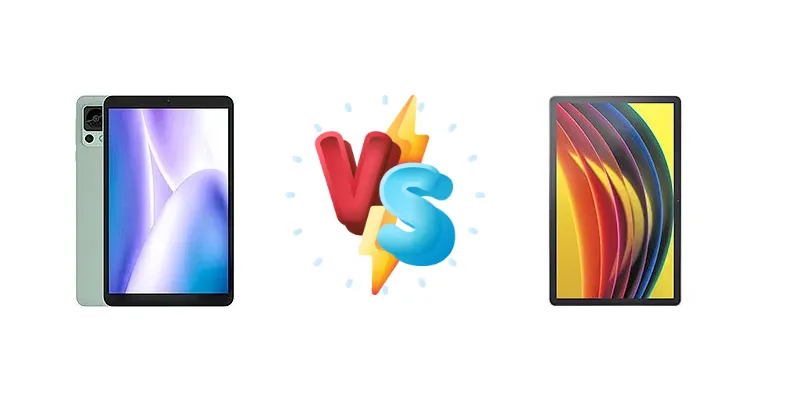
The sub-$200 tablet market is fiercely competitive. The Doogee T20mini and Lenovo Tab P11 Plus both aim to deliver a solid Android experience without breaking the bank, but they take different approaches to achieving that goal. This comparison dives deep into their core components to determine which tablet offers the best value for your money.
🏆 Quick Verdict
For most users, the Lenovo Tab P11 Plus emerges as the better choice. Its Helio G90T chipset provides a noticeable performance advantage over the Doogee T20mini’s Unisoc T606, making it more suitable for gaming and demanding applications. While the T20mini is more compact, the P11 Plus’s faster charging and superior processing power offer a more well-rounded experience.
| Network |
|---|
| 2G bands | GSM 850 / 900 / 1800 / 1900 | GSM 850 / 900 / 1800 / 1900 |
| 3G bands | HSDPA 850 / 900 / 1900 / 2100 | HSDPA 850 / 900 / 1900 / 2100 |
| 4G bands | 1, 3, 5, 7, 8, 20, 28, 34, 38, 39, 40, 41 | 1, 2, 3, 4, 5, 7, 8, 20, 28, 38, 40, 41 |
| Speed | HSPA, LTE | HSPA, LTE - cellular model only |
| Technology | GSM / HSPA / LTE | GSM / HSPA / LTE |
| Launch |
|---|
| Announced | 2023, August 04 | 2021, June 28 |
| Status | Available. Released 2023, August | Available. Released 2021, July 29 |
| Body |
|---|
| Dimensions | 202.5 x 125.8 x 7.4 mm (7.97 x 4.95 x 0.29 in) | 258.4 x 163 x 7.5 mm (10.17 x 6.42 x 0.30 in) |
| SIM | Nano-SIM + Nano-SIM | Nano-SIM (cellular model only) |
| Weight | 330 g (11.64 oz) | 490 g (1.08 lb) |
| | - | Stylus support |
| Display |
|---|
| Resolution | 1200 x 1920 pixels, 16:10 ratio (~270 ppi density) | 1200 x 2000 pixels, 5:3 ratio (~212 ppi density) |
| Size | 8.4 inches, 204.6 cm2 (~80.3% screen-to-body ratio) | 11.0 inches, 344.4 cm2 (~81.8% screen-to-body ratio) |
| Type | IPS LCD, 350 nits | IPS LCD, 400 nits (typ) |
| Platform |
|---|
| CPU | Octa-core (2x1.6 GHz Cortex-A75 & 6x1.6 GHz Cortex-A55) | Octa-core (2x2.05 GHz Cortex-A76 & 6x2.0 GHz Cortex-A55) |
| Chipset | Unisoc T606 (12 nm) | Mediatek MT6785 Helio G90T (12 nm) |
| GPU | Mali-G57 MP1 | Mali-G76 MC4 |
| OS | Android 13 | Android 11 |
| Memory |
|---|
| Card slot | microSDXC (uses shared SIM slot) | microSDXC (dedicated slot) |
| Internal | 128GB 4GB RAM | 64GB 4GB RAM, 128GB 4GB RAM, 128GB 6GB RAM |
| Main Camera |
|---|
| Features | LED flash | LED flash |
| Single | 13 MP | 13 MP, (wide), AF |
| Video | 1080p@30/60fps | 1080p@30fps |
| Selfie camera |
|---|
| Single | 5 MP | 8 MP, (wide) |
| Video | Yes | 1080p@30fps |
| Sound |
|---|
| 3.5mm jack | - | No |
| 35mm jack | Yes | No |
| Loudspeaker | Yes, with stereo speakers | Yes, with stereo speakers (4 speakers) |
| Comms |
|---|
| Bluetooth | 5.0, A2DP, LE | 5.1, A2DP, LE |
| NFC | No | No |
| Positioning | GPS, GLONASS, GALILEO, BDS | GPS, GLONASS, BDS - cellular model only |
| Radio | FM radio | FM radio |
| USB | USB Type-C 2.0 | USB Type-C 2.0 |
| WLAN | Wi-Fi 802.11 a/b/g/n/ac, dual-band | Wi-Fi 802.11 a/b/g/n/ac, dual-band, Wi-Fi Direct |
| Features |
|---|
| Sensors | Accelerometer, gyro, compass | Accelerometer, gyro, proximity |
| Battery |
|---|
| Charging | 10W wired | 20W wired |
| Type | 5060 mAh | Li-Po 7700 mAh |
| Misc |
|---|
| Colors | Moonlit Purple, Mint Green, Midnight Black | Slate Grey, Platinum Grey, Modernist teal |
| Models | - | ZA940124SE |
| Price | About 240 EUR | About 300 EUR |
Doogee T20mini
- More compact and portable design.
- Potentially lower price point.
- Sufficient for basic tasks like web browsing and video playback.
- Significantly weaker processor performance.
- Slow 10W charging.
- Less suitable for gaming or demanding applications.
Lenovo Tab P11 Plus
- Faster and more powerful Helio G90T processor.
- 20W fast charging for quicker replenishment.
- Better suited for multitasking and gaming.
- Larger and less portable than the Doogee T20mini.
- May be slightly more expensive.
- Potentially less battery life due to more powerful processor (though mitigated by efficiency).
Display Comparison
Neither Doogee nor Lenovo specify display details beyond size. However, the core difference lies in the processing power driving the display. The P11 Plus’s G90T can handle higher refresh rates (though not confirmed) and more complex graphics rendering, potentially resulting in smoother animations. Both utilize 12nm chipsets, suggesting similar power draw for display operation. The absence of detailed display specs makes a direct comparison difficult, but the G90T’s GPU suggests a more capable visual experience.
Camera Comparison
Camera performance is likely similar on both devices, given the lack of detailed specifications. Both tablets likely feature basic camera setups geared towards video calls and casual snapshots. Without knowing sensor sizes or image processing capabilities, it’s difficult to declare a winner. However, the G90T’s integrated image signal processor (ISP) is likely more advanced, potentially leading to slightly better image quality in favorable lighting conditions. Focusing on the chipset, the P11 Plus has a slight edge.
Performance
The Lenovo Tab P11 Plus’s MediaTek Helio G90T is the clear winner in the performance category. Its octa-core CPU, featuring 2x2.05 GHz Cortex-A76 cores, significantly outperforms the Doogee T20mini’s Unisoc T606 with its 2x1.6 GHz Cortex-A75 cores. The Cortex-A76 architecture is a generation ahead and offers superior single-core performance, crucial for responsive app launches and smoother multitasking. While both are built on a 12nm process, the G90T’s more efficient design and powerful cores translate to a more fluid user experience, especially in graphically intensive games.
Battery Life
The Lenovo Tab P11 Plus’s 20W wired charging is a significant advantage over the Doogee T20mini’s 10W charging. This means the P11 Plus can replenish its battery much faster, minimizing downtime. While battery capacity isn’t specified for either device, the faster charging speed is a tangible benefit for users who rely on their tablets throughout the day. The G90T’s power efficiency, despite being more powerful, could offset any potential battery life disadvantage due to its ability to complete tasks quicker.
Buying Guide
Buy the Doogee T20mini if you prioritize extreme portability and a smaller form factor for on-the-go media consumption. It’s ideal for users who primarily browse the web, read ebooks, and watch videos. Buy the Lenovo Tab P11 Plus if you need a tablet capable of handling more demanding tasks like gaming, multitasking, or running productivity apps. Its faster processor and 20W charging make it a better all-around performer for students and power users.
Frequently Asked Questions
❓ Will the Doogee T20mini struggle with multitasking between several apps?
Yes, the Unisoc T606 chipset in the Doogee T20mini is designed for light to moderate use. Running multiple apps simultaneously, especially resource-intensive ones, will likely result in noticeable lag and slowdowns. The Lenovo Tab P11 Plus, with its Helio G90T, handles multitasking far more efficiently.
❓ Is the Helio G90T in the Lenovo Tab P11 Plus capable of playing popular mobile games like PUBG or Call of Duty?
The Helio G90T is a capable gaming chipset. While it won’t deliver flagship-level performance, it can comfortably run PUBG and Call of Duty Mobile at medium to high settings with playable frame rates. The Doogee T20mini’s Unisoc T606 will struggle with these titles, requiring significantly lower graphics settings and potentially experiencing frame drops.
❓ How long does it realistically take to fully charge the Doogee T20mini with its 10W charger?
With a 10W charger, fully charging the Doogee T20mini will likely take between 3 to 4 hours, depending on the battery capacity (which is not specified). This is considerably slower than the Lenovo Tab P11 Plus, which can achieve a full charge in around 2 hours with its 20W charger.