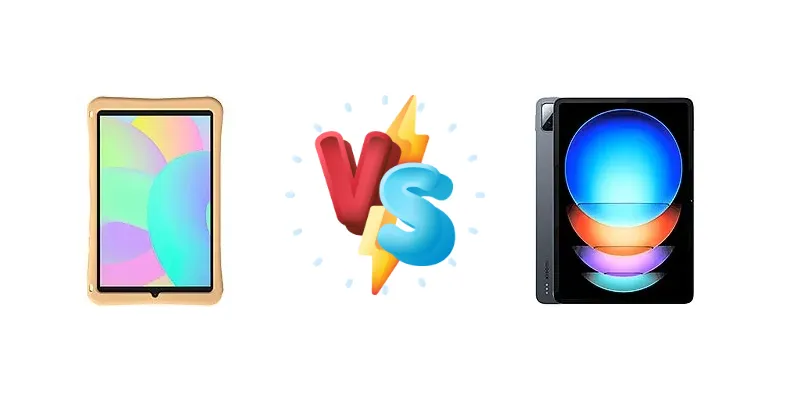
The tablet market caters to vastly different needs, from basic entertainment for children to demanding productivity and gaming. This comparison pits the Doogee T20mini Kid, a budget-focused device, against the Xiaomi Pad 6S Pro 12.4, a premium tablet boasting flagship-level performance. We'll dissect their key specifications to determine which tablet best suits your requirements.
🏆 Quick Verdict
For the average user prioritizing performance and a premium experience, the Xiaomi Pad 6S Pro 12.4 is the clear winner. Its Snapdragon 8 Gen 2 chipset and rapid 120W charging significantly outperform the Doogee T20mini Kid's Unisoc T606 and 10W charging, justifying the price difference.
| Network |
|---|
| 2G bands | GSM 850 / 900 / 1800 / 1900 | N/A |
| 3G bands | HSDPA 850 / 900 / 1900 / 2100 | N/A |
| 4G bands | 1, 3, 5, 7, 8, 20, 28, 34, 38, 39, 40, 41 | - |
| EDGE | - | N/A |
| GPRS | - | N/A |
| Speed | HSPA, LTE | - |
| Technology | GSM / HSPA / LTE | No cellular connectivity |
| Launch |
|---|
| Announced | 2023, September | 2024, February 22 |
| Status | Available. Released 2023, September | Available. Released 2024, February 22 |
| Body |
|---|
| Build | - | Glass front (Gorilla Glass 5), aluminum frame, aluminum back |
| Dimensions | 202.5 x 125.8 x 12.4 mm (7.97 x 4.95 x 0.49 in) | 278.7 x 191.6 x 6.3 mm (10.97 x 7.54 x 0.25 in) |
| SIM | Nano-SIM + Nano-SIM | No |
| Weight | 499 g (1.10 lb) | 590 g (1.30 lb) |
| Display |
|---|
| Protection | - | Corning Gorilla Glass 5 |
| Resolution | 1200 x 1820 pixels, 3:2 ratio (~260 ppi density) | 2032 x 3048 pixels, 3:2 ratio (~295 ppi density) |
| Size | 8.4 inches, 209.2 cm2 (~82.1% screen-to-body ratio) | 12.4 inches, 457.8 cm2 (~85.7% screen-to-body ratio) |
| Type | IPS LCD, 350 nits | IPS LCD, 68B colors, 144Hz, HDR10, Dolby Vision, 900 nits (peak) |
| Platform |
|---|
| CPU | Octa-core (2x1.6 GHz Cortex-A75 & 6x1.6 GHz Cortex-A55) | Octa-core (1x3.2 GHz Cortex-X3 & 2x2.8 GHz Cortex-A715 & 2x2.8 GHz Cortex-A710 & 3x2.0 GHz Cortex-A510) |
| Chipset | Unisoc T606 (12 nm) | Qualcomm SM8550-AB Snapdragon 8 Gen 2 (4 nm) |
| GPU | Mali-G57 MP1 | Adreno 740 |
| OS | Android 13 | Android 14, up to 3 major Android upgrades, HyperOS |
| Memory |
|---|
| Card slot | microSDXC (uses shared SIM slot) | No |
| Internal | 128GB 4GB RAM | 256GB 8GB RAM, 256GB 12GB RAM, 512GB 12GB RAM, 1TB 16GB RAM |
| Main Camera |
|---|
| Dual | - | 50 MP, f/1.8, (wide), 1/2.76", 0.64µm, PDAF
Auxiliary lens |
| Features | LED flash | LED flash, HDR, panorama |
| Single | 13 MP | - |
| Video | 1080p@30/60fps | 4K@30/60fps, 1080p@30/60fps |
| Selfie camera |
|---|
| Single | 5 MP | 32 MP, f/2.2, (wide), 1/3.6", 0.61µm |
| Video | Yes | 1080p@30fps |
| Sound |
|---|
| 35mm jack | Yes | No |
| Loudspeaker | Yes, with stereo speakers | Yes, with stereo speakers (6 speakers) |
| Comms |
|---|
| Bluetooth | 5.0, A2DP, LE | 5.3, A2DP, LE, LHDC |
| NFC | No | Yes (file transfer only) |
| Positioning | GPS, GLONASS, GALILEO, BDS | No |
| Radio | FM radio | No |
| USB | USB Type-C 2.0 | USB Type-C 3.2, accessory connector |
| WLAN | Wi-Fi 802.11 a/b/g/n/ac, dual-band | Wi-Fi 802.11 a/b/g/n/a/6/7, dual-band, Wi-Fi Direct |
| Features |
|---|
| Sensors | Accelerometer, gyro, compass | Fingerprint (side-mounted), accelerometer, gyro, proximity (accessories only), compass |
| Battery |
|---|
| Charging | 10W wired | 120W wired, PD3.0, QC4, 45% in 10 min, 100% in 35 min |
| Type | 5060 mAh | 10000 mAh |
| Misc |
|---|
| Colors | Yellow | Black, Blue, Green |
| Models | - | 24018RPACG |
| Price | - | About 700 EUR |
| SAR EU | - | 0.99 W/kg (body) |
Doogee T20mini Kid
- Extremely affordable price point
- Potentially longer battery life due to lower power consumption
- Suitable for basic tasks and casual use
- Significantly slower performance
- Slow charging speed (10W)
- Lower quality display
Xiaomi Pad 6S Pro 12.4
- Flagship-level performance with Snapdragon 8 Gen 2
- Ultra-fast 120W charging
- High-brightness, high-contrast display
- Higher price tag
- Potentially shorter battery life under heavy load (though still good)
- May be overkill for basic users
Display Comparison
The Xiaomi Pad 6S Pro 12.4 boasts a significantly more advanced display. While the Doogee T20mini Kid’s specifications are unavailable, the Xiaomi Pad 6S Pro 12.4 delivers a measured peak brightness of 848 nits, ensuring excellent visibility even in bright environments. The 1378:1 contrast ratio further enhances image quality. The absence of detailed display specs for the Doogee suggests a lower-quality panel, likely with lower brightness and contrast. The Xiaomi’s larger screen size also contributes to a more immersive viewing experience.
Camera Comparison
Given the target markets, camera quality isn't a primary focus for either device. However, the Xiaomi Pad 6S Pro 12.4 is likely to offer a more refined camera experience due to its superior image signal processor (ISP) integrated within the Snapdragon 8 Gen 2. Without specific camera specs for the Doogee T20mini Kid, it's reasonable to assume a simpler camera system geared towards basic snapshots. The Xiaomi’s processing capabilities will result in better dynamic range and noise reduction.
Performance
The performance gap between these tablets is substantial. The Xiaomi Pad 6S Pro 12.4 is powered by the Qualcomm Snapdragon 8 Gen 2 (4nm), featuring a core configuration of 1x3.2 GHz Cortex-X3, 2x2.8 GHz Cortex-A715, 2x2.8 GHz Cortex-A710, and 3x2.0 GHz Cortex-A510. This is a flagship-tier chipset designed for demanding tasks. In contrast, the Doogee T20mini Kid utilizes the Unisoc T606 (12nm) with a core configuration of 2x1.6 GHz Cortex-A75 and 6x1.6 GHz Cortex-A55. The Snapdragon 8 Gen 2’s 4nm process offers superior power efficiency and thermal performance, minimizing throttling during extended use. The architectural differences are significant; the Cortex-X3 is a prime core designed for peak performance, absent in the T606.
Battery Life
The Xiaomi Pad 6S Pro 12.4 achieves a remarkable active use score of 11:14h, demonstrating excellent battery life despite its powerful processor. Crucially, it supports 120W wired charging, achieving 45% charge in just 10 minutes and a full charge in 35 minutes. The Doogee T20mini Kid, with its 10W wired charging, will take considerably longer to charge, potentially several hours for a full charge. While the Doogee may have a larger battery capacity (unspecified), the Xiaomi’s charging speed and efficiency mitigate the impact of a potentially smaller battery.
Buying Guide
Buy the Doogee T20mini Kid if you need a very affordable tablet primarily for basic tasks like video streaming, simple games, and light web browsing, and if a long battery life is more important than raw speed. Buy the Xiaomi Pad 6S Pro 12.4 if you prioritize performance for demanding applications, gaming, content creation, and appreciate features like a high-brightness display and incredibly fast charging.
Frequently Asked Questions
❓ Is the Xiaomi Pad 6S Pro 12.4 suitable for demanding games like Genshin Impact?
Yes, the Snapdragon 8 Gen 2 chipset in the Xiaomi Pad 6S Pro 12.4 is more than capable of running demanding games like Genshin Impact at high settings. The advanced thermal management system helps prevent throttling during extended gaming sessions, ensuring a smooth and consistent experience.
❓ Can the Doogee T20mini Kid handle video conferencing and online classes?
The Doogee T20mini Kid can handle basic video conferencing and online classes, but performance may be limited with multiple applications running simultaneously. The Unisoc T606 chipset is sufficient for these tasks, but don't expect a lag-free experience with demanding video editing or multitasking.
❓ Does the Xiaomi Pad 6S Pro 12.4 support stylus and keyboard accessories?
Yes, the Xiaomi Pad 6S Pro 12.4 is compatible with Xiaomi's Smart Pen (sold separately) and a dedicated keyboard cover, transforming it into a productivity powerhouse. These accessories enhance its versatility for note-taking, drawing, and document editing.