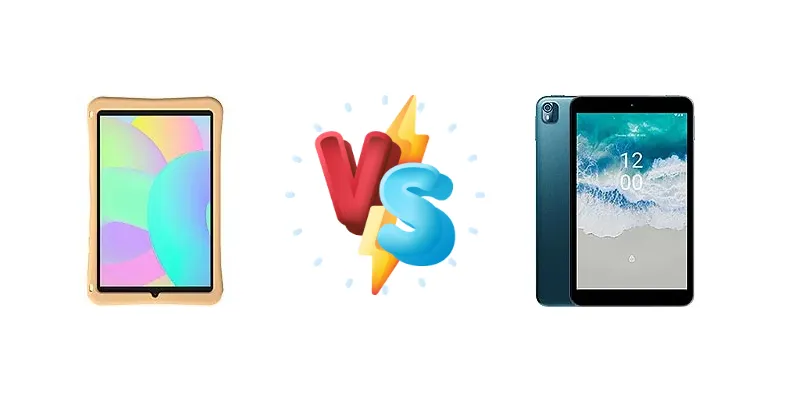
The sub-$150 tablet market is fiercely competitive, and the Doogee T20mini Kid and Nokia T10 are two contenders vying for your attention. Both devices are powered by the same Unisoc T606 chipset, making a direct hardware comparison less impactful. This review dives deep into the nuances of each tablet – from their intended use cases to potential software differences – to determine which offers the best value.
🏆 Quick Verdict
For most users, the Nokia T10 emerges as the slightly better choice. While both tablets share identical core performance due to the Unisoc T606, Nokia’s established software support and broader availability give it an edge. The Doogee T20mini Kid, however, may appeal to parents specifically seeking a ruggedized, kid-focused device.
| Network |
|---|
| 2G bands | GSM 850 / 900 / 1800 / 1900 | GSM 850 / 900 / 1800 / 1900 |
| 3G bands | HSDPA 850 / 900 / 1900 / 2100 | HSDPA 850 / 900 / 2100 |
| 4G bands | 1, 3, 5, 7, 8, 20, 28, 34, 38, 39, 40, 41 | 1, 3, 5, 7, 8, 20, 28, 38, 40, 41 |
| Speed | HSPA, LTE | HSPA 42.2/5.76 Mbps, LTE Cat4 150/50 Mbps |
| Technology | GSM / HSPA / LTE | GSM / HSPA / LTE |
| Launch |
|---|
| Announced | 2023, September | 2022, July 12 |
| Status | Available. Released 2023, September | Available. Released 2022, August 20 |
| Body |
|---|
| Build | - | Glass front, plastic back, plastic frame |
| Dimensions | 202.5 x 125.8 x 12.4 mm (7.97 x 4.95 x 0.49 in) | 208 x 123.2 x 9 mm (8.19 x 4.85 x 0.35 in) |
| SIM | Nano-SIM + Nano-SIM | Nano-SIM |
| Weight | 499 g (1.10 lb) | 375 g (13.23 oz) |
| | - | Splash resistant |
| Display |
|---|
| Resolution | 1200 x 1820 pixels, 3:2 ratio (~260 ppi density) | 800 x 1280 pixels, 16:10 ratio (~189 ppi density) |
| Size | 8.4 inches, 209.2 cm2 (~82.1% screen-to-body ratio) | 8.0 inches, 185.6 cm2 (~72.4% screen-to-body ratio) |
| Type | IPS LCD, 350 nits | IPS LCD, 360 nits (typ), 450 nits (peak) |
| Platform |
|---|
| CPU | Octa-core (2x1.6 GHz Cortex-A75 & 6x1.6 GHz Cortex-A55) | Octa-core (2x1.6 GHz Cortex-A75 & 6x1.6 GHz Cortex-A55) |
| Chipset | Unisoc T606 (12 nm) | Unisoc T606 (12 nm) |
| GPU | Mali-G57 MP1 | Mali-G57 MP1 |
| OS | Android 13 | Android 12, upgradable to Android 13 |
| Memory |
|---|
| Card slot | microSDXC (uses shared SIM slot) | microSDXC |
| Internal | 128GB 4GB RAM | 32GB 3GB RAM, 64GB 4GB RAM |
| Main Camera |
|---|
| Features | LED flash | LED flash |
| Single | 13 MP | 8 MP, 1/4.0", 1.12µm, AF |
| Video | 1080p@30/60fps | 1080p |
| Selfie camera |
|---|
| Single | 5 MP | 2 MP, 1/5.0", 1.65µm |
| Video | Yes | 720p |
| Sound |
|---|
| 3.5mm jack | - | Yes |
| 35mm jack | Yes | Yes |
| Loudspeaker | Yes, with stereo speakers | Yes, with stereo speakers |
| Comms |
|---|
| Bluetooth | 5.0, A2DP, LE | 5.0, A2DP, LE |
| NFC | No | No |
| Positioning | GPS, GLONASS, GALILEO, BDS | GPS, GLONASS, GALILEO |
| Radio | FM radio | No |
| USB | USB Type-C 2.0 | USB Type-C 2.0, OTG |
| WLAN | Wi-Fi 802.11 a/b/g/n/ac, dual-band | Wi-Fi 802.11 a/b/g/n/ac, dual-band |
| Features |
|---|
| Sensors | Accelerometer, gyro, compass | Accelerometer, proximity |
| Battery |
|---|
| Charging | 10W wired | 10W wired |
| Type | 5060 mAh | Li-Po 5250 mAh |
| Misc |
|---|
| Colors | Yellow | Ocean Blue |
| Models | - | TA-1503, TA-1472, TA-1462, TA-1457 |
| Price | - | About 160 EUR |
| SAR | - | 1.19 W/kg (body) |
| SAR EU | - | 0.27 W/kg (head) 1.57 W/kg (body) |
Doogee T20mini Kid
- Potentially more ruggedized build for children.
- May include pre-installed parental control software.
- Targeted marketing towards families.
- Less established brand reputation.
- Uncertainty regarding software update support.
- Potentially limited accessory availability.
Nokia T10
- Stronger brand reputation and software support.
- Wider availability and accessory ecosystem.
- Cleaner Android experience (likely closer to stock).
- Not specifically designed for children.
- May require additional parental control apps.
- Build quality may be less rugged.
Display Comparison
Both the Doogee T20mini Kid and Nokia T10 utilize an unspecified display panel, but given their price point, it’s safe to assume they are IPS LCDs. The absence of detailed display specifications like peak brightness or color gamut coverage suggests neither tablet will excel in outdoor visibility or color accuracy. Bezels are likely to be substantial on both, contributing to a larger overall footprint than more premium tablets. The 10W charging suggests neither device prioritizes fast display refresh rates, as those typically require more power delivery.
Camera Comparison
Camera performance is unlikely to be a key differentiator between these tablets. Both are likely equipped with basic camera sensors, and detailed specifications are unavailable. Given the target market, image quality will likely be sufficient for casual snapshots and video calls, but not for serious photography. The absence of OIS (Optical Image Stabilization) suggests images will be prone to blur, especially in low-light conditions. Any mention of a 2MP macro camera on either device should be viewed with skepticism, as such sensors rarely deliver usable results.
Performance
The core of both tablets is the Unisoc T606 (12 nm) chipset, featuring an octa-core CPU configuration with 2x1.6 GHz Cortex-A75 and 6x1.6 GHz Cortex-A55 cores. This means CPU performance will be virtually identical between the two devices. The Unisoc T606 is a capable chip for basic tasks like web browsing, video streaming, and light gaming, but it will struggle with demanding applications or heavy multitasking. The lack of information regarding RAM type and speed (LPDDR4X is likely) further limits potential performance gains. Thermal management is unlikely to be a significant concern given the chip's low power draw.
Battery Life
Battery capacity is not specified for either device, but given their similar size and chipset, they likely house batteries in the 5000-6000 mAh range. Both tablets support 10W wired charging, which is relatively slow by modern standards. Expect a full charge to take several hours. Real-world battery life will depend heavily on usage patterns, but users can anticipate around 6-8 hours of moderate use (web browsing, video streaming) on a single charge. The slow charging speed means topping up the battery throughout the day will be necessary for heavy users.
Buying Guide
Buy the Doogee T20mini Kid if you need a tablet specifically designed for children, prioritizing durability and potentially pre-installed parental controls. Buy the Nokia T10 if you prefer a more general-purpose tablet with a cleaner Android experience and a stronger brand reputation for software updates and long-term support. The Nokia T10 is also a better fit for users who value wider accessory availability.
Frequently Asked Questions
❓ Will the Unisoc T606 struggle with popular games like PUBG or Call of Duty?
Yes, the Unisoc T606 is not a gaming powerhouse. While it can handle less demanding games, PUBG and Call of Duty will likely require significant graphics settings reductions and may still experience frame rate drops. Expect a playable, but not optimal, gaming experience.
❓ How long will software updates be supported on the Nokia T10?
Nokia typically provides at least two years of security updates for its tablets. While major Android version updates are less frequent, the T10 is likely to receive at least one major update, potentially to Android 13. Doogee’s update policy is less clear, making the Nokia T10 a safer bet for long-term software support.
❓ Is the 10W charging speed a significant drawback?
Yes, 10W charging is relatively slow. It will take several hours to fully charge the tablet from 0%. This means planning ahead and charging overnight is recommended, or topping up frequently during the day if you're a heavy user.
❓ Are there any known issues with the Unisoc T606 chipset overheating?
The Unisoc T606 is a low-power chip and generally does not suffer from overheating issues. It's designed for efficiency rather than raw performance, so thermal throttling is unlikely to be a concern during typical usage scenarios.