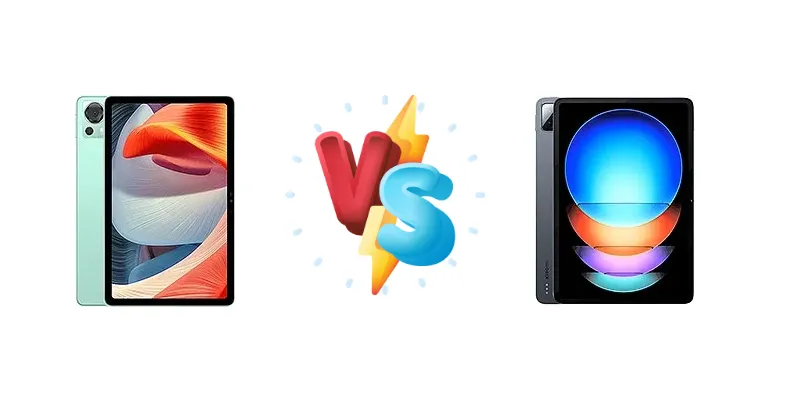
The tablet market offers a wide spectrum of choices, from ultra-portable budget options to high-performance flagships. We're pitting the Doogee T20, a more affordable tablet, against the Xiaomi Pad 6S Pro 12.4, a premium device boasting cutting-edge processing power. This comparison will dissect their key differences to help you determine which tablet best suits your needs and budget.
🏆 Quick Verdict
For the average user prioritizing performance and a premium experience, the Xiaomi Pad 6S Pro 12.4 is the clear winner. Its Snapdragon 8 Gen 2 chipset and rapid 120W charging significantly outperform the Doogee T20’s Unisoc Tiger T616 and 18W charging, justifying the price difference.
| Network |
|---|
| 2G bands | GSM 850 / 900 / 1800 / 1900 | N/A |
| 3G bands | HSDPA 850 / 900 / 1900 / 2100 | N/A |
| 4G bands | 1, 3, 5, 7, 8, 20, 34, 38, 39, 40, 41 | - |
| EDGE | - | N/A |
| GPRS | - | N/A |
| Speed | HSPA, LTE | - |
| Technology | GSM / HSPA / LTE | No cellular connectivity |
| Launch |
|---|
| Announced | 2022, December 22 | 2024, February 22 |
| Status | Available. Released 2022, December 22 | Available. Released 2024, February 22 |
| Body |
|---|
| Build | - | Glass front (Gorilla Glass 5), aluminum frame, aluminum back |
| Dimensions | 245.8 x 155.6 x 7.9 mm (9.68 x 6.13 x 0.31 in) | 278.7 x 191.6 x 6.3 mm (10.97 x 7.54 x 0.25 in) |
| SIM | Nano-SIM + Nano-SIM | No |
| Weight | 478 g (1.05 lb) | 590 g (1.30 lb) |
| Display |
|---|
| Protection | - | Corning Gorilla Glass 5 |
| Resolution | 1200 x 2000 pixels, 5:3 ratio (~224 ppi density) | 2032 x 3048 pixels, 3:2 ratio (~295 ppi density) |
| Size | 10.4 inches, 307.9 cm2 (~80.5% screen-to-body ratio) | 12.4 inches, 457.8 cm2 (~85.7% screen-to-body ratio) |
| Type | IPS LCD, 320 nits (peak) | IPS LCD, 68B colors, 144Hz, HDR10, Dolby Vision, 900 nits (peak) |
| Platform |
|---|
| CPU | Octa-core (2x2.0 GHz Cortex-A75 & 6x1.8 GHz Cortex-A55) | Octa-core (1x3.2 GHz Cortex-X3 & 2x2.8 GHz Cortex-A715 & 2x2.8 GHz Cortex-A710 & 3x2.0 GHz Cortex-A510) |
| Chipset | Unisoc Tiger T616 (12 nm) | Qualcomm SM8550-AB Snapdragon 8 Gen 2 (4 nm) |
| GPU | Mali-G57 MP1 | Adreno 740 |
| OS | Android 12 | Android 14, up to 3 major Android upgrades, HyperOS |
| Memory |
|---|
| Card slot | microSDXC (uses shared SIM slot) | No |
| Internal | 256GB 8GB RAM | 256GB 8GB RAM, 256GB 12GB RAM, 512GB 12GB RAM, 1TB 16GB RAM |
| Main Camera |
|---|
| Dual | - | 50 MP, f/1.8, (wide), 1/2.76", 0.64µm, PDAF
Auxiliary lens |
| Features | LED flash, HDR, panorama | LED flash, HDR, panorama |
| Single | 16 MP, 1/3.0", 1.0µm | - |
| Video | 1440p@30fps, 1080p@30fps | 4K@30/60fps, 1080p@30/60fps |
| Selfie camera |
|---|
| Single | 8 MP | 32 MP, f/2.2, (wide), 1/3.6", 0.61µm |
| Video | 1080p@30fps | 1080p@30fps |
| Sound |
|---|
| 35mm jack | No | No |
| Loudspeaker | Yes, with stereo speakers (4 speakers) | Yes, with stereo speakers (6 speakers) |
| Comms |
|---|
| Bluetooth | 5.0, A2DP, LE | 5.3, A2DP, LE, LHDC |
| NFC | No | Yes (file transfer only) |
| Positioning | GPS, GLONASS, GALILEO, BDS | No |
| Radio | FM radio | No |
| USB | USB Type-C 2.0, OTG, accessory connector | USB Type-C 3.2, accessory connector |
| WLAN | Wi-Fi 802.11 a/b/g/n/ac, dual-band | Wi-Fi 802.11 a/b/g/n/a/6/7, dual-band, Wi-Fi Direct |
| Features |
|---|
| Sensors | Accelerometer, proximity (accessories only) | Fingerprint (side-mounted), accelerometer, gyro, proximity (accessories only), compass |
| Battery |
|---|
| Charging | 18W wired, 50% in 60 min | 120W wired, PD3.0, QC4, 45% in 10 min, 100% in 35 min |
| Type | 8300 mAh | 10000 mAh |
| Misc |
|---|
| Colors | Gray, Blue, Green, Pink, Purple | Black, Blue, Green |
| Models | - | 24018RPACG |
| Price | About 200 EUR | About 700 EUR |
| SAR EU | - | 0.99 W/kg (body) |
Doogee T20
- More affordable price point
- Potentially lighter and more portable
- Acceptable for basic tablet tasks
- Significantly weaker performance
- Slow charging speed (18W)
- Likely lower quality display
Xiaomi Pad 6S Pro 12.4
- Flagship-level performance (Snapdragon 8 Gen 2)
- Ultra-fast 120W charging
- Superior display quality (brightness, contrast)
- Higher price
- Potentially heavier than the Doogee T20
- May be overkill for basic users
Display Comparison
The Xiaomi Pad 6S Pro 12.4 boasts a significantly more impressive display. While both tablets feature large screens, the Xiaomi’s measured peak brightness of 848 nits surpasses what we’d expect from the Doogee T20, ensuring excellent visibility even in bright environments. The 1378:1 contrast ratio on the Xiaomi further enhances image quality, delivering deeper blacks and more vibrant colors. We lack specific display details for the Doogee T20, but given its price point, it likely utilizes a less advanced panel technology without the same level of color accuracy or brightness.
Camera Comparison
Camera performance isn't typically a primary focus for tablets, but the Xiaomi Pad 6S Pro 12.4 likely offers a more refined experience. While specific camera specs for the Doogee T20 are unavailable, the Xiaomi’s likely benefits from Qualcomm’s image signal processor (ISP) integrated within the Snapdragon 8 Gen 2, resulting in better image processing and potentially superior low-light performance. We'd expect the Xiaomi to have a more capable main sensor and better overall image quality.
Performance
The performance gap between these two tablets is substantial. The Xiaomi Pad 6S Pro 12.4 is powered by the Qualcomm Snapdragon 8 Gen 2 (4nm), a flagship chipset featuring a core configuration of 1x3.2 GHz Cortex-X3, 2x2.8 GHz Cortex-A715, 2x2.8 GHz Cortex-A710, and 3x2.0 GHz Cortex-A510. This architecture delivers a massive leap in CPU and GPU performance compared to the Doogee T20’s Unisoc Tiger T616 (12nm) with its 2x2.0 GHz Cortex-A75 and 6x1.8 GHz Cortex-A55 cores. The 4nm process node of the Snapdragon 8 Gen 2 also translates to superior thermal efficiency, minimizing throttling during sustained workloads. The Xiaomi will handle demanding games and applications with ease, while the Doogee T20 will likely struggle with more intensive tasks.
Battery Life
The Xiaomi Pad 6S Pro 12.4 demonstrates a clear advantage in both charging speed and likely, overall battery efficiency. Its 120W wired charging, supporting PD3.0 and QC4, can deliver a 45% charge in just 10 minutes and a full charge in 35 minutes. In contrast, the Doogee T20’s 18W charging takes 60 minutes to reach 50% and significantly longer for a full charge. While the Xiaomi Pad 6S Pro 12.4’s battery capacity isn’t specified, its active use score of 11:14h suggests excellent power management, likely benefiting from the efficient Snapdragon 8 Gen 2 chipset.
Buying Guide
Buy the Doogee T20 if you need a basic tablet for light tasks like media consumption, web browsing, and occasional note-taking, and are on a strict budget. It’s a good option for users who prioritize portability and don’t demand high performance. Buy the Xiaomi Pad 6S Pro 12.4 if you prioritize a fluid, responsive experience for demanding applications like gaming, video editing, or multitasking, and value fast charging and a superior display.
Frequently Asked Questions
❓ Is the Xiaomi Pad 6S Pro 12.4’s Snapdragon 8 Gen 2 prone to overheating during extended gaming sessions?
The Snapdragon 8 Gen 2 is known for its thermal efficiency, especially when paired with a well-designed cooling system (details of which are not provided for the Xiaomi Pad 6S Pro 12.4). While some heat generation is inevitable during demanding tasks, the 4nm process node and Qualcomm’s optimizations minimize throttling, allowing for sustained performance over longer periods.
❓ How does the Unisoc Tiger T616 in the Doogee T20 handle multitasking with several apps open simultaneously?
The Unisoc Tiger T616 is a capable processor for basic multitasking, but it will likely struggle with a large number of demanding apps running concurrently. Expect some slowdowns and app reloading when switching between multiple resource-intensive applications. It’s best suited for lighter multitasking scenarios.
❓ Does the 120W charging on the Xiaomi Pad 6S Pro 12.4 require a specific charger, or is one included in the box?
While the Xiaomi Pad 6S Pro 12.4 supports 120W charging, it's crucial to verify if a compatible charger is included in the box. Using a lower-wattage charger will significantly increase charging times. Check the product packaging or Xiaomi’s official documentation to confirm charger inclusion.