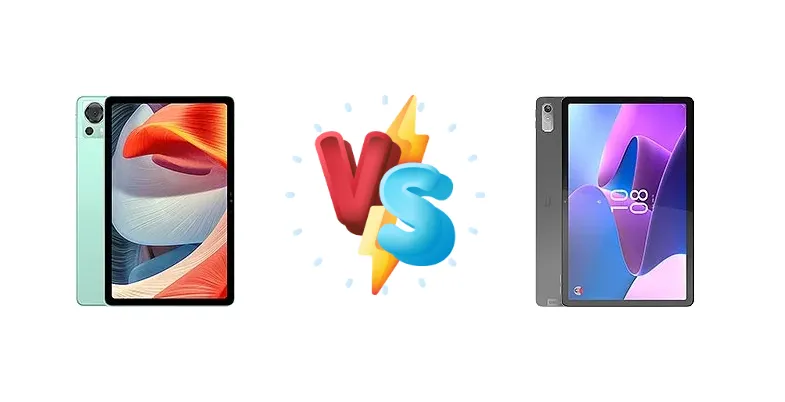
The tablet market is heating up with affordable options, and the Doogee T20 and Lenovo Tab P11 Gen 2 represent compelling choices for budget-conscious consumers. While both aim to deliver a versatile Android experience, they take different approaches to performance and efficiency. This comparison dives deep into their specifications to determine which tablet best suits your needs.
🏆 Quick Verdict
For the average user prioritizing sustained performance and efficiency, the Lenovo Tab P11 Gen 2 is the better choice. Its Mediatek Helio G99 chipset, built on a 6nm process, offers a noticeable advantage over the Doogee T20’s Unisoc Tiger T616 in both CPU and GPU tasks, translating to smoother multitasking and gaming.
| Network |
|---|
| 2G bands | GSM 850 / 900 / 1800 / 1900 | GSM 850 / 900 / 1800 / 1900 |
| 3G bands | HSDPA 850 / 900 / 1900 / 2100 | HSDPA 800 / 850 / 900 / 1700(AWS) / 1900 / 2100 |
| 4G bands | 1, 3, 5, 7, 8, 20, 34, 38, 39, 40, 41 | 1, 2, 3, 4, 5, 7, 8, 12, 13, 18, 19, 20, 25, 26, 28, 38, 40, 41, 66 |
| Speed | HSPA, LTE | HSPA, LTE - cellular model only |
| Technology | GSM / HSPA / LTE | GSM / HSPA / LTE |
| Launch |
|---|
| Announced | 2022, December 22 | 2022, September 01 |
| Status | Available. Released 2022, December 22 | Available. Released 2023, January |
| Body |
|---|
| Dimensions | 245.8 x 155.6 x 7.9 mm (9.68 x 6.13 x 0.31 in) | 269.1 x 169.4 x 7.4 mm (10.59 x 6.67 x 0.29 in) |
| SIM | Nano-SIM + Nano-SIM | Nano-SIM (cellular model only) |
| Weight | 478 g (1.05 lb) | 520 g (1.15 lb) |
| | - | Stylus support |
| Display |
|---|
| Resolution | 1200 x 2000 pixels, 5:3 ratio (~224 ppi density) | 1200 x 2000 pixels, 5:3 ratio (~203 ppi density) |
| Size | 10.4 inches, 307.9 cm2 (~80.5% screen-to-body ratio) | 11.5 inches, 376.4 cm2 (~82.6% screen-to-body ratio) |
| Type | IPS LCD, 320 nits (peak) | IPS LCD, 120Hz, 400 nits (typ) |
| Platform |
|---|
| CPU | Octa-core (2x2.0 GHz Cortex-A75 & 6x1.8 GHz Cortex-A55) | Octa-core (2x2.2 GHz Cortex-A76 & 6x2.0 GHz Cortex-A55) |
| Chipset | Unisoc Tiger T616 (12 nm) | Mediatek Helio G99 (6 nm) |
| GPU | Mali-G57 MP1 | Mali-G57 MC2 |
| OS | Android 12 | Android 12L |
| Memory |
|---|
| Card slot | microSDXC (uses shared SIM slot) | microSDXC (dedicated slot) |
| Internal | 256GB 8GB RAM | 64GB 4GB RAM, 128GB 4GB RAM, 128GB 6GB RAM |
| Main Camera |
|---|
| Features | LED flash, HDR, panorama | LED flash |
| Single | 16 MP, 1/3.0", 1.0µm | 13 MP, f/2.4, (wide), AF |
| Video | 1440p@30fps, 1080p@30fps | 1080p@30fps |
| Selfie camera |
|---|
| Single | 8 MP | 8 MP, f/2.0 |
| Video | 1080p@30fps | 1080p@30fps |
| Sound |
|---|
| 3.5mm jack | - | Yes |
| 35mm jack | No | Yes |
| Loudspeaker | Yes, with stereo speakers (4 speakers) | Yes, with stereo speakers (4 speakers) |
| Comms |
|---|
| Bluetooth | 5.0, A2DP, LE | 5.2, A2DP, LE |
| NFC | No | No |
| Positioning | GPS, GLONASS, GALILEO, BDS | GPS, GLONASS, BDS - cellular model only |
| Radio | FM radio | No |
| USB | USB Type-C 2.0, OTG, accessory connector | USB Type-C 2.0, OTG, magnetic connector |
| WLAN | Wi-Fi 802.11 a/b/g/n/ac, dual-band | Wi-Fi 802.11 a/b/g/n/ac/6e, dual-band, Wi-Fi Direct |
| Features |
|---|
| Sensors | Accelerometer, proximity (accessories only) | Accelerometer, gyro, proximity |
| Battery |
|---|
| Charging | 18W wired, 50% in 60 min | - |
| Type | 8300 mAh | Li-Po 7700 mAh |
| Misc |
|---|
| Colors | Gray, Blue, Green, Pink, Purple | Storm Grey, Sage |
| Models | - | TB350FU |
| Price | About 200 EUR | About 350 EUR |
Doogee T20
- Potentially lower price point
- Rugged build quality (based on Doogee's brand reputation)
- Acceptable performance for basic tasks
- Less efficient Unisoc Tiger T616 chipset
- Likely lower performance in demanding applications
- Potentially shorter battery life
Lenovo Tab P11 Gen 2
- More efficient Mediatek Helio G99 chipset
- Superior CPU and GPU performance
- Potentially longer battery life
- May be slightly more expensive
- Build quality may not be as rugged as the Doogee T20
- Camera performance likely similar to Doogee T20
Display Comparison
Neither device's display specifications are provided, so a direct comparison is limited. However, considering the market segment, both likely feature IPS LCD panels. The Lenovo Tab P11 Gen 2, being a newer generation, may benefit from slightly improved color accuracy and viewing angles. The absence of details like refresh rate or resolution makes it difficult to definitively declare a winner; however, Lenovo's history suggests a focus on display quality within this price range.
Camera Comparison
Without specific camera sensor details, a meaningful comparison is challenging. Both tablets likely feature modest camera setups geared towards casual use. The absence of information regarding megapixel counts, aperture sizes, or optical image stabilization (OIS) suggests neither device is a photography powerhouse. Image processing will likely be the differentiating factor, and Lenovo’s experience in mobile devices may give it a slight edge in producing more pleasing images.
Performance
The core difference lies in the chipsets. The Lenovo Tab P11 Gen 2’s Mediatek Helio G99 (6nm) boasts a significant architectural advantage over the Doogee T20’s Unisoc Tiger T616 (12nm). The Helio G99’s Cortex-A76 cores, clocked at 2.2 GHz, are more powerful than the T616’s Cortex-A75 cores at 2.0 GHz. The 6nm fabrication process also contributes to better power efficiency, meaning the Lenovo tablet will likely experience less thermal throttling during prolonged use. This translates to smoother performance in demanding applications and games. The T616 is adequate for basic tasks, but will struggle with more intensive workloads.
Battery Life
Battery capacity isn't specified for either device. However, the Mediatek Helio G99’s 6nm process in the Lenovo Tab P11 Gen 2 offers a significant advantage in power efficiency. While the Doogee T20 supports 18W wired charging with a 50% charge in 60 minutes, the Lenovo’s efficiency could potentially offset a smaller battery capacity, resulting in comparable or even superior real-world battery life. The T616’s 12nm process will consume more power, requiring more frequent charging.
Buying Guide
Buy the Doogee T20 if you need a rugged, basic tablet for light tasks like reading ebooks, browsing the web, and occasional video streaming, and prioritize a lower upfront cost. Buy the Lenovo Tab P11 Gen 2 if you prefer a more responsive experience for multitasking, gaming, and content creation, and value a more efficient chipset for longer battery life during demanding use.
Frequently Asked Questions
❓ Will the Unisoc Tiger T616 in the Doogee T20 struggle with multitasking between several apps?
Yes, the Unisoc Tiger T616, while capable for basic tasks, is likely to exhibit slowdowns and lag when multitasking with numerous apps simultaneously. Its less powerful CPU and GPU, combined with the less efficient 12nm process, will limit its ability to handle heavy workloads.
❓ Is the Mediatek Helio G99 in the Lenovo Tab P11 Gen 2 powerful enough for moderate gaming?
The Mediatek Helio G99 is well-suited for moderate gaming. While it won't deliver flagship-level performance, it can comfortably handle popular mobile games at medium settings. The 6nm process also helps to mitigate thermal throttling, allowing for sustained gaming sessions.
❓ How much of a real-world battery life difference can I expect between these two tablets?
Due to the lack of battery capacity information, it's difficult to provide a precise estimate. However, the Lenovo Tab P11 Gen 2’s Helio G99 chipset is significantly more power-efficient. Expect potentially 1-2 hours more of screen-on time with the Lenovo tablet during typical usage, and a more substantial difference during demanding tasks like gaming.