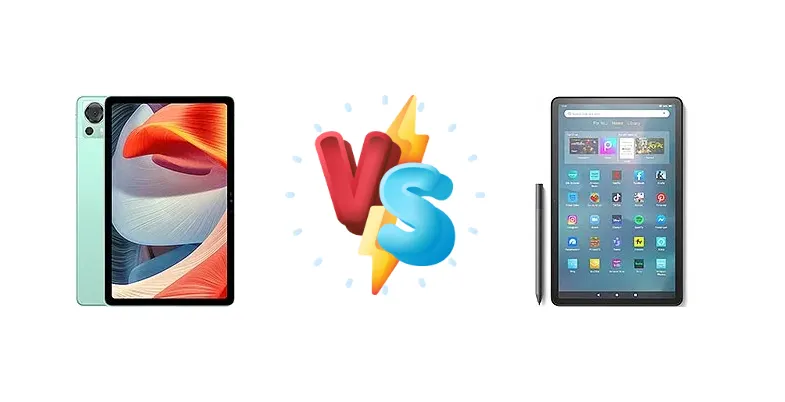
The tablet market has a new wave of affordable options, and the Doogee T20 and Amazon Fire Max 11 are two contenders vying for your attention. While both aim to deliver a tablet experience without breaking the bank, they take different approaches to performance and features. This comparison dissects their core components to determine which tablet best suits your needs.
🏆 Quick Verdict
For users prioritizing raw processing power and a more standard Android experience, the Doogee T20 emerges as the winner. Its Unisoc Tiger T616 chipset, featuring Cortex-A75 cores, offers a noticeable performance edge over the Mediatek MT8188J in the Fire Max 11, making it better suited for multitasking and demanding apps.
| Network |
|---|
| 2G bands | GSM 850 / 900 / 1800 / 1900 | N/A |
| 3G bands | HSDPA 850 / 900 / 1900 / 2100 | - |
| 4G bands | 1, 3, 5, 7, 8, 20, 34, 38, 39, 40, 41 | - |
| EDGE | - | No |
| GPRS | - | No |
| Speed | HSPA, LTE | - |
| Technology | GSM / HSPA / LTE | No cellular connectivity |
| Launch |
|---|
| Announced | 2022, December 22 | 2023, May 23 |
| Status | Available. Released 2022, December 22 | Available. Released 2023, May 23 |
| Body |
|---|
| Dimensions | 245.8 x 155.6 x 7.9 mm (9.68 x 6.13 x 0.31 in) | 259.1 x 163.7 x 7.5 mm (10.20 x 6.44 x 0.30 in) |
| SIM | Nano-SIM + Nano-SIM | No |
| Weight | 478 g (1.05 lb) | 490 g (1.08 lb) |
| Display |
|---|
| Resolution | 1200 x 2000 pixels, 5:3 ratio (~224 ppi density) | 2000 x 1200 pixels, 5:3 ratio (~212 ppi density) |
| Size | 10.4 inches, 307.9 cm2 (~80.5% screen-to-body ratio) | 11.0 inches, 344.4 cm2 (~81.2% screen-to-body ratio) |
| Type | IPS LCD, 320 nits (peak) | IPS LCD |
| Platform |
|---|
| CPU | Octa-core (2x2.0 GHz Cortex-A75 & 6x1.8 GHz Cortex-A55) | Octa-core (2x2.2 GHz Cortex-A78 & 6x2.0 GHz Cortex-A55) |
| Chipset | Unisoc Tiger T616 (12 nm) | Mediatek MT8188J |
| GPU | Mali-G57 MP1 | Mali-G57 MC2 |
| OS | Android 12 | Android 11, Fire OS 8 |
| Memory |
|---|
| Card slot | microSDXC (uses shared SIM slot) | microSDXC (dedicated slot) |
| Internal | 256GB 8GB RAM | 64GB 4GB RAM, 128GB 4GB RAM |
| Main Camera |
|---|
| Features | LED flash, HDR, panorama | - |
| Single | 16 MP, 1/3.0", 1.0µm | 8 MP, AF |
| Video | 1440p@30fps, 1080p@30fps | 1080p |
| Selfie camera |
|---|
| Single | 8 MP | 8 MP |
| Video | 1080p@30fps | 1080p |
| Sound |
|---|
| 35mm jack | No | No |
| Loudspeaker | Yes, with stereo speakers (4 speakers) | Yes, with stereo speakers |
| Comms |
|---|
| Bluetooth | 5.0, A2DP, LE | 5.3, A2DP, LE |
| NFC | No | No |
| Positioning | GPS, GLONASS, GALILEO, BDS | No |
| Radio | FM radio | No |
| USB | USB Type-C 2.0, OTG, accessory connector | USB Type-C 2.0, OTG, magnetic accessory connector |
| WLAN | Wi-Fi 802.11 a/b/g/n/ac, dual-band | Wi-Fi 802.11 a/b/g/n/ac/6, dual-band |
| Features |
|---|
| Sensors | Accelerometer, proximity (accessories only) | Fingerprint (side-mounted), accelerometer, proximity (accessories only) |
| Battery |
|---|
| Charging | 18W wired, 50% in 60 min | 15W wired |
| Type | 8300 mAh | Li-Ion |
| Misc |
|---|
| Colors | Gray, Blue, Green, Pink, Purple | Gray |
| Models | - | KFSNWI |
| Price | About 200 EUR | About 270 EUR |
Doogee T20
- More powerful CPU cores (Cortex-A75)
- Faster charging speed (18W)
- Standard Android experience
- No display specifications available
- Unisoc chipset may have limited software support compared to Mediatek
Amazon Fire Max 11
- Amazon ecosystem integration (Alexa, Amazon Kids+)
- Potentially optimized software for content consumption
- Slightly higher clocked CPU cores (A78)
- Slower charging speed (15W)
- Fire OS may not appeal to all users
- Less powerful overall CPU architecture
Display Comparison
Neither device provides display specifications in the provided data. However, given the price point, both likely utilize IPS LCD panels. The Fire Max 11 benefits from Amazon's software optimizations for content viewing. The Doogee T20, lacking such optimizations, will rely on the raw panel quality. Expect both to be adequate for media consumption but not exceptional in color accuracy or brightness.
Camera Comparison
Neither device is positioned as a photography powerhouse, and the provided data doesn't offer details beyond the chipsets. Expect basic camera performance suitable for casual snapshots. Without sensor size or aperture information, it's difficult to make a meaningful comparison. The inclusion of a 2MP macro camera on either device is likely a marketing tactic, offering limited real-world benefit due to the small sensor size and lack of optical image stabilization.
Performance
The core difference lies in the chipsets. The Doogee T20’s Unisoc Tiger T616 utilizes two Cortex-A75 cores clocked at 2.0 GHz, paired with six Cortex-A55 cores at 1.8 GHz. This architecture is a step up from the Amazon Fire Max 11’s Mediatek MT8188J, which features two Cortex-A78 cores at 2.2 GHz and six Cortex-A55 cores at 2.0 GHz. While the A78 cores in the Fire Max 11 are individually more powerful, the T616’s A75 cores offer a better balance of performance and efficiency, and the overall configuration is likely to translate to smoother multitasking and responsiveness in the Doogee T20. The 12nm process node of the T616 also suggests potentially better thermal management under sustained load.
Battery Life
The Doogee T20 supports 18W wired charging, claiming 50% charge in 60 minutes. The Amazon Fire Max 11 charges at 15W. While the Fire Max 11 charges slower, the actual impact on daily use depends heavily on battery capacity, which is not provided. The faster charging of the Doogee T20 is beneficial for users who need a quick power boost, but the overall battery life will depend on usage patterns and software optimization.
Buying Guide
Buy the Doogee T20 if you need a tablet capable of handling more than just streaming and basic tasks, and if you prefer a cleaner Android experience without Amazon's Fire OS overlay. Buy the Amazon Fire Max 11 if you are deeply embedded in the Amazon ecosystem, prioritize content consumption, and value the integrated features like Alexa and Amazon Kids+, accepting a performance trade-off.
Frequently Asked Questions
❓ Will the Unisoc Tiger T616 in the Doogee T20 struggle with graphically intensive games?
While the T616 isn't a flagship gaming chip, its Cortex-A75 cores and integrated GPU should handle most mobile games at medium settings. Expect some frame drops in the most demanding titles, but it's significantly more capable than the Mediatek MT8188J in the Fire Max 11 for gaming.
❓ How much does Amazon's Fire OS limit customization on the Fire Max 11?
Fire OS is heavily customized and deeply integrated with Amazon's services. Customization options are limited compared to standard Android. Users are encouraged to use Amazon's app store, and sideloading apps can be more complex. This is a significant trade-off for those who prefer a more open Android experience.
❓ Is the 15W charging on the Fire Max 11 noticeably slower than the 18W on the Doogee T20?
Yes, the 18W charging on the Doogee T20 will provide a faster charge, reaching 50% in approximately 60 minutes. The 15W charging on the Fire Max 11 will take longer to reach the same charge level, potentially impacting users who frequently need to quickly top up their device.