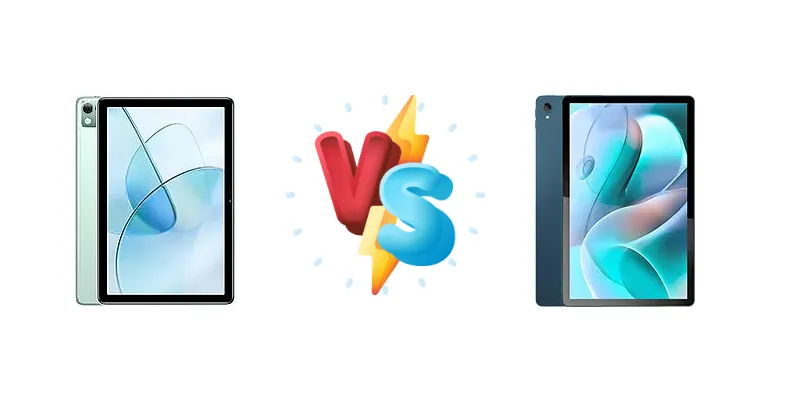
The budget tablet market is fiercely competitive, with options like the Doogee T10S and Motorola Moto Tab G70 vying for attention. Both aim to deliver a functional Android experience without breaking the bank, but they take different approaches to achieving this. The key differentiator lies in their chipsets: the Doogee utilizes the Unisoc T606, while the Motorola opts for the MediaTek Helio G90T. This comparison will dissect these differences and determine which tablet offers the best overall experience.
🏆 Quick Verdict
For the average user prioritizing performance and faster charging, the Motorola Moto Tab G70 is the better choice. Its Helio G90T chipset provides a noticeable performance uplift over the Doogee T10S’s Unisoc T606, making it more suitable for gaming and demanding applications. However, the Doogee remains a viable option for basic tasks and media consumption.
| Network |
|---|
| 2G bands | GSM 850 / 900 / 1800 / 1900 | GSM 850 / 900 / 1800 / 1900 |
| 3G bands | HSDPA 850 / 900 / 1900 / 2100 | HSDPA 850 / 900 / 1900 / 2100 |
| 4G bands | LTE | 1, 2, 4, 7, 8, 20, 28, 38, 40, 41 |
| Speed | HSPA, LTE | HSPA 42.2/5.76 Mbps, LTE Cat4 150/50 Mbps - cellular model only |
| Technology | GSM / HSPA / LTE | GSM / HSPA / LTE |
| Launch |
|---|
| Announced | 2023, July 01 | 2022, January 12 |
| Status | Available. Released 2023, July 20 | Available. Released 2022, January 13 |
| Body |
|---|
| Build | Glass front, aluminum frame, aluminum back | Glass front, aluminum back, aluminum frame |
| Dimensions | 8.4 mm thickness | 258.4 x 163 x 7.5 mm (10.17 x 6.42 x 0.30 in) |
| SIM | Nano-SIM + Nano-SIM | Nano-SIM (cellular model only) |
| Weight | 563 g (1.24 lb) | 500 g (1.10 lb) |
| | - | Water repellent design |
| Display |
|---|
| Resolution | 1200 x 1920 pixels, 16:10 ratio (~224 ppi density) | 1200 x 2000 pixels, 5:3 ratio (~212 ppi density) |
| Size | 10.1 inches, 295.8 cm2 | 11.0 inches, 344.4 cm2 (~81.8% screen-to-body ratio) |
| Type | IPS LCD | IPS LCD, 400 nits (typ) |
| Platform |
|---|
| CPU | Octa-core (2x1.6 GHz Cortex-A75 & 6x1.6 GHz Cortex-A55) | Octa-core (2x2.05 GHz Cortex-A76 & 6x2.0 GHz Cortex-A55) |
| Chipset | Unisoc T606 (12 nm) | Mediatek MT6785 Helio G90T (12 nm) |
| GPU | Mali-G57 MP1 | Mali-G76 MC4 |
| OS | Android 13 | Android 11 |
| Memory |
|---|
| Card slot | microSDXC (uses shared SIM slot) | microSDXC (dedicated slot) |
| Internal | 128GB 6GB RAM | 64GB 4GB RAM, 128GB 6GB RAM |
| | - | eMMC 5.1 |
| Main Camera |
|---|
| Dual | 8 MP
secondary unspecified camera | - |
| Features | LED flash, HDR, panorama | LED flash |
| Single | - | 13 MP, f/2.2, 26mm (wide), AF |
| Video | 1080p@30fps | 1080p@30fps |
| Selfie camera |
|---|
| Single | 5 MP | 8 MP, f/2.0, 26mm (wide) |
| Video | Yes | 1080p@30fps |
| Sound |
|---|
| 3.5mm jack | - | Yes |
| 35mm jack | Yes | Yes |
| Loudspeaker | Yes | Yes, with stereo speakers (4 speakers) |
| Comms |
|---|
| Bluetooth | Yes | 5.2, A2DP, LE |
| NFC | No | No |
| Positioning | Unspecified | GPS, GLONASS - cellular model only |
| Radio | Unspecified | No |
| USB | USB Type-C | USB Type-C 2.0, OTG |
| WLAN | Yes | Wi-Fi 802.11 a/b/g/n/ac, dual-band, Wi-Fi Direct |
| Features |
|---|
| Sensors | Unspecified | Accelerometer, gyro, proximity |
| Battery |
|---|
| Charging | - | 20W wired |
| Type | 6600 mAh | Li-Po 7700 mAh |
| Misc |
|---|
| Colors | Mint Green, Neptune Blue, Space Gray | Modernist Teal, Blue |
| Price | About 180 EUR | About 380 EUR |
Doogee T10S
- Potentially lower price point
- Likely lightweight design
- Suitable for basic tasks
- Inferior chipset performance
- Likely slower charging speeds
- Potentially limited software updates
Motorola Moto Tab G70
- More powerful MediaTek Helio G90T chipset
- Faster 20W wired charging
- Better performance for gaming and multitasking
- May be slightly more expensive
- Potentially larger and heavier
- Software update support may be limited
Display Comparison
Neither device’s display specifications are provided, so a direct comparison is limited. However, given the price points, both likely utilize IPS LCD panels. The Motorola, being a slightly more recent release, *may* benefit from improved color calibration or viewing angles. The absence of information regarding resolution or refresh rate suggests both are targeting the entry-level segment, prioritizing affordability over display fidelity. Bezels are likely to be substantial on both devices, typical of budget tablets.
Camera Comparison
Without specific camera sensor details, a meaningful comparison is difficult. Both tablets likely feature basic camera setups geared towards video calls and casual snapshots. The absence of information suggests neither device prioritizes camera quality. It’s reasonable to assume both will struggle in low-light conditions. Focusing on the chipset, the Helio G90T’s ISP (Image Signal Processor) is likely more advanced, potentially offering slightly better image processing capabilities, but this is speculative without detailed specs.
Performance
The core of the difference lies in the chipsets. The Motorola Moto Tab G70’s MediaTek Helio G90T, built on a 12nm process, features a more powerful CPU configuration: 2x2.05 GHz Cortex-A76 cores and 6x2.0 GHz Cortex-A55 cores. This contrasts with the Doogee T10S’s Unisoc T606, which has 2x1.6 GHz Cortex-A75 cores and 6x1.6 GHz Cortex-A55 cores. The Cortex-A76 cores in the Helio G90T represent a significant architectural improvement over the A75, offering better single-core performance and efficiency. This translates to snappier app launches, smoother multitasking, and a more responsive user experience on the Motorola. While both are 12nm chips, the Helio G90T’s superior core design provides a clear advantage. The G90T also has a more capable Mali-G76 MC4 GPU, further enhancing gaming performance.
Battery Life
Battery capacity isn’t specified for the Doogee T10S, but typical budget tablets in this class range from 5000mAh to 7000mAh. The Moto Tab G70 benefits from 20W wired charging, a significant advantage over potentially slower charging speeds on the Doogee. While a larger battery capacity on the Doogee *could* offset the faster charging of the Motorola, the Helio G90T’s improved efficiency means the Moto Tab G70 will likely deliver comparable, if not better, real-world battery life despite potentially having a similar capacity. The 20W charging will also reduce downtime significantly.
Buying Guide
Buy the Doogee T10S if you need a simple, affordable tablet primarily for basic tasks like web browsing, video calls, and light media consumption. It’s ideal for users who prioritize cost-effectiveness over raw power. Buy the Motorola Moto Tab G70 if you prefer a tablet capable of handling more demanding applications, occasional gaming, and benefit from faster 20W charging. This is the better choice for students or anyone needing a more versatile tablet experience.
Frequently Asked Questions
❓ Will the Motorola Moto Tab G70 handle demanding games like PUBG Mobile?
The Helio G90T chipset in the Moto Tab G70 is capable of running PUBG Mobile, but likely at medium settings to maintain a stable frame rate. While not a dedicated gaming tablet, it offers a significantly better gaming experience than the Doogee T10S due to its more powerful GPU.
❓ Is the Unisoc T606 in the Doogee T10S sufficient for streaming video?
Yes, the Unisoc T606 is adequate for streaming video from services like YouTube and Netflix. However, expect potential buffering or lag with higher resolutions (1080p or above) if other applications are running simultaneously. It's best suited for standard definition or 720p streaming.
❓ How long will it take to fully charge the Motorola Moto Tab G70 with the 20W charger?
While a precise time isn't available, the 20W charging should fully charge the Moto Tab G70 in approximately 2.5 to 3.5 hours, depending on the battery capacity. This is considerably faster than the charging speeds likely offered by the Doogee T10S.
❓ What Android version do these tablets ship with, and are software updates guaranteed?
Specific Android versions aren't provided. However, both tablets likely ship with Android 11 or 12. Software update support is typically limited on budget tablets; while minor updates are possible, major Android version upgrades are unlikely for either device.