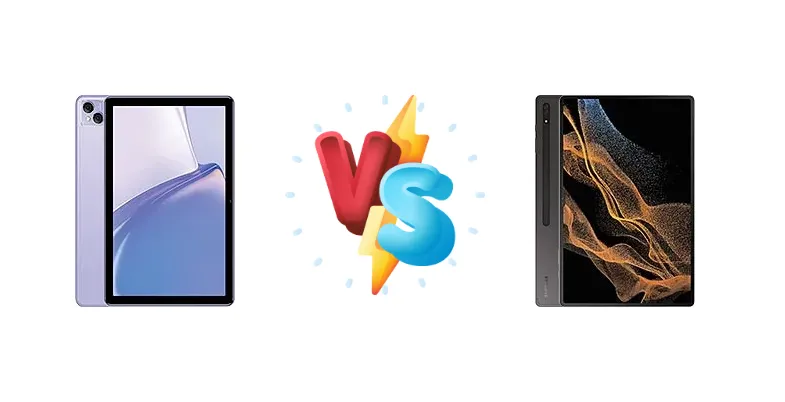
The tablet market offers a wide spectrum of options, from budget-friendly devices for casual use to ultra-premium powerhouses designed for professionals. We're pitting the Doogee T10Pro, a cost-effective Android tablet, against the Samsung Galaxy Tab S8 Ultra, a flagship boasting cutting-edge technology, to determine which device best suits your needs and budget.
🏆 Quick Verdict
For the average user prioritizing affordability and basic functionality, the Doogee T10Pro offers a compelling value. However, the Samsung Galaxy Tab S8 Ultra is the clear winner for those demanding top-tier performance, a stunning display, and a premium user experience, justifying its significantly higher price tag.
| Network |
|---|
| 2G bands | GSM 850 / 900 / 1800 / 1900 | GSM 850 / 900 / 1800 / 1900 |
| 3G bands | HSDPA 850 / 900 / 1900 / 2100 | HSDPA 850 / 900 / 1700(AWS) / 1900 / 2100 |
| 4G bands | 1, 3, 5, 7, 8, 20, 34, 38, 40, 41 | LTE |
| 5G bands | - | SA/NSA |
| Speed | HSPA, LTE | HSPA, LTE, 5G - cellular model only |
| Technology | GSM / HSPA / LTE | GSM / HSPA / LTE / 5G |
| Launch |
|---|
| Announced | 2023, September | 2022, February 09 |
| Status | Available. Released 2023, September | Available. Released 2022, April 30 |
| Body |
|---|
| Build | Glass front, aluminum frame, aluminum back | - |
| Dimensions | 242.3 x 161.1 x 8.5 mm (9.54 x 6.34 x 0.33 in) | 326.4 x 208.6 x 5.5 mm (12.85 x 8.21 x 0.22 in) |
| SIM | Nano-SIM + Nano-SIM | Nano-SIM (cellular model only) |
| Weight | 568 g (1.25 lb) | 726 g (Wi-Fi), 728 g (5G) (1.60 lb) |
| | - | Stylus, 2.8ms latency (Bluetooth integration, accelerometer, gyro) |
| Display |
|---|
| Protection | - | Corning Gorilla Glass 5 |
| Resolution | 1200 x 1920 pixels, 16:10 ratio (~224 ppi density) | 1848 x 2960 pixels, 16:10 ratio (~240 ppi density) |
| Size | 10.1 inches, 295.8 cm2 (~75.8% screen-to-body ratio) | 14.6 inches, 612.6 cm2 (~90.0% screen-to-body ratio) |
| Type | IPS LCD | Super AMOLED, 120Hz, HDR10+ |
| Platform |
|---|
| CPU | Octa-core (2x1.6 GHz Cortex-A75 & 6x1.6 GHz Cortex-A55) | Octa-core (1x3.00 GHz Cortex-X2 & 3x2.50 GHz Cortex-A710 & 4x1.80 GHz Cortex-A510) |
| Chipset | Unisoc T606 (12 nm) | Qualcomm SM8450 Snapdragon 8 Gen 1 (4 nm) |
| GPU | Mali-G57 MP1 | Adreno 730 |
| OS | Android 12 | Android 12, up to 4 major Android upgrades, One UI 6.1.1 |
| Memory |
|---|
| Card slot | microSDXC (uses shared SIM slot) | microSDXC (dedicated slot) |
| Internal | 256GB 8GB RAM | 128GB 8GB RAM, 256GB 8GB RAM, 256GB 12GB RAM, 256GB 16GB RAM, 512GB 12GB RAM, 512GB 16GB RAM |
| | - | UFS |
| Main Camera |
|---|
| Dual | 13 MP
secondary unspecified camera | 13 MP, f/2.0, 26mm (wide), 1/3.4", 1.0µm, AF
6 MP, f/2.2, (ultrawide) |
| Features | LED flash | LED flash, HDR, panorama |
| Video | 1440p@30fps, 1080p@30fps | 4K@30/60fps, 1080p@30fps |
| Selfie camera |
|---|
| Dual | - | 12 MP, f/2.2, 26mm (wide)
12 MP, f/2.4, 120˚ (ultrawide) |
| Features | - | HDR |
| Single | 8 MP | - |
| Video | Yes | 4K@30/60fps, 1080p@30fps |
| Sound |
|---|
| 3.5mm jack | - | No |
| 35mm jack | Yes | No |
| Loudspeaker | Yes, with stereo speakers | Yes, with stereo speakers (4 speakers) |
| | - | Tuned by AKG |
| Comms |
|---|
| Bluetooth | 5.0, A2DP, LE | 5.2, A2DP, LE |
| NFC | No | No |
| Positioning | GPS, GLONASS, GALILEO, BDS | GPS, GLONASS, BDS, GALILEO - cellular model only |
| Radio | Unspecified | No |
| USB | USB Type-C 2.0, OTG | USB Type-C 3.2, magnetic connector |
| WLAN | Wi-Fi 802.11 a/b/g/n/ac, dual-band | Wi-Fi 802.11 a/b/g/n/ac/6e, dual-band, Wi-Fi Direct |
| Features |
|---|
| Sensors | Accelerometer, proximity (accessories only) | Fingerprint (under display, optical), accelerometer, gyro, proximity, compass |
| | - | Wireless Samsung DeX |
| Battery |
|---|
| Charging | 18W wired | 45W wired, 100% in 82 min |
| Type | 8580 mAh | Li-Po 11200 mAh |
| Misc |
|---|
| Colors | Black, Pink, Purple | Graphite |
| Models | - | SM-X900, SM-X906, SM-X906B, SM-X906U, SM-X906N |
| Price | - | About 1150 EUR |
| SAR EU | - | 0.69 W/kg (body) |
Doogee T10Pro
- Significantly more affordable
- Large display for media consumption
- Suitable for basic tasks
- Underpowered processor
- Likely lower quality display
- Slower charging speed
Samsung Galaxy Tab S8 Ultra
- Exceptional performance with Snapdragon 8 Gen 1
- Stunning Super AMOLED display with LTPO
- Fast 45W charging
- Very expensive
- Large size may not be ideal for all users
- Premium price point
Display Comparison
While specific display specs for the Doogee T10Pro are unavailable, it's reasonable to expect an IPS LCD panel given its price point. The Samsung Galaxy Tab S8 Ultra, however, features a 14.6-inch Super AMOLED display. This difference is substantial; AMOLED offers superior contrast, vibrant colors, and deeper blacks compared to IPS LCD. The Tab S8 Ultra’s larger screen size and potentially higher peak brightness (estimated based on Samsung’s flagship history) make it significantly better for media consumption and creative work. The Tab S8 Ultra likely incorporates LTPO technology, dynamically adjusting the refresh rate for improved battery efficiency, a feature absent in the T10Pro.
Camera Comparison
Camera performance is unlikely to be a primary concern for most tablet users, but the Tab S8 Ultra will offer a superior experience. While specific camera specs for the Doogee T10Pro are unknown, it likely features a basic camera setup. The Tab S8 Ultra, benefiting from Samsung’s image processing expertise, will deliver better image quality and more versatile shooting options. The larger sensor size (expected in a flagship device) and potentially OIS (Optical Image Stabilization) will improve low-light performance and reduce blur.
Performance
The core difference lies in the chipsets. The Doogee T10Pro utilizes the Unisoc T606, a 12nm processor with a focus on efficiency. Its octa-core configuration (2x1.6 GHz Cortex-A75 & 6x1.6 GHz Cortex-A55) is suitable for everyday tasks but will struggle with demanding applications. Conversely, the Samsung Galaxy Tab S8 Ultra is powered by the Qualcomm Snapdragon 8 Gen 1, a 4nm powerhouse. The 4nm process node provides significantly better thermal efficiency and performance per watt than the 12nm Unisoc chip. The Snapdragon 8 Gen 1’s CPU configuration (1x3.00 GHz Cortex-X2 & 3x2.50 GHz Cortex-A710 & 4x1.80 GHz Cortex-A510) delivers substantially faster processing speeds, particularly in CPU-intensive tasks. The Tab S8 Ultra also benefits from faster LPDDR5X RAM, further enhancing multitasking and responsiveness.
Battery Life
The Doogee T10Pro supports 18W wired charging, while the Samsung Galaxy Tab S8 Ultra boasts 45W wired charging, reaching 100% in approximately 82 minutes. While the T10Pro’s battery capacity is unknown, the Tab S8 Ultra’s larger battery, combined with the more efficient Snapdragon 8 Gen 1 processor and potentially optimized software, will likely provide longer real-world battery life. The faster charging speed of the Tab S8 Ultra is a significant convenience factor for users who need to quickly top up their device.
Buying Guide
Buy the Doogee T10Pro if you need a large-screen tablet for casual browsing, video streaming, and light productivity tasks, and are constrained by a tight budget. It's ideal for families or individuals who don't require demanding applications or high-end gaming. Buy the Samsung Galaxy Tab S8 Ultra if you prioritize performance for demanding tasks like video editing, graphic design, or gaming, and value a premium build quality, exceptional display, and S Pen integration for enhanced productivity.
Frequently Asked Questions
❓ Is the Unisoc T606 in the Doogee T10Pro sufficient for playing demanding games like Genshin Impact?
The Unisoc T606 is not ideally suited for graphically intensive games like Genshin Impact. While it may be possible to run the game at lower settings, expect significant frame rate drops and potential lag. The Tab S8 Ultra’s Snapdragon 8 Gen 1 provides a vastly superior gaming experience.
❓ Does the Samsung Galaxy Tab S8 Ultra’s S Pen offer a significant advantage for note-taking and drawing?
Yes, the S Pen is a key feature of the Tab S8 Ultra. It offers incredibly low latency and precise control, making it ideal for note-taking, sketching, and digital art. The S Pen integration with Samsung’s software provides a seamless and intuitive experience.
❓ What type of storage does the Doogee T10Pro use, and is it expandable?
Specific storage details for the Doogee T10Pro are unavailable. However, budget tablets often utilize eMMC storage, which is slower than the UFS storage found in the Tab S8 Ultra. Expandability via microSD card is likely, but performance will be limited by the eMMC storage.
❓ How does the thermal management of the Snapdragon 8 Gen 1 in the Tab S8 Ultra perform under sustained load?
The Snapdragon 8 Gen 1 is known to generate heat under prolonged stress. Samsung likely employs a sophisticated cooling system (vapor chamber or heat pipes) within the Tab S8 Ultra to mitigate throttling and maintain performance during extended gaming sessions or video editing.