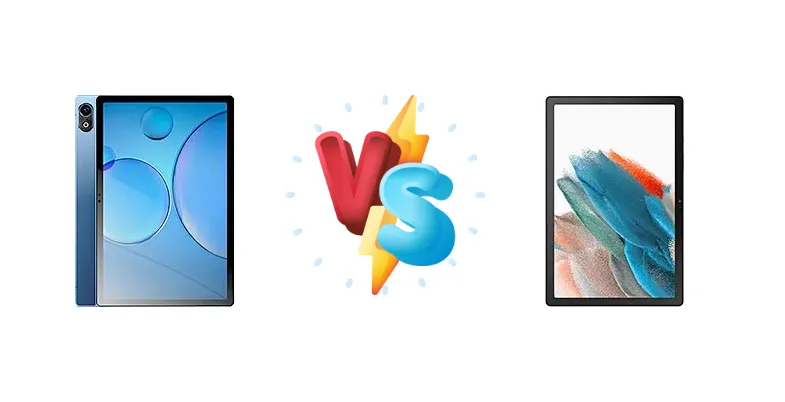
The budget tablet market is fiercely competitive, and the Doogee T10Plus and Samsung Galaxy Tab A8 10.5 (2021) represent compelling options for users seeking affordable entertainment and productivity. Both tablets utilize Unisoc chipsets, but subtle differences in CPU clock speeds and overall system optimization create a noticeable performance gap. This comparison dives deep into the specifications to determine which tablet delivers the best value.
🏆 Quick Verdict
For the average user prioritizing a slightly smoother experience, the Samsung Galaxy Tab A8 10.5 (2021) is the better choice. Its Unisoc Tiger T618, with its 2.0 GHz Cortex-A75 cores, provides a modest but measurable performance advantage over the Doogee T10Plus’s Unisoc T606. However, the T10Plus remains a viable option for basic tasks and media consumption.
| Network |
|---|
| 2G bands | GSM 850 / 900 / 1800 / 1900 | GSM 850 / 900 / 1800 / 1900 |
| 3G bands | HSDPA 850 / 900 / 1900 / 2100 | HSDPA 850 / 900 / 1700(AWS) / 1900 / 2100 |
| 4G bands | 1, 3, 5, 7, 8, 20, 28, 34, 38, 40, 41 | 1, 2, 3, 4, 5, 7, 8, 12, 17, 20, 28, 38, 40, 41, 66 |
| Speed | HSPA, LTE | HSPA, LTE - cellular model only |
| Technology | GSM / HSPA / LTE | GSM / HSPA / LTE |
| Launch |
|---|
| Announced | 2023, September | 2021, December 15 |
| Status | Available. Released 2023, September | Available. Released 2022, January 17 |
| Body |
|---|
| Build | Glass front, aluminum frame, aluminum back | - |
| Dimensions | 246.4 x 161.5 x 7.4 mm (9.70 x 6.36 x 0.29 in) | 246.8 x 161.9 x 6.9 mm (9.72 x 6.37 x 0.27 in) |
| SIM | Nano-SIM + Nano-SIM | Nano-SIM (cellular model only) |
| Weight | 505 g (1.11 lb) | 508 g (1.12 lb) |
| Display |
|---|
| Resolution | 1200 x 1920 pixels, 16:10 ratio (~216 ppi density) | 1200 x 1920 pixels, 16:10 ratio (~216 ppi density) |
| Size | 10.5 inches, 319.7 cm2 (~80.3% screen-to-body ratio) | 10.5 inches, 319.7 cm2 (~80.0% screen-to-body ratio) |
| Type | IPS LCD | TFT LCD |
| Platform |
|---|
| CPU | Octa-core (2x1.6 GHz Cortex-A75 & 6x1.6 GHz Cortex-A55) | Octa-core (2x2.0 GHz Cortex-A75 & 6x2.0 GHz Cortex-A55) |
| Chipset | Unisoc T606 (12 nm) | Unisoc Tiger T618 (12 nm) |
| GPU | Mali-G57 MP1 | Mali G52 MP2 |
| OS | Android 13 | Android 11, upgradable to Android 14, One UI 6 |
| Memory |
|---|
| Card slot | microSDXC (uses shared SIM slot) | microSDXC (dedicated slot) |
| Internal | 256GB 8GB RAM | 32GB 2GB RAM, 32GB 3GB RAM, 64GB 2GB RAM, 64GB 3GB RAM, 64GB 4GB RAM, 128GB 3GB RAM, 128GB 4GB RAM |
| Main Camera |
|---|
| Dual | 13 MP
secondary unspecified camera | - |
| Features | LED flash | - |
| Single | - | 8 MP, AF |
| Video | 1440p@30fps, 1080p@30fps | 1080p@30fps |
| Selfie camera |
|---|
| Single | 8 MP | 5 MP |
| Video | Yes | 1080p@30fps |
| Sound |
|---|
| 3.5mm jack | - | Yes |
| 35mm jack | Yes | Yes |
| Loudspeaker | Yes, with stereo speakers (4 speakers) | Yes, with stereo speakers (4 speakers) |
| Comms |
|---|
| Bluetooth | 5.0, A2DP, LE | 5.0, A2DP, LE |
| NFC | No | No |
| Positioning | GPS, GLONASS, GALILEO, BDS | GPS, GLONASS, BDS, GALILEO, QZSS - cellular model only |
| Radio | Unspecified | No |
| USB | USB Type-C 2.0, OTG, magnetic connector | USB Type-C 2.0 |
| WLAN | Wi-Fi 802.11 a/b/g/n/ac, dual-band | Wi-Fi 802.11 a/b/g/n/ac, dual-band, Wi-Fi Direct |
| Features |
|---|
| Sensors | Accelerometer, proximity (accessories only), gyro, compass | Accelerometer, gyro, proximity, compass |
| Battery |
|---|
| Charging | 18W wired | 15W wired |
| Type | 8250 mAh | Li-Po 7040 mAh |
| Misc |
|---|
| Colors | Black, Green, Blue | Gray, Silver, Pink Gold |
| Models | - | SM-X200, SM-X205 |
| Price | - | About 230 EUR |
| SAR EU | - | 0.92 W/kg (body) |
Doogee T10Plus
- Potentially faster charging with 18W support
- Likely the more affordable option
- Large display for media consumption
- Slower processor compared to the Tab A8
- Less refined software experience
- Uncertain battery capacity
Samsung Galaxy Tab A8 10.5 (2021)
- Faster processor for smoother multitasking
- Samsung brand reputation and software optimization
- Potentially better display performance
- Slower charging at 15W
- Generally more expensive than the Doogee T10Plus
- Uncertain battery capacity
Display Comparison
Neither Doogee nor Samsung specify display details beyond size (10.1” and 10.5” respectively). Given the price points, both likely utilize IPS LCD panels. The key difference lies under the hood. The Tab A8’s Unisoc T618 is better equipped to handle display tasks, potentially resulting in smoother scrolling and video playback. Bezels are expected to be similar on both, reflecting their budget positioning. Color accuracy is unlikely to be a strong suit for either device, but the Tab A8’s slightly more powerful GPU may offer better color processing.
Camera Comparison
Camera performance is unlikely to be a deciding factor for buyers in this segment. Both tablets will likely feature basic camera setups suitable for video calls and casual snapshots. Details are scarce, but it’s safe to assume both will have a primary rear camera and a front-facing camera. Focusing on megapixel counts would be misleading; image quality will be heavily influenced by software processing and sensor size, neither of which are specified. The absence of OIS on either device suggests limited low-light performance.
Performance
The core distinction between these tablets is the chipset. The Samsung Galaxy Tab A8 features the Unisoc Tiger T618, boasting 2x 2.0 GHz Cortex-A75 cores and 6x 2.0 GHz Cortex-A55 cores. The Doogee T10Plus utilizes the Unisoc T606, with 2x 1.6 GHz Cortex-A75 cores and 6x 1.6 GHz Cortex-A55 cores. This 0.4 GHz clock speed difference, while seemingly small, translates to a tangible performance boost for the Tab A8 in CPU-intensive tasks. Both use a 12nm process, so thermal management should be comparable, but the Tab A8 will likely sustain higher clock speeds for longer. RAM configurations are not specified, but the Tab A8’s optimized software could mitigate any RAM disadvantages.
Battery Life
Battery capacity is not specified for either device. However, the Doogee T10Plus supports 18W wired charging, while the Samsung Galaxy Tab A8 is limited to 15W. This suggests the T10Plus *could* charge slightly faster, potentially offsetting a smaller battery capacity. Real-world battery life will depend heavily on usage patterns, but the Tab A8’s more efficient chipset may contribute to longer runtimes during moderate use. Without knowing the battery capacities, it’s difficult to definitively declare a winner.
Buying Guide
Buy the Doogee T10Plus if you need a large-screen tablet for primarily static tasks like reading ebooks, watching downloaded videos, or simple web browsing, and are prioritizing the absolute lowest price point. Buy the Samsung Galaxy Tab A8 10.5 (2021) if you prefer a more responsive user experience for multitasking, light gaming, and streaming, and value the Samsung brand reputation and software ecosystem.
Frequently Asked Questions
❓ Will the Unisoc T606 in the Doogee T10Plus struggle with demanding apps like video editors or graphically intensive games?
Yes, the Unisoc T606 is an entry-level chipset. While it can handle basic tasks and light gaming, it will likely exhibit noticeable lag and slowdowns when running resource-intensive applications. The Samsung Galaxy Tab A8’s T618 offers a more comfortable experience for these workloads, though it’s still not a gaming powerhouse.
❓ Does the Samsung Galaxy Tab A8 support Samsung DeX, allowing for a desktop-like experience when connected to an external display?
No, the Samsung Galaxy Tab A8 (2021) does *not* support Samsung DeX. This feature is typically reserved for higher-end Samsung tablets like the Tab S series. You can still connect it to an external display for mirroring, but you won’t get the full DeX interface.
❓ What kind of storage options are available on each tablet, and can the storage be expanded via microSD card?
Storage options are not explicitly stated in the provided data. However, based on market trends for budget tablets, both the Doogee T10Plus and Samsung Galaxy Tab A8 likely offer 32GB or 64GB of internal storage. Crucially, both tablets *do* support microSD card expansion, allowing users to increase storage capacity as needed.