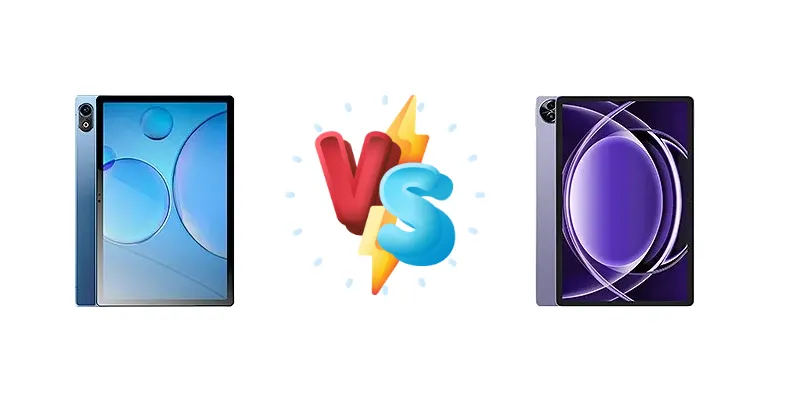
The budget tablet market is heating up, with options like the Doogee T10 Plus and Realme Pad 2 Lite vying for attention. Both aim to deliver a capable experience without breaking the bank, but they take different approaches. The Doogee focuses on a larger screen and basic functionality, while the Realme Pad 2 Lite prioritizes a more modern chipset for improved performance. This comparison dives deep into the specs to determine which tablet offers the best value.
🏆 Quick Verdict
For most users, the Realme Pad 2 Lite emerges as the better choice. Its Mediatek Helio G99 chipset, fabricated on a 6nm process, provides a significant performance advantage over the Doogee T10 Plus’s Unisoc T606. While the Doogee offers a slightly larger screen, the Realme’s superior processing power translates to a smoother, more responsive user experience.
| Network |
|---|
| 2G bands | GSM 850 / 900 / 1800 / 1900 | GSM 850 / 900 / 1800 / 1900 |
| 3G bands | HSDPA 850 / 900 / 1900 / 2100 | HSDPA 850 / 900 / 2100 |
| 4G bands | 1, 3, 5, 7, 8, 20, 28, 34, 38, 40, 41 | 1, 3, 5, 7, 8, 20, 28, 38, 40, 41 |
| Speed | HSPA, LTE | HSPA, LTE |
| Technology | GSM / HSPA / LTE | GSM / HSPA / LTE |
| Launch |
|---|
| Announced | 2023, September | 2024, September 13 |
| Status | Available. Released 2023, September | Available. Released 2024, September 26 |
| Body |
|---|
| Build | Glass front, aluminum frame, aluminum back | - |
| Dimensions | 246.4 x 161.5 x 7.4 mm (9.70 x 6.36 x 0.29 in) | 258 x 169.5 x 8.3 mm (10.16 x 6.67 x 0.33 in) |
| SIM | Nano-SIM + Nano-SIM | No |
| Weight | 505 g (1.11 lb) | 525 g (1.16 lb) |
| Display |
|---|
| Resolution | 1200 x 1920 pixels, 16:10 ratio (~216 ppi density) | 1200 x 1920 pixels, 16:10 ratio (~207 ppi density) |
| Size | 10.5 inches, 319.7 cm2 (~80.3% screen-to-body ratio) | 10.95 inches, 347.7 cm2 (~79.5% screen-to-body ratio) |
| Type | IPS LCD | IPS LCD, 1B colors, 90Hz, 450 nits (peak) |
| Platform |
|---|
| CPU | Octa-core (2x1.6 GHz Cortex-A75 & 6x1.6 GHz Cortex-A55) | Octa-core (2x2.2 GHz Cortex-A76 & 6x2.0 GHz Cortex-A55) |
| Chipset | Unisoc T606 (12 nm) | Mediatek Helio G99 (6 nm) |
| GPU | Mali-G57 MP1 | Mali-G57 MC2 |
| OS | Android 13 | Android 14, Realme UI 5.0 for Pad |
| Memory |
|---|
| Card slot | microSDXC (uses shared SIM slot) | Unspecified |
| Internal | 256GB 8GB RAM | 128GB 4GB RAM, 128GB 8GB RAM |
| Main Camera |
|---|
| Dual | 13 MP
secondary unspecified camera | - |
| Features | LED flash | Panorama |
| Single | - | 8 MP, f/2.0 |
| Video | 1440p@30fps, 1080p@30fps | 1080p@30fps |
| Selfie camera |
|---|
| Features | - | Panorama |
| Single | 8 MP | 5 MP, f/2.2 |
| Video | Yes | 1080p@30fps |
| Sound |
|---|
| 35mm jack | Yes | No |
| Loudspeaker | Yes, with stereo speakers (4 speakers) | Yes, with stereo speakers (4 speakers) |
| Comms |
|---|
| Bluetooth | 5.0, A2DP, LE | 5.2, A2DP, LE |
| NFC | No | No |
| Positioning | GPS, GLONASS, GALILEO, BDS | GPS, GALILEO, GLONASS, BDS |
| Radio | Unspecified | No |
| USB | USB Type-C 2.0, OTG, magnetic connector | USB Type-C |
| WLAN | Wi-Fi 802.11 a/b/g/n/ac, dual-band | Wi-Fi 802.11 a/b/g/n/ac, dual-band |
| Features |
|---|
| Sensors | Accelerometer, proximity (accessories only), gyro, compass | Accelerometer |
| Battery |
|---|
| Charging | 18W wired | 15W wired |
| Type | 8250 mAh | 8300 mAh |
| Misc |
|---|
| Colors | Black, Green, Blue | Nebula Purple, Space Grey |
| Models | - | RMP2402 |
| Price | - | About 160 EUR |
Doogee T10Plus
- Faster charging (18W vs 15W)
- Potentially larger screen real estate
- Lower price point (likely)
- Older, less efficient Unisoc T606 chipset
- Likely lower performance in demanding tasks
- Less future-proof
Realme Pad 2 Lite
- More powerful and efficient Mediatek Helio G99 chipset
- Smoother multitasking and app performance
- Better long-term value
- Slower charging speed (15W)
- Potentially smaller screen size
- May be slightly more expensive
Display Comparison
Both tablets feature 10.1-inch displays, but details beyond size are scarce. The Realme Pad 2 Lite likely benefits from a more modern panel, but without knowing the panel type (IPS, TFT) or color gamut coverage for either, it’s difficult to assess visual quality. The Doogee T10 Plus’s larger size might be preferable for some, but the Realme’s potential for better color accuracy and viewing angles could offset this.
Camera Comparison
Neither tablet is expected to excel in photography. Given the target price point, camera quality is likely a secondary consideration. Without specific sensor details, it’s safe to assume both will offer adequate performance for casual snapshots, but not much more. Focusing on the chipset difference is far more relevant to the overall user experience.
Performance
The core difference lies in the chipsets. The Realme Pad 2 Lite’s Mediatek Helio G99 (6nm) is a clear upgrade over the Doogee T10 Plus’s Unisoc T606 (12nm). The 6nm process allows for greater transistor density and improved power efficiency, resulting in better sustained performance and less heat generation. The Helio G99’s Cortex-A76 cores, clocked at 2.2 GHz, also outperform the T606’s Cortex-A75 cores at 1.6 GHz. This translates to faster app loading times, smoother multitasking, and a more responsive user interface on the Realme Pad 2 Lite.
Battery Life
While battery capacity isn’t specified, the Realme Pad 2 Lite’s 15W charging is slower than the Doogee T10 Plus’s 18W charging. However, the Helio G99’s superior power efficiency likely means the Realme Pad 2 Lite will achieve comparable or even better battery life despite the slower charging speed. The 6nm process reduces power draw, offsetting the charging wattage difference.
Buying Guide
Buy the Doogee T10 Plus if you prioritize a larger display for static content consumption like reading or displaying presentations and are on a very tight budget. It’s a functional device for basic tasks. Buy the Realme Pad 2 Lite if you value performance for multitasking, light gaming, and a more fluid overall experience. The Helio G99 chipset makes it a more future-proof option, even if it means a slightly smaller screen.
Frequently Asked Questions
❓ Will the Realme Pad 2 Lite handle demanding games like PUBG Mobile?
The Mediatek Helio G99 is capable of running PUBG Mobile, but you’ll likely need to lower the graphics settings to achieve a smooth frame rate. It’s not a dedicated gaming tablet, but it offers a significantly better gaming experience than the Doogee T10 Plus due to its more powerful GPU.
❓ Is the Unisoc T606 in the Doogee T10 Plus sufficient for everyday tasks like browsing and video streaming?
Yes, the Unisoc T606 is adequate for basic tasks like web browsing, video streaming, and document editing. However, you may experience slowdowns when multitasking or running more demanding applications. It’s best suited for users with light usage patterns.
❓ How much does the charging speed difference between 15W and 18W actually matter?
While 18W is technically faster, the Realme Pad 2 Lite’s more efficient chipset means it likely won’t take significantly longer to charge. The difference in charge times will be minimal, and the overall battery life may be better on the Realme Pad 2 Lite.