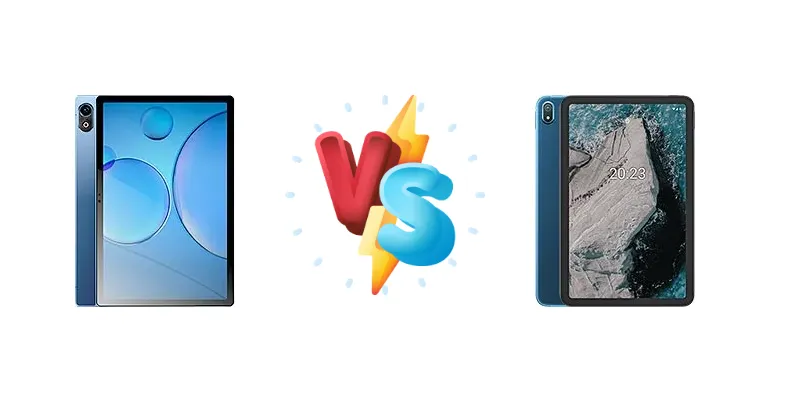
The budget tablet market is fiercely competitive, with options like the Doogee T10Plus and Nokia T20 vying for attention. Both tablets aim to deliver an affordable Android experience, but they differ in key areas like processing power and display quality. This comparison dives deep into the specifications to determine which tablet offers the best value for your money.
🏆 Quick Verdict
For most users, the Nokia T20 emerges as the slightly better choice. While both utilize the Unisoc T610/T606 series, the Nokia T20’s brighter 422 nit display and slightly faster CPU clock speeds provide a more enjoyable user experience, justifying the small price difference.
| Network |
|---|
| 2G bands | GSM 850 / 900 / 1800 / 1900 | GSM 850 / 900 / 1800 / 1900 |
| 3G bands | HSDPA 850 / 900 / 1900 / 2100 | HSDPA 850 / 900 / 1700(AWS) / 1900 / 2100 - US, LATAM |
| 4G bands | 1, 3, 5, 7, 8, 20, 28, 34, 38, 40, 41 | 1, 2, 3, 4, 5, 7, 8, 12, 13, 17, 20, 28, 40, 66 - US, LATAM |
| Speed | HSPA, LTE | HSPA, LTE Cat4 150/50 Mbps - cellular model only |
| Technology | GSM / HSPA / LTE | GSM / HSPA / LTE |
| | - | 1, 3, 5, 7, 8, 20, 28, 38, 40, 41 - International |
| Launch |
|---|
| Announced | 2023, September | 2021, October 06 |
| Status | Available. Released 2023, September | Available. Released 2021, November 02 |
| Body |
|---|
| Build | Glass front, aluminum frame, aluminum back | Glass front, aluminum back |
| Dimensions | 246.4 x 161.5 x 7.4 mm (9.70 x 6.36 x 0.29 in) | 247.6 x 157.5 x 7.8 mm (9.75 x 6.20 x 0.31 in) |
| SIM | Nano-SIM + Nano-SIM | Nano-SIM (cellular model only) |
| Weight | 505 g (1.11 lb) | 465 g (Wi-Fi), 470 g (LTE) (1.03 lb) |
| | - | Splash resistant |
| Display |
|---|
| Protection | - | Scratch-resistant glass |
| Resolution | 1200 x 1920 pixels, 16:10 ratio (~216 ppi density) | 1200 x 2000 pixels, 5:3 ratio (~224 ppi density) |
| Size | 10.5 inches, 319.7 cm2 (~80.3% screen-to-body ratio) | 10.4 inches, 307.9 cm2 (~78.9% screen-to-body ratio) |
| Type | IPS LCD | IPS LCD, 400 nits (typ) |
| Platform |
|---|
| CPU | Octa-core (2x1.6 GHz Cortex-A75 & 6x1.6 GHz Cortex-A55) | Octa-core (2x1.8 GHz Cortex-A75 & 6x1.8 GHz Cortex-A55) |
| Chipset | Unisoc T606 (12 nm) | Unisoc T610 (12 nm) |
| GPU | Mali-G57 MP1 | Mali-G52 MP2 |
| OS | Android 13 | Android 11, upgradable to Android 13 |
| Memory |
|---|
| Card slot | microSDXC (uses shared SIM slot) | microSDXC (dedicated slot) |
| Internal | 256GB 8GB RAM | 32GB 3GB RAM, 64GB 4GB RAM |
| | - | eMMC 5.1 |
| Main Camera |
|---|
| Dual | 13 MP
secondary unspecified camera | - |
| Features | LED flash | LED flash |
| Single | - | 8 MP, AF |
| Video | 1440p@30fps, 1080p@30fps | 1080p@30fps |
| Selfie camera |
|---|
| Single | 8 MP | 5 MP |
| Video | Yes | Yes |
| Sound |
|---|
| 3.5mm jack | - | Yes |
| 35mm jack | Yes | Yes |
| Loudspeaker | Yes, with stereo speakers (4 speakers) | Yes, with stereo speakers |
| Comms |
|---|
| Bluetooth | 5.0, A2DP, LE | 5.0, A2DP, LE |
| NFC | No | No |
| Positioning | GPS, GLONASS, GALILEO, BDS | GPS - cellular model only |
| Radio | Unspecified | FM radio |
| USB | USB Type-C 2.0, OTG, magnetic connector | USB Type-C 2.0 |
| WLAN | Wi-Fi 802.11 a/b/g/n/ac, dual-band | Wi-Fi 802.11 a/b/g/n/ac, dual-band |
| Features |
|---|
| Sensors | Accelerometer, proximity (accessories only), gyro, compass | Accelerometer |
| Battery |
|---|
| Charging | 18W wired | 15W wired |
| Type | 8250 mAh | Li-Po 8200 mAh |
| Misc |
|---|
| Colors | Black, Green, Blue | Deep Ocean |
| Models | - | TA-1397, TA-1394, TA-1392 |
| Price | - | About 200 EUR |
| SAR | - | 1.34 W/kg (body) |
| SAR EU | - | 1.35 W/kg (body) |
Doogee T10Plus
- Potentially faster charging with 18W support
- Lower price point (likely)
- Suitable for basic tasks
- Likely lower display brightness
- Slightly slower processor
Nokia T20
- Brighter and higher contrast display
- Slightly faster processor
- More responsive user experience
- Slower charging speed (15W)
- Higher price point
Display Comparison
The Nokia T20 boasts a significant advantage in display quality, achieving a measured peak brightness of 422 nits. This is crucial for outdoor visibility and a more immersive viewing experience. While the Doogee T10Plus’s display specifications are not provided, it’s reasonable to assume it falls below this brightness level. The Nokia T20’s 1786:1 contrast ratio further enhances image clarity and depth, making it superior for media consumption. The absence of display details for the Doogee T10Plus suggests it’s a cost-saving measure, potentially impacting the overall user experience.
Camera Comparison
Neither tablet is positioned as a photography powerhouse, and detailed camera specifications are lacking. Given the budget nature of both devices, image quality is likely to be adequate for casual snapshots but not competitive with smartphones. Without specific sensor details, it’s difficult to draw definitive conclusions, but focusing on the core functionality of these tablets – media consumption and productivity – suggests the camera is a secondary consideration.
Performance
Both tablets are powered by Unisoc chipsets, but the Nokia T20 utilizes the slightly more powerful Unisoc T610, clocked at 2x1.8 GHz Cortex-A75 cores and 6x1.8 GHz Cortex-A55 cores, compared to the Doogee T10Plus’s Unisoc T606 with 2x1.6 GHz Cortex-A75 and 6x1.6 GHz Cortex-A55 cores. This 10% clock speed increase in the T610 translates to marginally faster application loading times and smoother multitasking. Both chipsets are built on a 12nm process, indicating similar power efficiency. However, the Nokia T20’s slightly faster CPU will likely result in a more responsive user interface.
Battery Life
The Doogee T10Plus supports 18W wired charging, while the Nokia T20 is limited to 15W. While the higher wattage suggests potentially faster charging speeds for the Doogee T10Plus, the actual charging time will depend on battery capacity (which is not provided for either device). The difference of 3W is unlikely to be dramatically noticeable in real-world usage. Without knowing the battery capacity of each device, it’s impossible to accurately predict battery life, but the power efficiency of the Unisoc chipsets suggests both tablets should offer a reasonable day’s use with moderate usage.
Buying Guide
Buy the Doogee T10Plus if you prioritize absolute affordability and are primarily using the tablet for basic tasks like web browsing and light media consumption. Buy the Nokia T20 if you value a more vibrant display for streaming video, a slightly smoother user experience, and are willing to spend a bit more for improved overall quality.
Frequently Asked Questions
❓ Will the Unisoc T606 in the Doogee T10Plus struggle with demanding games?
The Unisoc T606 is an entry-level chipset. While it can handle casual gaming, demanding titles will likely require reduced graphics settings and may experience occasional frame drops. The Nokia T20’s T610 offers a slight performance boost, but neither tablet is designed for hardcore gaming.
❓ Is the Nokia T20’s display bright enough to use comfortably outdoors?
With a measured peak brightness of 422 nits, the Nokia T20’s display is reasonably bright for outdoor use, especially in shaded areas. However, direct sunlight may still cause some glare and reduce visibility. The Doogee T10Plus, lacking brightness specifications, is likely less suitable for outdoor viewing.
❓ How does the charging speed of the Doogee T10Plus compare to the Nokia T20 in real-world use?
While the Doogee T10Plus supports 18W charging compared to the Nokia T20’s 15W, the actual difference in charging time will depend on the battery capacity of each device. Without that information, it’s difficult to quantify the difference, but it’s unlikely to be substantial.