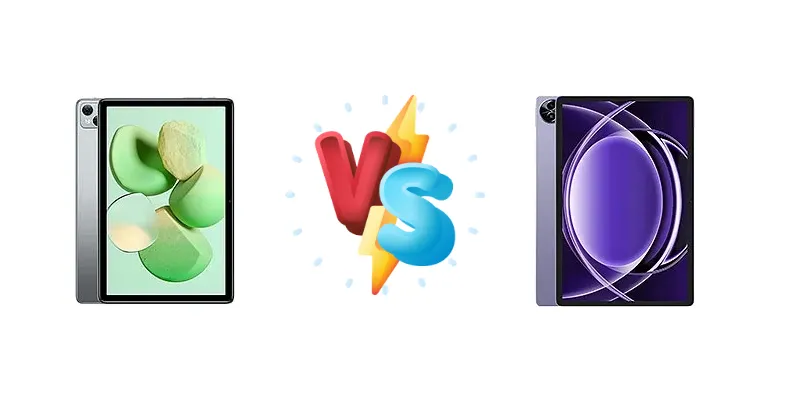
The budget tablet market is fiercely competitive, and the Doogee T10 and Realme Pad 2 Lite represent compelling options for users seeking affordable entertainment and productivity. This comparison dives deep into their core specifications, focusing on the critical differences in chipset architecture and charging capabilities to determine which tablet delivers the best value.
🏆 Quick Verdict
For most users, the Realme Pad 2 Lite emerges as the better choice. Its Mediatek Helio G99, built on a more efficient 6nm process, provides a noticeable performance advantage over the Doogee T10’s Unisoc T606, making it more responsive for everyday tasks and light gaming. While the T10 offers a slightly lower price point, the G99’s efficiency justifies the small premium.
| Network |
|---|
| 2G bands | GSM 850 / 900 / 1800 / 1900 | GSM 850 / 900 / 1800 / 1900 |
| 3G bands | HSDPA 850 / 900 / 1900 / 2100 | HSDPA 850 / 900 / 2100 |
| 4G bands | 1, 3, 5, 7, 20, 34, 38, 39, 40, 41 | 1, 3, 5, 7, 8, 20, 28, 38, 40, 41 |
| Speed | HSPA, LTE | HSPA, LTE |
| Technology | GSM / HSPA / LTE | GSM / HSPA / LTE |
| Launch |
|---|
| Announced | 2022, November 01 | 2024, September 13 |
| Status | Available. Released 2022, November 01 | Available. Released 2024, September 26 |
| Body |
|---|
| Build | Glass front, aluminum frame, aluminum back | - |
| Dimensions | 242.3 x 161.1 x 7.5 mm (9.54 x 6.34 x 0.30 in) | 258 x 169.5 x 8.3 mm (10.16 x 6.67 x 0.33 in) |
| SIM | Nano-SIM + Nano-SIM | No |
| Weight | - | 525 g (1.16 lb) |
| Display |
|---|
| Resolution | 1200 x 1920 pixels, 16:10 ratio (~224 ppi density) | 1200 x 1920 pixels, 16:10 ratio (~207 ppi density) |
| Size | 10.1 inches, 295.8 cm2 (~75.8% screen-to-body ratio) | 10.95 inches, 347.7 cm2 (~79.5% screen-to-body ratio) |
| Type | IPS LCD, 300 nits (typ) | IPS LCD, 1B colors, 90Hz, 450 nits (peak) |
| Platform |
|---|
| CPU | Octa-core (2x1.6 GHz Cortex-A75 & 6x1.6 GHz Cortex-A55) | Octa-core (2x2.2 GHz Cortex-A76 & 6x2.0 GHz Cortex-A55) |
| Chipset | Unisoc T606 (12 nm) | Mediatek Helio G99 (6 nm) |
| GPU | Mali-G57 MP1 | Mali-G57 MC2 |
| OS | Android 12 | Android 14, Realme UI 5.0 for Pad |
| Memory |
|---|
| Card slot | microSDXC (uses shared SIM slot) | Unspecified |
| Internal | 128GB 8GB RAM | 128GB 4GB RAM, 128GB 8GB RAM |
| Main Camera |
|---|
| Dual | 13 MP
secondary unspecified camera | - |
| Features | LED flash, HDR, panorama | Panorama |
| Single | - | 8 MP, f/2.0 |
| Video | 1440p@30fps, 1080p@30fps | 1080p@30fps |
| Selfie camera |
|---|
| Features | - | Panorama |
| Single | 8 MP | 5 MP, f/2.2 |
| Video | 1080p@30fps | 1080p@30fps |
| Sound |
|---|
| 35mm jack | Yes | No |
| Loudspeaker | Yes, with stereo speakers | Yes, with stereo speakers (4 speakers) |
| Comms |
|---|
| Bluetooth | 5.0, A2DP, LE | 5.2, A2DP, LE |
| NFC | No | No |
| Positioning | GPS, GLONASS, GALILEO, BDS | GPS, GALILEO, GLONASS, BDS |
| Radio | FM radio | No |
| USB | USB Type-C 2.0, OTG | USB Type-C |
| WLAN | Wi-Fi 802.11 a/b/g/n/ac, dual-band | Wi-Fi 802.11 a/b/g/n/ac, dual-band |
| Features |
|---|
| Sensors | Gyro | Accelerometer |
| Battery |
|---|
| Charging | 18W wired | 15W wired |
| Type | 8300 mAh | 8300 mAh |
| Misc |
|---|
| Colors | Space Gray, Moonlight Silver, Neptune Blue | Nebula Purple, Space Grey |
| Models | - | RMP2402 |
| Price | About 140 EUR | About 160 EUR |
Doogee T10
- Potentially faster charging with 18W support.
- Lowest possible price point in this category.
- Sufficient for basic tasks like reading and web browsing.
- Less powerful Unisoc T606 chipset.
- 12nm process is less efficient, potentially impacting battery life.
- Likely to struggle with demanding applications.
Realme Pad 2 Lite
- More powerful and efficient Mediatek Helio G99 chipset.
- 6nm process offers improved performance and battery life.
- Smoother multitasking and a more responsive user experience.
- Slightly higher price compared to the Doogee T10.
- Slower 15W charging.
- Camera performance likely similar to the Doogee T10.
Display Comparison
Neither Doogee nor Realme provide detailed display specifications beyond screen size. However, the choice of panel technology and resolution will likely be similar given the price points. The absence of information regarding peak brightness, color gamut coverage, or refresh rates suggests both tablets target casual media consumption rather than color-critical work. Bezels are expected to be substantial on both devices, typical for this segment.
Camera Comparison
Given the budget nature of these tablets, camera performance is unlikely to be a key differentiator. Detailed camera specifications are unavailable, but it’s safe to assume both devices feature basic camera setups geared towards casual snapshots. Focusing on the main sensor resolution would be more relevant than analyzing potentially low-quality macro lenses. The image processing capabilities will likely be limited on both devices.
Performance
The core difference lies in the chipsets. The Realme Pad 2 Lite’s Mediatek Helio G99 (6nm) boasts significantly improved efficiency and performance compared to the Doogee T10’s Unisoc T606 (12nm). The G99’s Cortex-A76 cores, clocked at 2.2 GHz, offer a substantial architectural advantage over the T606’s Cortex-A75 cores at 1.6 GHz. This translates to faster app loading times, smoother multitasking, and a more responsive overall experience. The 6nm process further enhances efficiency, potentially leading to longer battery life under load. While both utilize octa-core configurations, the G99’s superior core design and fabrication process give it a clear edge.
Battery Life
Battery capacity is not specified for either device. However, the Realme Pad 2 Lite’s 15W charging, while slower than the Doogee T10’s 18W, is less critical given the Helio G99’s superior power efficiency. The 6nm process allows the G99 to deliver comparable performance with lower power consumption, potentially offsetting the slower charging speed. The T10’s 18W charging may offer slightly faster top-ups, but the G99’s efficiency could result in longer overall usage times on a single charge.
Buying Guide
Buy the Doogee T10 if you prioritize absolute lowest cost and primarily need a tablet for static tasks like reading ebooks or basic web browsing. Its Unisoc T606 is sufficient for these workloads. Buy the Realme Pad 2 Lite if you value smoother multitasking, a more responsive user experience, and the potential for light gaming; the Helio G99’s architecture and 6nm fabrication process deliver a tangible improvement in performance and efficiency.
Frequently Asked Questions
❓ Will the Realme Pad 2 Lite handle popular mobile games like PUBG or Call of Duty?
The Mediatek Helio G99 is capable of running PUBG and Call of Duty at medium settings, but don't expect a flagship gaming experience. Frame rates will likely be capped to maintain stability, and extended gaming sessions may result in some thermal throttling. The Doogee T10’s Unisoc T606 will struggle with these titles.
❓ Is the difference in charging speed between 15W and 18W noticeable in everyday use?
While 18W charging on the Doogee T10 is technically faster, the difference in charging time from 0-100% will likely be minimal – perhaps 15-30 minutes. The Realme Pad 2 Lite’s 15W charging is perfectly adequate, and the G99’s efficiency means you may not even notice the slower charging speed due to longer battery life.
❓ Can either of these tablets be used for video editing or other demanding creative tasks?
Neither the Doogee T10 nor the Realme Pad 2 Lite are well-suited for demanding creative tasks like video editing. The chipsets lack the processing power and RAM bandwidth required for smooth performance. They are best suited for media consumption and light productivity.