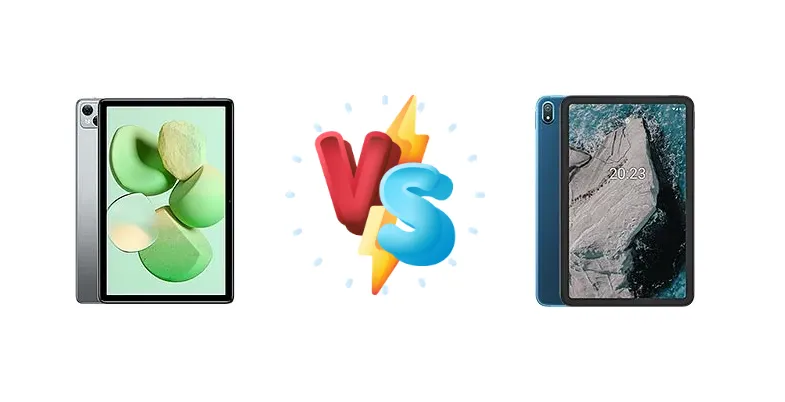
The budget tablet market is fiercely competitive, and the Doogee T10 and Nokia T20 represent compelling options for users seeking affordable entertainment and productivity. Both tablets leverage Unisoc chipsets, but subtle differences in CPU clock speeds and display characteristics create distinct user experiences. This comparison dissects these nuances to determine which tablet delivers the best value.
🏆 Quick Verdict
For most users, the Nokia T20 emerges as the slightly better choice. Its brighter 422-nit display significantly enhances outdoor visibility and media consumption, while the marginally faster CPU provides a smoother overall experience. However, the Doogee T10 remains a viable option for those prioritizing cost above all else.
| Network |
|---|
| 2G bands | GSM 850 / 900 / 1800 / 1900 | GSM 850 / 900 / 1800 / 1900 |
| 3G bands | HSDPA 850 / 900 / 1900 / 2100 | HSDPA 850 / 900 / 1700(AWS) / 1900 / 2100 - US, LATAM |
| 4G bands | 1, 3, 5, 7, 20, 34, 38, 39, 40, 41 | 1, 2, 3, 4, 5, 7, 8, 12, 13, 17, 20, 28, 40, 66 - US, LATAM |
| Speed | HSPA, LTE | HSPA, LTE Cat4 150/50 Mbps - cellular model only |
| Technology | GSM / HSPA / LTE | GSM / HSPA / LTE |
| | - | 1, 3, 5, 7, 8, 20, 28, 38, 40, 41 - International |
| Launch |
|---|
| Announced | 2022, November 01 | 2021, October 06 |
| Status | Available. Released 2022, November 01 | Available. Released 2021, November 02 |
| Body |
|---|
| Build | Glass front, aluminum frame, aluminum back | Glass front, aluminum back |
| Dimensions | 242.3 x 161.1 x 7.5 mm (9.54 x 6.34 x 0.30 in) | 247.6 x 157.5 x 7.8 mm (9.75 x 6.20 x 0.31 in) |
| SIM | Nano-SIM + Nano-SIM | Nano-SIM (cellular model only) |
| Weight | - | 465 g (Wi-Fi), 470 g (LTE) (1.03 lb) |
| | - | Splash resistant |
| Display |
|---|
| Protection | - | Scratch-resistant glass |
| Resolution | 1200 x 1920 pixels, 16:10 ratio (~224 ppi density) | 1200 x 2000 pixels, 5:3 ratio (~224 ppi density) |
| Size | 10.1 inches, 295.8 cm2 (~75.8% screen-to-body ratio) | 10.4 inches, 307.9 cm2 (~78.9% screen-to-body ratio) |
| Type | IPS LCD, 300 nits (typ) | IPS LCD, 400 nits (typ) |
| Platform |
|---|
| CPU | Octa-core (2x1.6 GHz Cortex-A75 & 6x1.6 GHz Cortex-A55) | Octa-core (2x1.8 GHz Cortex-A75 & 6x1.8 GHz Cortex-A55) |
| Chipset | Unisoc T606 (12 nm) | Unisoc T610 (12 nm) |
| GPU | Mali-G57 MP1 | Mali-G52 MP2 |
| OS | Android 12 | Android 11, upgradable to Android 13 |
| Memory |
|---|
| Card slot | microSDXC (uses shared SIM slot) | microSDXC (dedicated slot) |
| Internal | 128GB 8GB RAM | 32GB 3GB RAM, 64GB 4GB RAM |
| | - | eMMC 5.1 |
| Main Camera |
|---|
| Dual | 13 MP
secondary unspecified camera | - |
| Features | LED flash, HDR, panorama | LED flash |
| Single | - | 8 MP, AF |
| Video | 1440p@30fps, 1080p@30fps | 1080p@30fps |
| Selfie camera |
|---|
| Single | 8 MP | 5 MP |
| Video | 1080p@30fps | Yes |
| Sound |
|---|
| 3.5mm jack | - | Yes |
| 35mm jack | Yes | Yes |
| Loudspeaker | Yes, with stereo speakers | Yes, with stereo speakers |
| Comms |
|---|
| Bluetooth | 5.0, A2DP, LE | 5.0, A2DP, LE |
| NFC | No | No |
| Positioning | GPS, GLONASS, GALILEO, BDS | GPS - cellular model only |
| Radio | FM radio | FM radio |
| USB | USB Type-C 2.0, OTG | USB Type-C 2.0 |
| WLAN | Wi-Fi 802.11 a/b/g/n/ac, dual-band | Wi-Fi 802.11 a/b/g/n/ac, dual-band |
| Features |
|---|
| Sensors | Gyro | Accelerometer |
| Battery |
|---|
| Charging | 18W wired | 15W wired |
| Type | 8300 mAh | Li-Po 8200 mAh |
| Misc |
|---|
| Colors | Space Gray, Moonlight Silver, Neptune Blue | Deep Ocean |
| Models | - | TA-1397, TA-1394, TA-1392 |
| Price | About 140 EUR | About 200 EUR |
| SAR | - | 1.34 W/kg (body) |
| SAR EU | - | 1.35 W/kg (body) |
Doogee T10
- Potentially faster charging with 18W support
- Likely more affordable price point
- Functional for basic tablet tasks
- Display likely lacks brightness and color accuracy
- Slightly slower CPU performance
Nokia T20
- Brighter 422-nit display for better outdoor visibility
- Slightly faster CPU for smoother performance
- Higher contrast ratio for improved image quality
- Slower 15W charging
- Potentially higher price
Display Comparison
The Nokia T20 boasts a clear advantage in display quality, achieving a measured peak brightness of 422 nits. This is a significant improvement over what we'd expect in this price bracket, making it far more usable in brightly lit environments. While the Doogee T10’s display specifications are not provided, the Nokia T20’s 1786:1 contrast ratio ensures deeper blacks and more vibrant colors. The lack of information on the Doogee T10’s panel type suggests it likely utilizes a standard IPS LCD, potentially lacking the color accuracy and viewing angles of a higher-end panel.
Camera Comparison
Neither tablet is expected to excel in photography. Given the market segment, camera quality is likely a secondary consideration. Without specific details on the Doogee T10’s camera sensors, it’s difficult to make a direct comparison. However, focusing on the primary sensor resolution and image processing capabilities is more important than the inclusion of low-resolution macro lenses, which are often found on budget tablets and offer limited practical value.
Performance
Both tablets are powered by Unisoc chipsets, but the Nokia T20’s Unisoc T610 features a slightly higher CPU clock speed – 2x1.8 GHz Cortex-A75 cores versus the Doogee T10’s 2x1.6 GHz Cortex-A75 cores. This 10% clock speed increase, coupled with the identical Cortex-A55 core configuration, translates to a modest performance boost in the Nokia T20, particularly in CPU-intensive tasks. Both utilize a 12nm process, suggesting similar power efficiency. Neither device is positioned for demanding gaming, but the Nokia T20 will likely handle multitasking and app switching with slightly less lag.
Battery Life
The Doogee T10 supports 18W wired charging, while the Nokia T20 is limited to 15W. While the higher wattage suggests potentially faster charging speeds for the Doogee T10, the actual 0-100% charge time will depend on battery capacity (which is not provided for either device) and charging efficiency. The difference of 3W is unlikely to be dramatically noticeable in real-world usage. Battery life will ultimately depend on usage patterns, but the power efficiency of the Unisoc T606 and T610 chipsets should provide adequate endurance for typical tablet tasks.
Buying Guide
Buy the Doogee T10 if you need a tablet primarily for basic tasks like web browsing and light media consumption, and your budget is extremely tight. It's a functional device for those who don't demand high performance or a premium display. Buy the Nokia T20 if you prioritize a more enjoyable viewing experience, especially outdoors, and appreciate a slightly more responsive user interface. It's ideal for streaming video, reading ebooks, and casual gaming.
Frequently Asked Questions
❓ Will the Nokia T20 handle video streaming services like Netflix and YouTube comfortably?
Yes, the Nokia T20’s Unisoc T610 chipset and 422-nit display are well-suited for streaming video content. The brighter screen ensures good visibility even in moderately lit rooms, and the processor provides sufficient power for smooth playback at 1080p resolution.
❓ Is the 18W charging on the Doogee T10 a significant advantage over the Nokia T20’s 15W charging?
While 18W is faster on paper, the actual difference in charging time will depend on the battery capacity of each device, which isn't specified. The difference is unlikely to be dramatic, and both tablets will likely take several hours to fully charge from 0%.
❓ Can either of these tablets be used for taking notes with a stylus?
Neither Doogee nor Nokia officially markets a stylus for these tablets. While a capacitive stylus *might* work, the experience is unlikely to be optimized, and pressure sensitivity will likely be limited or non-existent. These tablets are not designed for serious note-taking.