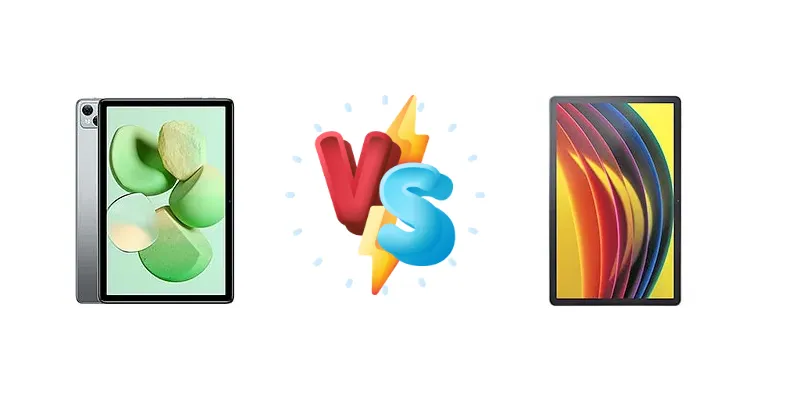
The budget tablet market is fiercely competitive, and the Doogee T10 and Lenovo Tab P11 Plus represent compelling options for users seeking affordability without sacrificing essential features. This comparison dives deep into their core specifications, focusing on the crucial differences in processing power and charging capabilities to determine which tablet delivers the best value.
🏆 Quick Verdict
For most users, the Lenovo Tab P11 Plus emerges as the stronger choice. Its Helio G90T chipset, featuring Cortex-A76 cores, provides a noticeable performance advantage over the Doogee T10’s Unisoc T606, making it better suited for gaming and demanding applications. While the T10 is cheaper, the P11 Plus’s extra performance justifies the price difference.
| Network |
|---|
| 2G bands | GSM 850 / 900 / 1800 / 1900 | GSM 850 / 900 / 1800 / 1900 |
| 3G bands | HSDPA 850 / 900 / 1900 / 2100 | HSDPA 850 / 900 / 1900 / 2100 |
| 4G bands | 1, 3, 5, 7, 20, 34, 38, 39, 40, 41 | 1, 2, 3, 4, 5, 7, 8, 20, 28, 38, 40, 41 |
| Speed | HSPA, LTE | HSPA, LTE - cellular model only |
| Technology | GSM / HSPA / LTE | GSM / HSPA / LTE |
| Launch |
|---|
| Announced | 2022, November 01 | 2021, June 28 |
| Status | Available. Released 2022, November 01 | Available. Released 2021, July 29 |
| Body |
|---|
| Build | Glass front, aluminum frame, aluminum back | - |
| Dimensions | 242.3 x 161.1 x 7.5 mm (9.54 x 6.34 x 0.30 in) | 258.4 x 163 x 7.5 mm (10.17 x 6.42 x 0.30 in) |
| SIM | Nano-SIM + Nano-SIM | Nano-SIM (cellular model only) |
| Weight | - | 490 g (1.08 lb) |
| | - | Stylus support |
| Display |
|---|
| Resolution | 1200 x 1920 pixels, 16:10 ratio (~224 ppi density) | 1200 x 2000 pixels, 5:3 ratio (~212 ppi density) |
| Size | 10.1 inches, 295.8 cm2 (~75.8% screen-to-body ratio) | 11.0 inches, 344.4 cm2 (~81.8% screen-to-body ratio) |
| Type | IPS LCD, 300 nits (typ) | IPS LCD, 400 nits (typ) |
| Platform |
|---|
| CPU | Octa-core (2x1.6 GHz Cortex-A75 & 6x1.6 GHz Cortex-A55) | Octa-core (2x2.05 GHz Cortex-A76 & 6x2.0 GHz Cortex-A55) |
| Chipset | Unisoc T606 (12 nm) | Mediatek MT6785 Helio G90T (12 nm) |
| GPU | Mali-G57 MP1 | Mali-G76 MC4 |
| OS | Android 12 | Android 11 |
| Memory |
|---|
| Card slot | microSDXC (uses shared SIM slot) | microSDXC (dedicated slot) |
| Internal | 128GB 8GB RAM | 64GB 4GB RAM, 128GB 4GB RAM, 128GB 6GB RAM |
| Main Camera |
|---|
| Dual | 13 MP
secondary unspecified camera | - |
| Features | LED flash, HDR, panorama | LED flash |
| Single | - | 13 MP, (wide), AF |
| Video | 1440p@30fps, 1080p@30fps | 1080p@30fps |
| Selfie camera |
|---|
| Single | 8 MP | 8 MP, (wide) |
| Video | 1080p@30fps | 1080p@30fps |
| Sound |
|---|
| 3.5mm jack | - | No |
| 35mm jack | Yes | No |
| Loudspeaker | Yes, with stereo speakers | Yes, with stereo speakers (4 speakers) |
| Comms |
|---|
| Bluetooth | 5.0, A2DP, LE | 5.1, A2DP, LE |
| NFC | No | No |
| Positioning | GPS, GLONASS, GALILEO, BDS | GPS, GLONASS, BDS - cellular model only |
| Radio | FM radio | FM radio |
| USB | USB Type-C 2.0, OTG | USB Type-C 2.0 |
| WLAN | Wi-Fi 802.11 a/b/g/n/ac, dual-band | Wi-Fi 802.11 a/b/g/n/ac, dual-band, Wi-Fi Direct |
| Features |
|---|
| Sensors | Gyro | Accelerometer, gyro, proximity |
| Battery |
|---|
| Charging | 18W wired | 20W wired |
| Type | 8300 mAh | Li-Po 7700 mAh |
| Misc |
|---|
| Colors | Space Gray, Moonlight Silver, Neptune Blue | Slate Grey, Platinum Grey, Modernist teal |
| Models | - | ZA940124SE |
| Price | About 140 EUR | About 300 EUR |
Doogee T10
- Lower price point makes it highly accessible.
- Sufficient for basic tasks like web browsing and video streaming.
- Unisoc T606 is relatively power efficient.
- Unisoc T606 chipset struggles with demanding applications.
- Slower charging speed (18W) compared to the competition.
- Likely limited multitasking capabilities.
Lenovo Tab P11 Plus
- More powerful Helio G90T chipset delivers smoother performance.
- Faster 20W wired charging reduces downtime.
- Better suited for gaming and multitasking.
- Higher price compared to the Doogee T10.
- Helio G90T can generate more heat under sustained load.
- May not offer significantly better battery life despite faster charging.
Display Comparison
Neither Doogee nor Lenovo provide detailed display specs beyond resolution. However, the focus here is on performance, so display differences are less critical. Both utilize 12nm chipsets, suggesting similar power draw considerations for panel brightness. Expect typical IPS LCD characteristics in this price bracket – adequate viewing angles but potentially limited peak brightness for outdoor use. Bezels are likely comparable, reflecting the budget nature of both devices.
Camera Comparison
Given the price point, camera performance isn’t a primary differentiator. Both tablets likely feature modest camera setups focused on basic functionality. Detailed sensor information is unavailable, but it’s safe to assume both will struggle in low-light conditions. Focusing on the chipset difference, the G90T’s ISP (Image Signal Processor) is likely more capable, potentially leading to slightly better image processing, but the overall experience will be limited by the sensor quality.
Performance
The core difference lies in the chipsets. The Lenovo Tab P11 Plus’s MediaTek Helio G90T utilizes two Cortex-A76 cores clocked at 2.05 GHz, alongside six Cortex-A55 cores at 2.0 GHz. This architecture is significantly more powerful than the Doogee T10’s Unisoc T606, which features two Cortex-A75 cores at 1.6 GHz and six Cortex-A55 cores also at 1.6 GHz. The A76 cores in the G90T offer a substantial IPC (Instructions Per Clock) improvement over the A75, translating to faster app loading times and smoother multitasking. While both are 12nm chips, the architectural advantage of the G90T is clear. The P11 Plus will handle graphically intensive games and demanding applications with considerably less strain.
Battery Life
Battery capacity isn’t specified, but the charging speeds offer a point of comparison. The Lenovo Tab P11 Plus supports 20W wired charging, while the Doogee T10 is limited to 18W. This means the P11 Plus will charge slightly faster, reducing downtime. However, real-world battery life will depend heavily on usage patterns and the actual battery capacity of each device, which remains unknown. The faster charging of the P11 Plus is a convenience factor, especially for users who rely on their tablet throughout the day.
Buying Guide
Buy the Doogee T10 if you prioritize extreme affordability and primarily need a tablet for basic tasks like web browsing, video playback, and light productivity. It’s ideal for users on a very tight budget or as a secondary device. Buy the Lenovo Tab P11 Plus if you value smoother multitasking, occasional gaming, and a more responsive user experience. It’s a better fit for students, media consumers, and anyone who wants a tablet that can handle a wider range of tasks without significant lag.
Frequently Asked Questions
❓ Will the Helio G90T in the Lenovo Tab P11 Plus overheat during extended gaming sessions?
The Helio G90T is known to generate more heat than some other mid-range chipsets. While the Tab P11 Plus likely has thermal management solutions in place, prolonged gaming at maximum settings could lead to some throttling to prevent overheating. Expect performance to remain acceptable, but not consistently at peak levels.
❓ Is the performance difference between the Unisoc T606 and Helio G90T noticeable in everyday tasks like browsing and video playback?
For basic tasks like web browsing, email, and video playback, the difference may not be immediately apparent. However, when switching between apps, opening heavier websites, or running multiple applications simultaneously, the Helio G90T’s superior processing power will provide a noticeably smoother and more responsive experience.
❓ Does the Lenovo Tab P11 Plus support any form of stylus input or keyboard attachment?
While not explicitly stated in the provided specs, Lenovo often offers optional accessories like styluses and keyboards for their tablets. Checking Lenovo’s official website or retailer listings will confirm compatibility and availability for the Tab P11 Plus.