
Doogee S98 vs. Ulefone Armor 12 5G: A Deep Dive into Rugged Smartphone Performance
| Phones Images | |||||
|---|---|---|---|---|---|
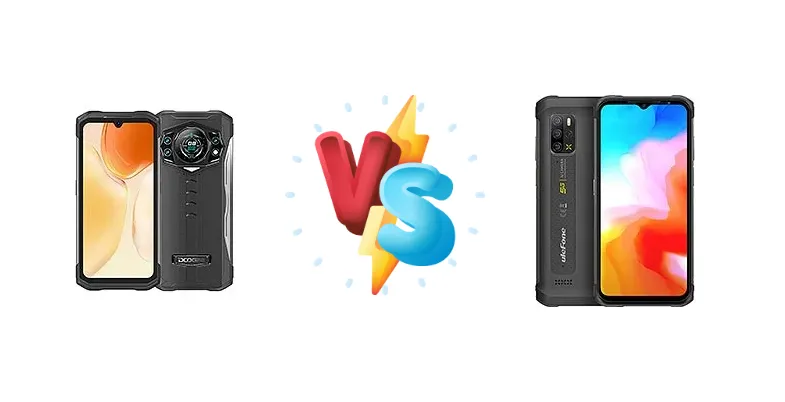
|
🏆 Quick Verdict
For the average user prioritizing sustained performance and future-proofing, the Ulefone Armor 12 5G emerges as the better choice. Its Dimensity 700, built on a more efficient 7nm process, offers a slight CPU performance edge and better thermal management compared to the Doogee S98’s Helio G96.
| PHONES | ||
|---|---|---|
| Phone Names | Doogee S98 | Ulefone Armor 12 5G |
| Network | ||
|---|---|---|
| 2G bands | GSM 850 / 900 / 1800 / 1900 | GSM 850 / 900 / 1800 / 1900 |
| 3G bands | HSDPA 800 / 850 / 900 / 1700(AWS) / 1900 / 2100 | HSDPA 850 / 900 / 1700(AWS) / 1900 / 2100 |
| 4G bands | 1, 2, 3, 4, 5, 7, 8, 12, 13, 17, 18, 19, 20, 25, 26, 28, 34, 38, 39, 40, 41, 66 | 1, 2, 3, 4, 5, 7, 8, 12, 13, 17, 18, 19, 20, 25, 26, 28, 34, 38, 39, 40, 41, 66 |
| 5G bands | - | 1, 3, 28, 38, 41, 77, 78 SA/NSA |
| Speed | HSPA, LTE | HSPA, LTE, 5G |
| Technology | GSM / CDMA / HSPA / LTE | GSM / CDMA / HSPA / EVDO / LTE / 5G |
| - | CDMA2000 1xEV-DO | |
| Launch | ||
|---|---|---|
| Announced | 2022, March 18 | 2021, August 14 |
| Status | Available. Released 2022, March 28 | Available. Released 2021, August 23 |
| Body | ||
|---|---|---|
| Build | - | Front glass, aluminum back with rubber, aluminum frame |
| Dimensions | 172 x 82 x 15.5 mm (6.77 x 3.23 x 0.61 in) | 175.9 x 82.5 x 14.3 mm (6.93 x 3.25 x 0.56 in) |
| SIM | Nano-SIM + Nano-SIM | Nano-SIM + Nano-SIM |
| Weight | 320 g (11.29 oz) | 296 g (10.44 oz) |
| - | IP68 dust/water resistant (up to 1.5m for 30 min) Drop-to-concrete resistance from up to 1.2m MIL-STD-810G compliant | |
| Display | ||
|---|---|---|
| Protection | Corning Gorilla Glass | - |
| Resolution | 1080 x 2340 pixels, 19.5:9 ratio (~409 ppi density) | 720 x 1560 pixels, 19.5:9 ratio (~264 ppi density) |
| Size | 6.3 inches, 97.4 cm2 (~69.1% screen-to-body ratio) | 6.52 inches, 104.4 cm2 (~71.9% screen-to-body ratio) |
| Type | IPS LCD, 500 nits (peak) | IPS LCD |
| Platform | ||
|---|---|---|
| CPU | Octa-core (2x2.05 GHz Cortex-A76 & 6x2.0 GHz Cortex-A55) | Octa-core (2x2.2 GHz Cortex-A76 & 6x2.0 GHz Cortex-A55) |
| Chipset | Mediatek MT6781 Helio G96 (12 nm) | Mediatek Dimensity 700 (7 nm) |
| GPU | Mali-G57 MC2 | Mali-G57 MC2 |
| OS | Android 12 | Android 11 |
| Memory | ||
|---|---|---|
| Card slot | microSDXC (dedicated slot) | microSDXC |
| Internal | 256GB 8GB RAM | 128GB 8GB RAM |
| Main Camera | ||
|---|---|---|
| Features | Dual-LED flash, HDR, panorama | Dual-LED flash, HDR, panorama |
| Quad | - | 48 MP, f/1.8, 26mm (wide), 1/2.0", 0.8µm, PDAF 8 MP, f/2.2, (ultrawide) 2 MP (macro) Auxiliary lens |
| Single | - | 16 MP, f/2.2 |
| Triple | 64 MP, f/1.8, (wide), PDAF 8 MP, f/2.2, 130˚ (ultrawide) 20 MP, f/1.8, (night vision), 2 infrared night vision lights | - |
| Video | 1440p, 1080p | 1440p@30fps |
| Selfie camera | ||
|---|---|---|
| Features | - | HDR, panorama |
| Single | 16 MP, f/2.0, (wide) | 16 MP, f/2.2 |
| Video | 1080p | 1080p@30fps |
| Sound | ||
|---|---|---|
| 3.5mm jack | - | No |
| 35mm jack | Unspecified | No |
| Loudspeaker | Yes | Yes, with dual speakers |
| Comms | ||
|---|---|---|
| Bluetooth | 5.1, A2DP, LE | 5.1, A2DP, LE |
| NFC | Yes | Yes |
| Positioning | GPS, GLONASS, BDS, GALILEO | GPS, GLONASS, GALILEO, BDS |
| Radio | FM radio | Wireless FM radio, RDS |
| USB | USB Type-C 2.0, OTG | USB Type-C 2.0, OTG |
| WLAN | Wi-Fi 802.11 a/b/g/n/ac, dual-band | Wi-Fi 802.11 a/b/g/n/ac, Wi-Fi Direct |
| Features | ||
|---|---|---|
| Sensors | Fingerprint (side-mounted), accelerometer, gyro, proximity, compass | Fingerprint (side-mounted), accelerometer, gyro, proximity, compass, coulombmeter |
| Battery | ||
|---|---|---|
| Charging | 33W wired 15W wireless | 18W wired 15W wireless |
| Type | 6000 mAh | Li-Po 5180 mAh |
| Misc | ||
|---|---|---|
| Colors | Black, Orange, Red | Black/Orange, Gray/Black |
| Price | About 350 EUR | About 370 EUR |
Doogee S98
- Faster 33W wired charging for quick power-ups.
- Potentially lower cost (depending on market pricing).
- Helio G96 offers adequate performance for everyday tasks.
- Less efficient 12nm chipset may lead to more heat and throttling.
- Diminished long-term performance potential compared to 7nm counterpart.
Ulefone Armor 12 5G
- More efficient 7nm Dimensity 700 chipset for better performance and battery life.
- Integrated 5G modem for faster connectivity.
- Potentially better thermal management for sustained performance.
- Slower 18W wired charging.
- May be slightly more expensive than the Doogee S98.
Display Comparison
Neither device's display specifications are provided, so a direct comparison is limited. However, given the rugged nature of both phones, we can assume both utilize durable, likely IPS LCD panels. The absence of details like refresh rate or resolution suggests a focus on practicality over premium visual experience. Bezels are likely to be substantial on both to enhance drop protection.
Camera Comparison
Without detailed camera specifications beyond the chipsets, a precise comparison is difficult. However, rugged phones often prioritize durability over cutting-edge camera technology. We can assume both phones will feature a multi-camera setup, but image quality will likely be determined more by software processing and sensor size (which is unknown) than by the chipset alone. The inclusion of a 2MP macro lens on either device is likely a marketing feature with limited real-world utility.
Performance
The core difference lies in the chipsets. The Ulefone Armor 12 5G’s Mediatek Dimensity 700, fabricated on a 7nm process, offers a more efficient architecture than the Doogee S98’s Mediatek Helio G96 (12nm). While both CPUs feature the same Cortex-A76 (2x2.05/2.2 GHz) and Cortex-A55 (6x2.0 GHz) core configuration, the 7nm process allows the Dimensity 700 to deliver comparable performance with lower power consumption and reduced thermal throttling. This translates to potentially longer sustained performance during demanding tasks like gaming or prolonged video recording. The Dimensity 700 also integrates a more advanced 5G modem.
Battery Life
Both devices offer 15W wireless charging, a convenient feature for rugged users. The Doogee S98 boasts 33W wired charging, significantly faster than the Ulefone Armor 12 5G’s 18W. This faster charging is a clear advantage for users who need to quickly replenish the battery in the field. While battery capacity isn't specified, the more efficient Dimensity 700 in the Ulefone Armor 12 5G may offset the charging speed difference with longer overall battery life.
Buying Guide
Buy the Doogee S98 if you prioritize faster wired charging (33W vs 18W) and are frequently using the device in situations where quick top-ups are essential. Buy the Ulefone Armor 12 5G if you value a more modern and efficient chipset, potentially leading to better long-term performance and slightly improved power efficiency for extended use in the field.