
Doogee S89 vs Blackview BV9200: A Head-to-Head Rugged Smartphone Showdown
| Phones Images | |||||
|---|---|---|---|---|---|
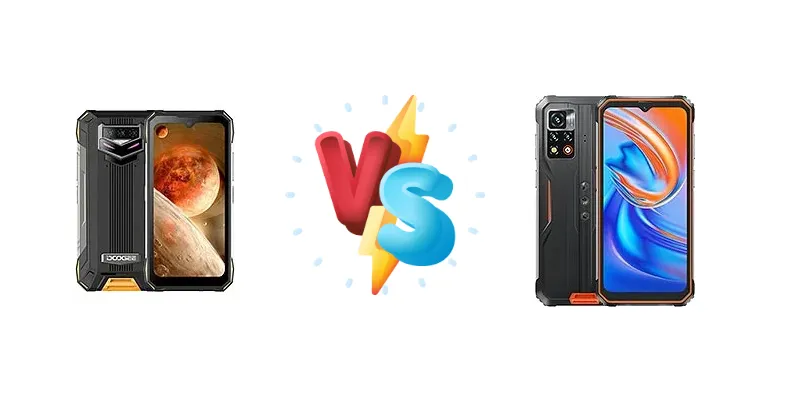
|
🏆 Quick Verdict
For most users prioritizing performance and faster charging, the Blackview BV9200 is the better choice. Its Helio G96 chipset offers a slight edge in CPU and GPU performance, coupled with significantly faster 66W charging. However, the Doogee S89 remains a viable option for those seeking a more established brand in the rugged space.
| PHONES | ||
|---|---|---|
| Phone Names | Doogee S89 | Blackview BV9200 |
| Network | ||
|---|---|---|
| 2G bands | GSM 850 / 900 / 1800 / 1900 | GSM 850 / 900 / 1800 / 1900 |
| 3G bands | HSDPA 800 / 850 / 900 / 1700(AWS) / 1900 / 2100 | HSDPA 850 / 900 / 1700(AWS) / 1900 / 2100 |
| 4G bands | 1, 2, 3, 4, 5, 7, 8, 12, 13, 17, 18, 19, 20, 25, 26, 28, 34, 38, 39, 40, 41, 66 | 1, 2, 3, 4, 5, 7, 8, 12, 13, 17, 18, 19, 20, 25, 26, 28, 34, 38, 39, 40, 41, 66 |
| Speed | HSPA, LTE | HSPA, LTE |
| Technology | GSM / CDMA / HSPA / LTE | GSM / CDMA / HSPA / LTE |
| - | CDMA 800 / 1900 | |
| Launch | ||
|---|---|---|
| Announced | 2022, August 22 | 2022, December 28 |
| Status | Available. Released 2022, August 28 | Available. Released 2023, January 09 |
| Body | ||
|---|---|---|
| Dimensions | 172 x 86 x 19.4 mm (6.77 x 3.39 x 0.76 in) | 174.5 x 81.8 x 13.6 mm (6.87 x 3.22 x 0.54 in) |
| SIM | Nano-SIM + Nano-SIM | Nano-SIM + Nano-SIM |
| Weight | 400 g (14.11 oz) | 310 g (10.93 oz) |
| - | IP68/IP69K dust/water resistant (up to 1.5m for 30 min) Drop-to-concrete resistance from up to 1.8m MIL-STD-810H compliant | |
| Display | ||
|---|---|---|
| Protection | Corning Gorilla Glass | Corning Gorilla Glass 5 |
| Resolution | 1080 x 2340 pixels, 19.5:9 ratio (~409 ppi density) | 1080 x 2408 pixels, 20:9 ratio (~400 ppi density) |
| Size | 6.3 inches, 97.4 cm2 (~65.9% screen-to-body ratio) | 6.6 inches, 104.9 cm2 (~73.5% screen-to-body ratio) |
| Type | IPS LCD | IPS LCD, 120Hz |
| Platform | ||
|---|---|---|
| CPU | Octa-core (2x2.1 GHz Cortex-A75 & 6x2.0 GHz Cortex-A55) | Octa-core (2x2.05 GHz Cortex-A76 & 6x2.0 GHz Cortex-A55) |
| Chipset | Mediatek MT6779 Helio P90 (12 nm) | Mediatek MT6781 Helio G96 (12 nm) |
| GPU | PowerVR GM9446 | Mali-G52 MC2 |
| OS | Android 12 | Android 12, Doke-OS 3.1 |
| Memory | ||
|---|---|---|
| Card slot | microSDXC (dedicated slot) | microSDXC (dedicated slot) |
| Internal | 128GB 8GB RAM | 256GB 8GB RAM |
| - | UFS 2.1 | |
| Main Camera | ||
|---|---|---|
| Features | Dual-LED flash, HDR, panorama | LED flash, HDR, panorama |
| Single | - | 16 MP, (wide), 1/3", 1.0µm |
| Triple | 48 MP, f/1.8, (wide), PDAF 8 MP, f/2.2, 130˚, (ultrawide) 20 MP, f/1.8, (night vision), 4 infrared night vision lights | 50 MP, f/1.8, (wide), 1/2.76", 0.64µm, PDAF 8 MP, f/1.8, 120˚, (ultrawide), AF Auxiliary lens |
| Video | 1440p, 1080p | 1440p@30fps, 1080p@30fps |
| Selfie camera | ||
|---|---|---|
| Single | 16 MP, f/2.0, (wide) | 16 MP, f/2.0, (wide), 1/3", 1.0µm |
| Video | 1080p | 1080p |
| Sound | ||
|---|---|---|
| 3.5mm jack | - | No |
| 35mm jack | Yes | No |
| Loudspeaker | Yes | Yes, with dual speakers |
| Comms | ||
|---|---|---|
| Bluetooth | 5.1, A2DP, LE | 5.2, A2DP, LE |
| NFC | Yes | Yes |
| Positioning | GPS, GLONASS, BDS, GALILEO | GPS, GLONASS, GALILEO, BDS |
| Radio | FM radio | FM radio |
| USB | USB Type-C 2.0, OTG | USB Type-C, OTG |
| WLAN | Wi-Fi 802.11 a/b/g/n/ac, dual-band | Wi-Fi 802.11 a/b/g/n/ac, dual-band |
| Features | ||
|---|---|---|
| Sensors | Fingerprint (side-mounted), accelerometer, gyro, proximity, compass | Fingerprint (side-mounted), accelerometer, gyro, proximity, compass, barometer |
| Battery | ||
|---|---|---|
| Charging | 33W wired 15W wireless | 66W wired 30W wireless |
| Type | 12000 mAh | 5000 mAh |
| Misc | ||
|---|---|---|
| Colors | Black, Orange | Black, Orange, Green |
| Price | About 280 EUR | About 200 EUR |
Doogee S89
- Established rugged phone brand
- Wireless charging support
- Potentially more affordable (depending on sales)
- Older Helio P90 chipset
- Slower charging speeds (wired and wireless)
Blackview BV9200
- Faster Helio G96 chipset
- Significantly faster 66W wired charging
- Brighter display for outdoor visibility
- Less established brand in rugged phone market
- Potentially higher price point
Display Comparison
The Blackview BV9200 boasts a measurable 481 nits of peak brightness, a significant advantage over the Doogee S89 (brightness data unavailable). This higher brightness translates to better visibility in direct sunlight, crucial for outdoor use. While both likely utilize IPS LCD panels common in this segment, the BV9200’s 1423:1 contrast ratio suggests deeper blacks and a more vibrant image. The S89’s display specs are less defined, making it difficult to assess its color accuracy or viewing angles relative to the BV9200.
Camera Comparison
Without detailed camera specifications for either device beyond the chipsets, a direct comparison is limited. However, the chipset plays a role in image signal processing (ISP) capabilities. The Helio G96 in the BV9200 generally offers improved ISP performance compared to the P90 in the S89, potentially resulting in better dynamic range and noise reduction. It’s reasonable to assume both phones will feature a primary camera, ultrawide, and potentially depth/macro sensors, but the quality will heavily depend on the sensor size and lens aperture – data currently unavailable. The ISP improvements in the G96 will be more noticeable in low-light conditions.
Performance
The Blackview BV9200’s Mediatek Helio G96 chipset represents a generational upgrade over the Doogee S89’s Helio P90. The G96 utilizes two Cortex-A76 cores clocked at 2.05 GHz, offering a performance improvement over the P90’s Cortex-A75 cores at 2.1 GHz. While the clock speed difference isn’t massive, the architectural improvements in the A76 cores provide better instructions-per-clock (IPC). Both chips feature the same six Cortex-A55 efficiency cores clocked at 2.0 GHz. This means the BV9200 will likely handle multitasking and demanding applications more smoothly. Neither device is a gaming powerhouse, but the BV9200’s GPU will provide a more playable experience in graphically intensive titles.
Battery Life
Both phones offer wireless charging, but the Blackview BV9200’s 30W wireless charging significantly outpaces the Doogee S89’s 15W. More importantly, the BV9200’s 66W wired charging is a game-changer, drastically reducing charging times compared to the S89’s 33W. While battery capacity isn’t specified for either device, the faster charging of the BV9200 mitigates the impact of a potentially smaller battery, allowing for quicker top-ups throughout the day. For users who frequently rely on their phone in remote locations, the BV9200’s charging speed is a major advantage.
Buying Guide
Buy the Doogee S89 if you prioritize a brand with a longer track record in rugged phone manufacturing and value wireless charging convenience. Buy the Blackview BV9200 if you need a performance boost for gaming or demanding applications and want the fastest possible wired charging speeds, making it ideal for users who frequently work in remote locations with limited power access.