
Doogee S86 vs. Ulefone Armor 9E: A Deep Dive into Rugged Smartphone Performance
| Phones Images | |||||
|---|---|---|---|---|---|
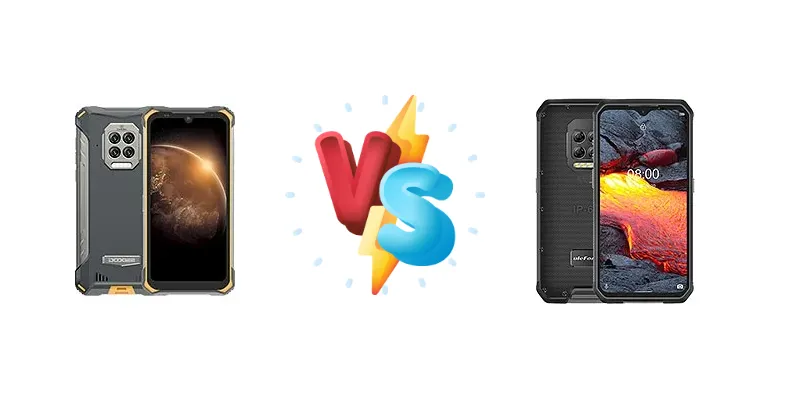
|
🏆 Quick Verdict
For the average user prioritizing responsiveness and future-proofing, the Ulefone Armor 9E is the better choice. Its Helio P90 chipset offers a noticeable performance uplift over the Doogee S86’s Helio P60, translating to smoother multitasking and better gaming capabilities. While the S86 remains a viable option, the 9E provides more value for its price.
| PHONES | ||
|---|---|---|
| Phone Names | Doogee S86 | Ulefone Armor 9E |
| Network | ||
|---|---|---|
| 2G bands | GSM 850 / 900 / 1800 / 1900 | GSM 850 / 900 / 1800 / 1900 |
| 3G bands | HSDPA 850 / 900 / 1700(AWS) / 1900 / 2100 | HSDPA 850 / 900 / 1700(AWS) / 1900 / 2100 |
| 4G bands | 1, 2, 3, 4, 5, 7, 8, 12, 13, 17, 19, 20, 25, 26, 28, 66 | 1, 2, 3, 4, 5, 7, 8, 12, 13, 17, 18, 19, 20, 25, 26, 28, 34, 38, 39, 40, 41, 66 |
| Speed | HSPA, LTE | HSPA 42.2/11.5 Mbps, LTE Cat12 600/150 Mbps |
| Technology | GSM / HSPA / LTE | GSM / CDMA / HSPA / EVDO / LTE |
| - | CDMA2000 1xEV-DO | |
| Launch | ||
|---|---|---|
| Announced | 2021, February 26 | 2020, September 08. Released 2020, September 08 |
| Status | Available. Released 2021, March | Discontinued |
| Body | ||
|---|---|---|
| Build | - | Front glass, aluminum back with rubber, aluminum frame |
| Dimensions | 164.6 x 81.2 x 16.8 mm (6.48 x 3.20 x 0.66 in) | 168.2 x 82 x 15 mm (6.62 x 3.23 x 0.59 in) |
| SIM | Nano-SIM + Nano-SIM | Nano-SIM + Nano-SIM |
| Weight | 323 g (11.39 oz) | 324 g (11.43 oz) |
| - | IP68/IP69K dust/water resistant (up to 1.5m for 30 min) Drop-to-concrete resistance from up to 1.2m MIL-STD-810G compliant | |
| Display | ||
|---|---|---|
| Protection | Corning Gorilla Glass | Scratch-resistant glass, oleophobic coating |
| Resolution | 720 x 1560 pixels, 19.5:9 ratio (~282 ppi density) | 1080 x 2340 pixels, 19.5:9 ratio (~409 ppi density) |
| Size | 6.1 inches, 91.3 cm2 (~68.3% screen-to-body ratio) | 6.3 inches, 97.4 cm2 (~70.6% screen-to-body ratio) |
| Type | IPS LCD | IPS LCD |
| Platform | ||
|---|---|---|
| CPU | Octa-core (4x2.0 GHz Cortex-A73 & 4x2.0 GHz Cortex-A53) | Octa-core (2x2.2 GHz Cortex-A75 & 6x2.0 GHz Cortex-A55) |
| Chipset | Mediatek MT6771 Helio P60 (12 nm) | Mediatek MT6779 Helio P90 (12 nm) |
| GPU | Mali-G72 MP3 | PowerVR GM9446 |
| OS | Android 10 | Android 10 |
| Memory | ||
|---|---|---|
| Card slot | microSDXC (uses shared SIM slot) | microSDXC (uses shared SIM slot) |
| Internal | 128GB 6GB RAM | 128GB 8GB RAM |
| - | UFS 2.1 | |
| Main Camera | ||
|---|---|---|
| Features | Quad-LED flash, HDR, panorama | Quad-LED flash, HDR, panorama |
| Quad | 16 MP, f/2.0, (wide), PDAF 8 MP, f/2.2, 130˚, (ultrawide) 2 MP (macro) Auxiliary lens | 64 MP, f/1.9, 26mm (wide), 1/1.72", 0.8µm, PDAF 8 MP, f/2.4, 100˚ (ultrawide), 1/4.0", 1.12µm 2 MP (macro) Auxiliary lens |
| Video | 1080p | 4K@30fps, 1080p@30fps |
| Selfie camera | ||
|---|---|---|
| Features | - | HDR, panorama |
| Single | 8 MP, f/2.2, (wide) | 8 MP, f/2.2 |
| Video | 1080p | 1080p@30fps |
| Sound | ||
|---|---|---|
| 3.5mm jack | - | Yes |
| 35mm jack | Yes | Yes |
| Loudspeaker | Yes | Yes |
| Comms | ||
|---|---|---|
| Bluetooth | 5.0, A2DP, LE | 5.0, A2DP, LE |
| NFC | Yes | Yes |
| Positioning | GPS, GLONASS, BDS | GPS, GLONASS, GALILEO, BDS |
| Radio | FM radio | FM radio, RDS, recording |
| USB | USB Type-C 2.0, OTG | USB Type-C 2.0, OTG, accessory connector |
| WLAN | Wi-Fi 802.11 a/b/g/n | Wi-Fi 802.11 a/b/g/n/ac, Wi-Fi Direct |
| Features | ||
|---|---|---|
| Sensors | Fingerprint (side-mounted), accelerometer, gyro, proximity, compass | Fingerprint (side-mounted), accelerometer, gyro, proximity, compass, coulombmeter |
| - | Endoscope mount (camera sold separately) | |
| Battery | ||
|---|---|---|
| Charging | 24W wired | 18W wired |
| Type | 8500 mAh | Li-Po 6600 mAh |
| Misc | ||
|---|---|---|
| Colors | Black, Orange, Red | Black |
| Price | About 210 EUR | About 290 EUR |
Doogee S86
- Faster wired charging (24W)
- More affordable price point
- Rugged design for demanding environments
- Less powerful Helio P60 chipset
- Potentially slower app loading times
- Limited future-proofing
Ulefone Armor 9E
- More powerful Helio P90 chipset
- Improved multitasking and gaming performance
- Better image processing capabilities
- Slower wired charging (18W)
- Slightly higher price
- May experience more heat under sustained load
Display Comparison
Neither Doogee nor Ulefone provide detailed display specifications beyond the basic resolution. However, the chipset difference suggests the Armor 9E is more capable of driving a higher refresh rate display, should one be implemented. The P90’s GPU is more powerful, meaning smoother animations and potentially better visual fidelity in games. Both likely utilize IPS LCD panels, common in this price bracket, and brightness levels are expected to be similar, prioritizing visibility in direct sunlight over color accuracy.
Camera Comparison
Without detailed sensor information, a direct camera comparison is difficult. However, the P90’s improved ISP (Image Signal Processor) in the Armor 9E will likely result in better image processing, particularly in low-light conditions. The P90 can handle more complex algorithms for noise reduction and dynamic range optimization. While both phones likely feature a standard array of cameras, the Armor 9E’s chipset provides the computational horsepower to extract more detail and clarity from the images. The presence of a more powerful GPU also aids in post-processing tasks.
Performance
The core difference lies in the chipsets. The Ulefone Armor 9E’s MediaTek Helio P90 utilizes a dual-core Cortex-A75 setup (2x2.2 GHz) paired with six Cortex-A55 cores (6x2.0 GHz), built on a 12nm process. This architecture is significantly more efficient and powerful than the Doogee S86’s Helio P60, which features four Cortex-A73 cores (4x2.0 GHz) and four Cortex-A53 cores (4x2.0 GHz), also on a 12nm process. The A75 cores in the P90 offer a substantial IPC (Instructions Per Clock) improvement over the A73 cores, resulting in faster application loading and smoother multitasking. This benefits users who frequently switch between apps or engage in moderate gaming.
Battery Life
Both phones offer adequate battery life for their target audience. The Doogee S86 supports 24W wired charging, while the Ulefone Armor 9E is limited to 18W. While the S86 charges slightly faster, the P90’s improved power efficiency in the Armor 9E means it may achieve comparable real-world battery endurance despite the slower charging speed. The P90’s ability to quickly process tasks and then return to a low-power state contributes to this efficiency. Users prioritizing minimal downtime might lean towards the S86, but the 9E’s efficiency is a strong counterpoint.
Buying Guide
Buy the Doogee S86 if you need a highly affordable, durable phone for basic tasks like calls, texts, and light app usage, and aren't concerned with demanding applications. Buy the Ulefone Armor 9E if you prefer a more responsive experience, plan to use your phone for gaming or resource-intensive apps, and want a device that will remain capable for a longer period.