
Doogee S86 vs Blackview BV9900E: A Deep Dive into Rugged Smartphone Performance
| Phones Images | |||||
|---|---|---|---|---|---|
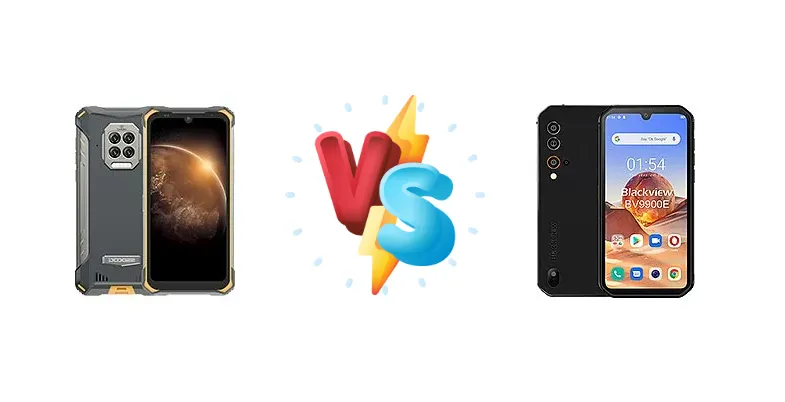
|
🏆 Quick Verdict
For the average user prioritizing raw performance and future-proofing, the Blackview BV9900E emerges as the winner. Its Helio P90 chipset offers a significant architectural advantage over the S86’s Helio P60, translating to smoother multitasking and gaming. However, the Doogee S86 remains a viable option for budget-conscious buyers.
| PHONES | ||
|---|---|---|
| Phone Names | Doogee S86 | Blackview BV9900E |
| Network | ||
|---|---|---|
| 2G bands | GSM 850 / 900 / 1800 / 1900 | GSM 850 / 900 / 1800 / 1900 |
| 3G bands | HSDPA 850 / 900 / 1700(AWS) / 1900 / 2100 | HSDPA 800 / 850 / 900 / 1700(AWS) / 1900 / 2100 |
| 4G bands | 1, 2, 3, 4, 5, 7, 8, 12, 13, 17, 19, 20, 25, 26, 28, 66 | 1, 2, 3, 4, 5, 7, 8, 12, 13, 17, 18, 19, 20, 25, 26, 28, 34, 38, 39, 40, 41, 66 |
| Speed | HSPA, LTE | HSPA, LTE |
| Technology | GSM / HSPA / LTE | GSM / CDMA / HSPA / CDMA2000 / LTE |
| Launch | ||
|---|---|---|
| Announced | 2021, February 26 | 2020, September 10. Released 2020, September |
| Status | Available. Released 2021, March | Discontinued |
| Body | ||
|---|---|---|
| Dimensions | 164.6 x 81.2 x 16.8 mm (6.48 x 3.20 x 0.66 in) | 156.5 x 78.3 x 14.2 mm (6.16 x 3.08 x 0.56 in) |
| SIM | Nano-SIM + Nano-SIM | Nano-SIM + Nano-SIM |
| Weight | 323 g (11.39 oz) | 273 g (9.63 oz) |
| Display | ||
|---|---|---|
| Protection | Corning Gorilla Glass | Corning Gorilla Glass 5 |
| Resolution | 720 x 1560 pixels, 19.5:9 ratio (~282 ppi density) | 1080 x 2280 pixels, 19:9 ratio (~432 ppi density) |
| Size | 6.1 inches, 91.3 cm2 (~68.3% screen-to-body ratio) | 5.84 inches, 85.1 cm2 (~69.5% screen-to-body ratio) |
| Type | IPS LCD | IPS LCD |
| Platform | ||
|---|---|---|
| CPU | Octa-core (4x2.0 GHz Cortex-A73 & 4x2.0 GHz Cortex-A53) | Octa-core (2x2.2 GHz Cortex-A75 & 6x2.0 GHz Cortex-A55) |
| Chipset | Mediatek MT6771 Helio P60 (12 nm) | Mediatek MT6779V/CE Helio P90 (12 nm) |
| GPU | Mali-G72 MP3 | PowerVR GM9446 |
| OS | Android 10 | Android 10 |
| Memory | ||
|---|---|---|
| Card slot | microSDXC (uses shared SIM slot) | microSDXC |
| Internal | 128GB 6GB RAM | 128GB 6GB RAM |
| Main Camera | ||
|---|---|---|
| Features | Quad-LED flash, HDR, panorama | LED flash, HDR, panorama |
| Quad | 16 MP, f/2.0, (wide), PDAF 8 MP, f/2.2, 130˚, (ultrawide) 2 MP (macro) Auxiliary lens | 48 MP, f/1.8, (wide), PDAF 16 MP, 120˚ (ultrawide) 2 MP (macro) Auxiliary lens |
| Video | 1080p | 4K@30fps, 1080p@60fps |
| Selfie camera | ||
|---|---|---|
| Single | 8 MP, f/2.2, (wide) | 16 MP, f/2.0, (wide) |
| Video | 1080p | 1080p@30fps |
| Sound | ||
|---|---|---|
| 35mm jack | Yes | No |
| Loudspeaker | Yes | Yes |
| Comms | ||
|---|---|---|
| Bluetooth | 5.0, A2DP, LE | 5.0, A2DP, LE |
| NFC | Yes | Yes |
| Positioning | GPS, GLONASS, BDS | GPS, GLONASS, GALILEO, BDS |
| Radio | FM radio | FM radio |
| USB | USB Type-C 2.0, OTG | USB Type-C 2.0, OTG |
| WLAN | Wi-Fi 802.11 a/b/g/n | Wi-Fi 802.11 a/b/g/n/ac |
| Features | ||
|---|---|---|
| Sensors | Fingerprint (side-mounted), accelerometer, gyro, proximity, compass | Fingerprint (side-mounted), accelerometer, gyro, proximity, compass, barometer |
| Battery | ||
|---|---|---|
| Charging | 24W wired | 15W wired 18W wireless |
| Type | 8500 mAh | 4380 mAh |
| Misc | ||
|---|---|---|
| Colors | Black, Orange, Red | Black, Silver |
| Price | About 210 EUR | About 260 EUR |
Doogee S86
- More affordable price point
- Reliable performance for basic tasks
- Rugged build quality
- Older Helio P60 chipset
- Lacks wireless charging
Blackview BV9900E
- More powerful Helio P90 chipset
- 18W wireless charging support
- Potentially better camera performance
- Higher price tag
- May experience more heat under sustained load
Display Comparison
Neither device’s display specifications are provided, so a direct comparison is limited. However, given the market segment, both likely utilize IPS LCD panels. The Blackview BV9900E, being the higher-tier device, may benefit from a slightly higher resolution or improved color calibration. Rugged phones often prioritize durability over display quality, so expect practical, rather than stunning, visuals on both.
Camera Comparison
Without detailed camera specifications, a precise comparison is difficult. However, the market positioning suggests the Blackview BV9900E likely features a more capable camera system. While both will likely include multiple lenses, the P90’s image signal processor (ISP) is more advanced, potentially leading to better image quality, especially in low-light conditions. The presence of OIS (Optical Image Stabilization) on the BV9900E would further enhance its photographic capabilities, a feature not guaranteed on the S86.
Performance
The core difference lies in the chipsets. The Blackview BV9900E’s Helio P90 (12nm) represents a substantial upgrade over the Doogee S86’s Helio P60 (12nm). The P90 utilizes a more modern CPU architecture – 2x2.2 GHz Cortex-A75 cores alongside 6x2.0 GHz Cortex-A55 cores – compared to the P60’s 4x2.0 GHz Cortex-A73 and 4x2.0 GHz Cortex-A53 configuration. The Cortex-A75 cores in the P90 offer significantly improved single-core performance, crucial for responsive app launches and smoother UI navigation. This translates to a noticeable advantage for the BV9900E in demanding tasks and multitasking scenarios. While both are 12nm chips, the architectural improvements of the P90 outweigh the process node similarity.
Battery Life
The Blackview BV9900E offers a unique advantage with its 18W wireless charging capability, a feature absent on the Doogee S86, which is limited to 24W wired charging. While 24W wired charging is faster than 18W, the convenience of wireless charging is a significant benefit for many users. Battery capacity isn’t specified for either device, but the P90’s improved efficiency could offset a potentially smaller battery in the BV9900E, resulting in comparable real-world battery life. The wireless charging option gives the BV9900E a versatility edge.
Buying Guide
Buy the Doogee S86 if you need a highly affordable, dependable rugged phone for basic tasks like communication, navigation, and light media consumption. It’s ideal for users who prioritize cost-effectiveness over peak performance. Buy the Blackview BV9900E if you prefer a more powerful device capable of handling demanding applications, gaming, and extended use without significant slowdown. It’s geared towards users who need a rugged phone that can also function as a daily driver.