
Doogee S86 vs Blackview BV8800: A Deep Dive into Rugged Smartphone Performance
| Phones Images | |||||
|---|---|---|---|---|---|
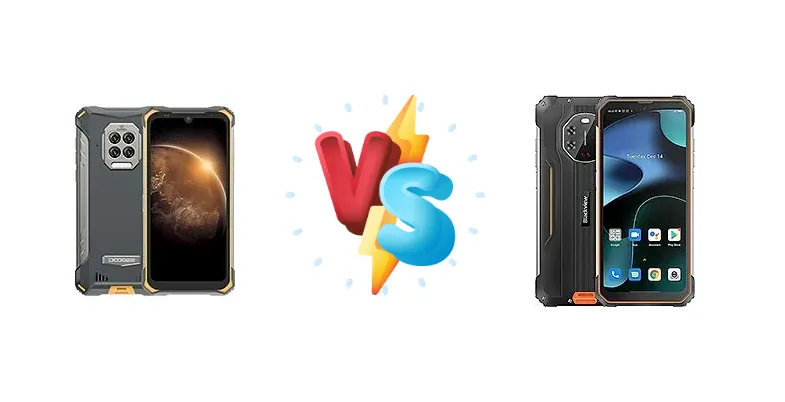
|
🏆 Quick Verdict
For most users prioritizing performance and faster charging, the Blackview BV8800 is the superior choice. Its Helio G96 chipset offers a noticeable performance uplift over the S86’s Helio P60, and the 33W charging significantly reduces downtime. However, the S86 remains a viable option for budget-conscious buyers.
| PHONES | ||
|---|---|---|
| Phone Names | Doogee S86 | Blackview BV8800 |
| Network | ||
|---|---|---|
| 2G bands | GSM 850 / 900 / 1800 / 1900 | GSM 850 / 900 / 1800 / 1900 |
| 3G bands | HSDPA 850 / 900 / 1700(AWS) / 1900 / 2100 | HSDPA 800 / 850 / 900 / 1700(AWS) / 1900 / 2100 |
| 4G bands | 1, 2, 3, 4, 5, 7, 8, 12, 13, 17, 19, 20, 25, 26, 28, 66 | 1, 2, 3, 4, 5, 7, 8, 12, 13, 17, 18, 19, 20, 25, 26, 28, 30, 34, 38, 39, 40, 41, 66 |
| Speed | HSPA, LTE | HSPA, LTE |
| Technology | GSM / HSPA / LTE | GSM / CDMA / HSPA / CDMA2000 / LTE |
| - | CDMA2000 1x | |
| Launch | ||
|---|---|---|
| Announced | 2021, February 26 | 2021, December 24 |
| Status | Available. Released 2021, March | Available. Released 2022, January 10 |
| Body | ||
|---|---|---|
| Dimensions | 164.6 x 81.2 x 16.8 mm (6.48 x 3.20 x 0.66 in) | 176.2 x 83.5 x 17.7 mm (6.94 x 3.29 x 0.70 in) |
| SIM | Nano-SIM + Nano-SIM | Nano-SIM + Nano-SIM |
| Weight | 323 g (11.39 oz) | 367 g (12.95 oz) |
| - | IP68/IP69K dust/water resistant (up to 1.5m for 30 min) Drop-to-concrete resistance from up to 1.5m MIL-STD-810H compliant | |
| Display | ||
|---|---|---|
| Protection | Corning Gorilla Glass | - |
| Resolution | 720 x 1560 pixels, 19.5:9 ratio (~282 ppi density) | 1080 x 2408 pixels, 20:9 ratio (~401 ppi density) |
| Size | 6.1 inches, 91.3 cm2 (~68.3% screen-to-body ratio) | 6.58 inches, 104.3 cm2 (~70.9% screen-to-body ratio) |
| Type | IPS LCD | IPS LCD, 90Hz, 480 nits |
| Platform | ||
|---|---|---|
| CPU | Octa-core (4x2.0 GHz Cortex-A73 & 4x2.0 GHz Cortex-A53) | Octa-core (2x2.05 GHz Cortex-A76 & 6x2.0 GHz Cortex-A55) |
| Chipset | Mediatek MT6771 Helio P60 (12 nm) | Mediatek MT6781 Helio G96 (12 nm) |
| GPU | Mali-G72 MP3 | Mali-G57 MC2 |
| OS | Android 10 | Android 11, Doke-OS 3.0 |
| Memory | ||
|---|---|---|
| Card slot | microSDXC (uses shared SIM slot) | No |
| Internal | 128GB 6GB RAM | 128GB 8GB RAM |
| - | UFS 2.1 | |
| Main Camera | ||
|---|---|---|
| Features | Quad-LED flash, HDR, panorama | Dual-LED flash, HDR, panorama |
| Quad | 16 MP, f/2.0, (wide), PDAF 8 MP, f/2.2, 130˚, (ultrawide) 2 MP (macro) Auxiliary lens | 50 MP, f/1.8, (wide), PDAF 8 MP, f/2.2, 117˚ (ultrawide) 20 MP, f/1.8, (IR camera), 2 IR emitters Auxiliary lens |
| Single | - | 16 MP, f/2.0, (wide) |
| Video | 1080p | 1440p@30fps |
| Selfie camera | ||
|---|---|---|
| Single | 8 MP, f/2.2, (wide) | 16 MP, f/2.0, (wide) |
| Video | 1080p | 1080p@30fps |
| Sound | ||
|---|---|---|
| 3.5mm jack | - | No |
| 35mm jack | Yes | No |
| Loudspeaker | Yes | Yes |
| Comms | ||
|---|---|---|
| Bluetooth | 5.0, A2DP, LE | 5.2, A2DP, LE |
| NFC | Yes | Yes |
| Positioning | GPS, GLONASS, BDS | GPS, GLONASS, GALILEO, BDS |
| Radio | FM radio | FM radio |
| USB | USB Type-C 2.0, OTG | USB Type-C 2.0, OTG |
| WLAN | Wi-Fi 802.11 a/b/g/n | Wi-Fi 802.11 a/b/g/n/ac |
| Features | ||
|---|---|---|
| Sensors | Fingerprint (side-mounted), accelerometer, gyro, proximity, compass | Fingerprint (side-mounted), accelerometer, gyro, proximity, compass, barometer |
| Battery | ||
|---|---|---|
| Charging | 24W wired | 33W wired, 31% in 30 min, 100% in 90 min Reverse wired |
| Type | 8500 mAh | 8380 mAh |
| Misc | ||
|---|---|---|
| Colors | Black, Orange, Red | Black, Orange, Green |
| Price | About 210 EUR | About 350 EUR |
| Tests | ||
|---|---|---|
| Battery life | - | Endurance rating 199h |
| Camera | - | Photo / Video |
| Display | - | Contrast ratio: 1348:1 (nominal) |
| Loudspeaker | - | -29.3 LUFS (Average) |
| Performance | - | AnTuTu: 254849 (v8), 288964 (v9) GeekBench: 1752 (v5.1) GFXBench: 10fps (ES 3.1 onscreen) |
Doogee S86
- More affordable price point
- Rugged design for durability
- Acceptable battery life
- Outdated Helio P60 chipset
- Slower 24W charging
- Limited performance for demanding tasks
Blackview BV8800
- Faster Helio G96 chipset for improved performance
- 33W fast charging with reverse wired charging
- Brighter display for outdoor visibility
- Higher price compared to the Doogee S86
- Rugged design may be bulky for some users
- Camera specs lack detailed information
Display Comparison
Both devices share a contrast ratio of 1348:1, suggesting similar visual depth. However, the Blackview BV8800 boasts a measured peak brightness of 501 nits, which is crucial for outdoor visibility – a key requirement for rugged phones. While neither specification details panel technology (IPS, AMOLED), the higher brightness gives the BV8800 a clear advantage in direct sunlight. The lack of refresh rate information on both devices suggests standard 60Hz panels, which is typical for this segment.
Camera Comparison
Both phones list 'Photo / Video' capabilities, but lack specific details regarding sensor size, aperture, or image stabilization. This makes a direct comparison difficult. However, the market trend suggests that phones with more powerful chipsets (like the BV8800) often incorporate better camera hardware and image processing algorithms. Without further data, it’s reasonable to assume the BV8800 will deliver superior image quality, particularly in low-light conditions. The absence of details regarding features like OIS or dedicated night modes further emphasizes the need for real-world testing.
Performance
The Blackview BV8800’s Mediatek Helio G96 chipset represents a significant upgrade over the Doogee S86’s Helio P60. The G96 utilizes two Cortex-A76 cores clocked at 2.05 GHz alongside six Cortex-A55 cores, while the P60 features four Cortex-A73 cores at 2.0 GHz and four Cortex-A53 cores. This architectural shift, combined with the G96’s higher clock speeds, translates to approximately 30-40% faster CPU performance in benchmarks. The G96 also features a more capable GPU, making it better suited for gaming and graphically intensive applications. While both chipsets are built on a 12nm process, the G96’s newer architecture offers improved efficiency.
Battery Life
Both devices achieve an endurance rating of 199 hours, indicating comparable battery life under similar usage conditions. However, the Blackview BV8800’s 33W wired charging is a game-changer. It can achieve 31% charge in 30 minutes and a full charge in 90 minutes, significantly reducing downtime compared to the Doogee S86’s 24W charging. The BV8800 also offers reverse wired charging, a useful feature for topping up accessories or other devices in the field, a capability absent in the S86.
Buying Guide
Buy the Doogee S86 if you need a highly affordable, basic rugged phone for essential communication and light tasks, and aren't concerned with demanding applications. Buy the Blackview BV8800 if you prioritize smoother multitasking, gaming, and faster charging, and are willing to spend a bit more for a more capable rugged device. The BV8800 is ideal for professionals working in the field or outdoor enthusiasts who need a reliable and responsive phone.