
Doogee S61 Pro vs. Ulefone Power Armor 13: A Rugged Smartphone Battle
| Phones Images | |||||
|---|---|---|---|---|---|
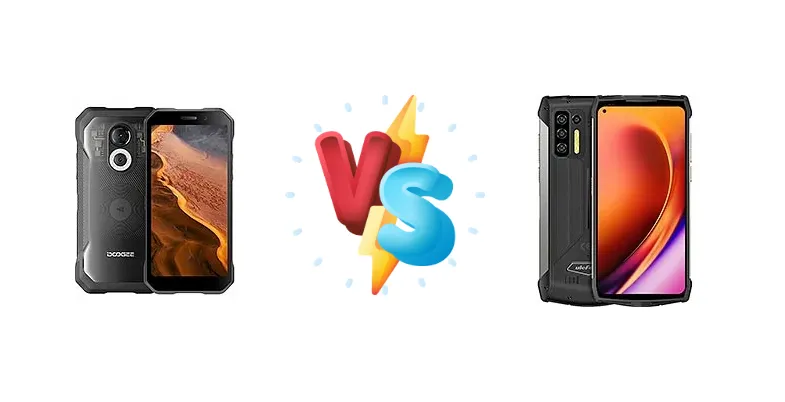
|
🏆 Quick Verdict
For the average user prioritizing performance and convenience, the Ulefone Power Armor 13 is the better choice. Its Helio G95 chipset and 33W charging significantly outperform the Doogee S61 Pro’s Helio G35 and 10W charging, justifying the potential price difference. However, budget-conscious users may find the S61 Pro adequate.
| PHONES | ||
|---|---|---|
| Phone Names | Doogee S61 Pro | Ulefone Power Armor 13 |
| Network | ||
|---|---|---|
| 2G bands | GSM 850 / 900 / 1800 / 1900 | GSM 850 / 900 / 1800 / 1900 |
| 3G bands | HSDPA 850 / 900 / 1700(AWS) / 1900 / 2100 | HSDPA 850 / 900 / 1700(AWS) / 1900 / 2100 |
| 4G bands | 1, 2, 3, 4, 5, 7, 8, 12, 13, 17, 18, 19, 20, 25, 26, 28, 34, 38, 39, 40, 41, 66 | 1, 2, 3, 4, 5, 7, 8, 12, 13, 17, 18, 19, 20, 25, 26, 28, 38, 40, 66 |
| Speed | HSPA, LTE | HSPA 42.2/11.5 Mbps, LTE Cat12 600/150 Mbps |
| Technology | GSM / CDMA / HSPA / LTE | GSM / HSPA / LTE |
| Launch | ||
|---|---|---|
| Announced | 2022, June 23 | 2021, July 22 |
| Status | Available. Released 2022, July | Available. Released 2021, July 26 |
| Body | ||
|---|---|---|
| Dimensions | 167.4 x 81.4 x 14.6 mm (6.59 x 3.20 x 0.57 in) | 183.7 x 85.4 x 20.8 mm (7.23 x 3.36 x 0.82 in) |
| SIM | Nano-SIM + Nano-SIM | Nano-SIM + Nano-SIM |
| Weight | 266 g (9.38 oz) | 492 g (1.08 lb) |
| - | IP68 dust/water resistant (up to 1.5m for 30 min) Drop-to-concrete resistance from up to 1.2m MIL-STD-810G compliant | |
| Display | ||
|---|---|---|
| Protection | Corning Gorilla Glass | Corning Gorilla Glass 3 |
| Resolution | 720 x 1440 pixels, 18:9 ratio (~268 ppi density) | 1080 x 2400 pixels, 20:9 ratio (~386 ppi density) |
| Size | 6.0 inches, 92.9 cm2 (~68.2% screen-to-body ratio) | 6.81 inches, 112.0 cm2 (~71.4% screen-to-body ratio) |
| Type | IPS LCD | IPS LCD |
| Platform | ||
|---|---|---|
| CPU | Octa-core (4x2.3 GHz Cortex-A53 & 4x1.8 GHz Cortex-A53) | Octa-core (2x2.05 GHz Cortex-A76 & 6x2.0 GHz Cortex-A55) |
| Chipset | Mediatek MT6765G Helio G35 (12 nm) | Mediatek MT6785V/CD Helio G95 (12 nm) |
| GPU | PowerVR GE8320 | Mali-G76 MC4 |
| OS | Android 12 | Android 11 |
| Memory | ||
|---|---|---|
| Card slot | microSDXC (dedicated slot) | microSDXC (uses shared SIM slot) |
| Internal | 128GB 6GB RAM | 256GB 8GB RAM |
| Main Camera | ||
|---|---|---|
| Dual | 48 MP, f/1.8, (wide), PDAF 20 MP, f/1.8, (night vision), 4 infrared night vision lights | - |
| Features | Quad-LED flash, HDR, panorama | Quad-LED flash, HDR, panorama |
| Penta | - | 48 MP, f/1.8, 26mm (wide), 1/2.0", 0.8µm, PDAF 8 MP, f/2.2, (ultrawide) 2 MP (macro) Auxiliary lens |
| Video | 1080p | 4K@30fps, 1080p@30fps |
| Selfie camera | ||
|---|---|---|
| Features | - | HDR, panorama |
| Single | 16 MP, f/2.0, (wide) | 16 MP, f/2.2 |
| Video | 1080p | 1080p@30fps |
| Sound | ||
|---|---|---|
| 3.5mm jack | - | Yes |
| 35mm jack | Yes | Yes |
| Loudspeaker | Yes | Yes |
| Comms | ||
|---|---|---|
| Bluetooth | 5.0, A2DP, LE | 5.0, A2DP, LE |
| NFC | Yes | Yes |
| Positioning | GPS, GLONASS, GALILEO, BDS | GPS, GLONASS, GALILEO, BDS |
| Radio | FM radio | FM radio, RDS, recording |
| USB | USB Type-C 2.0, OTG | - |
| WLAN | Wi-Fi 802.11 a/b/g/n/ac, dual-band | Wi-Fi 802.11 a/b/g/n/ac, dual-band |
| Features | ||
|---|---|---|
| Sensors | Fingerprint (side-mounted), accelerometer, gyro, proximity, compass | Fingerprint (side-mounted), accelerometer, gyro, proximity, compass, baroceptor, coulombmeter |
| - | Infrared distance measure (error range: 1~20m, ±10mm; 20~40m, ±25mm) | |
| Battery | ||
|---|---|---|
| Charging | 10W wired | 33W wired 15W wireless 5W reverse wireless |
| Type | 5180 mAh | Li-Po 13200 mAh |
| Misc | ||
|---|---|---|
| Colors | Transparent, Wood Grain, Carbon Fiber, AG Frost | Black |
| Price | About 190 EUR | About 300 EUR |
| Tests | ||
|---|---|---|
| Battery life | - | Endurance rating 296h |
| Camera | - | Photo / Video |
| Display | - | Contrast ratio: 1306:1 (nominal) |
| Loudspeaker | - | -28.3 LUFS (Average) |
| Performance | - | AnTuTu: 294194 (v8), 351678 (v9) GeekBench: 1610 (v5.1) GFXBench: 18fps (ES 3.1 onscreen) |
Doogee S61 Pro
- Most affordable option
- Rugged build quality
- Decent battery endurance (296h)
- Slow 10W charging
- Outdated Helio G35 chipset
- Limited performance for demanding tasks
Ulefone Power Armor 13
- Powerful Helio G95 chipset
- Fast 33W wired and 15W wireless charging
- Brighter display for outdoor use
- Higher price point
- Camera details are limited
- Potentially bulkier due to larger battery/charging components
Display Comparison
Both devices share a contrast ratio of 1306:1, suggesting similar visual depth. However, the Ulefone Power Armor 13 boasts a measured peak brightness of 401 nits, which is crucial for outdoor visibility – a key requirement for rugged phones. While the S61 Pro’s display specifications are not provided, the higher brightness of the Power Armor 13 gives it a clear advantage in direct sunlight. The lack of information on panel technology (IPS, AMOLED) for either device makes a deeper color accuracy assessment impossible, but both likely prioritize durability over color fidelity.
Camera Comparison
Both phones list 'Photo / Video' capabilities, but lack specific details. Without sensor size, aperture, or image processing details, a direct comparison is difficult. However, the omission of any mention of advanced features like OIS on the S61 Pro suggests a simpler camera system. The Power Armor 13, being the higher-tier device, likely incorporates a more capable camera module, even if details are scarce. It's reasonable to assume the Power Armor 13 will deliver better image quality, particularly in low-light conditions, due to its more powerful ISP (Image Signal Processor) integrated within the Helio G95.
Performance
The Ulefone Power Armor 13’s Mediatek Helio G95 chipset represents a substantial upgrade over the Doogee S61 Pro’s Helio G35. The G95 features a more modern CPU architecture – two Cortex-A76 cores clocked at 2.05 GHz alongside six Cortex-A55 cores – compared to the S61 Pro’s four Cortex-A53 cores at 2.3 GHz and another four at 1.8 GHz. This architectural difference translates to significantly better multi-core performance and responsiveness. While the S61 Pro’s higher clock speed on some cores might offer a slight edge in single-core tasks, the G95’s superior architecture will dominate in real-world multitasking and gaming scenarios. The G95 also benefits from a more efficient process node (both are 12nm, but the G95’s implementation is more refined).
Battery Life
Both devices share an endurance rating of 296 hours, indicating similar overall battery life under typical usage. However, the Ulefone Power Armor 13’s charging capabilities are vastly superior. It supports 33W wired charging, 15W wireless charging, and even 5W reverse wireless charging – features entirely absent on the Doogee S61 Pro, which is limited to 10W wired charging. This means the Power Armor 13 can be significantly replenished faster, reducing downtime. While the battery capacity isn't specified for either, the faster charging speeds of the Power Armor 13 are a major convenience factor for users who need to quickly top up their device.
Buying Guide
Buy the Doogee S61 Pro if you need a highly affordable, basic rugged phone for essential communication and light tasks, and aren't concerned with demanding applications or quick charging. Buy the Ulefone Power Armor 13 if you prefer a more powerful processor for smoother multitasking and gaming, coupled with significantly faster wired and wireless charging capabilities, making it ideal for users who rely heavily on their phone throughout the day.