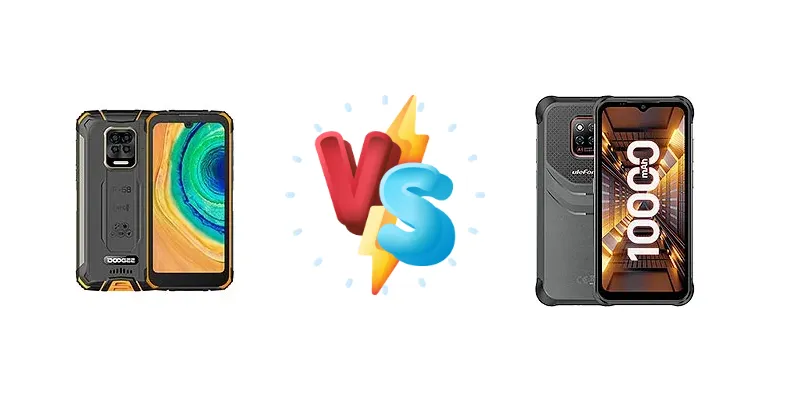
The rugged smartphone market caters to a specific user: those needing durability above all else. Both the Doogee S59 and Ulefone Power Armor 14 Pro aim to deliver that, but they take different approaches to performance and features. The S59 focuses on affordability, while the 14 Pro attempts to balance toughness with a more capable chipset. This comparison dissects the key differences to help you choose the right tool for your demanding lifestyle.
🏆 Quick Verdict
For the average user prioritizing responsiveness and future-proofing, the Ulefone Power Armor 14 Pro is the better choice. Its Helio G85 chipset offers a significant performance uplift over the S59’s Helio A25, making it more suitable for multitasking and demanding applications, despite the slightly slower wired charging.
| Network |
|---|
| 2G bands | GSM 850 / 900 / 1800 / 1900 | GSM 850 / 900 / 1800 / 1900 |
| 3G bands | HSDPA 850 / 900 / 1700(AWS) / 1900 / 2100 | HSDPA 850 / 900 / 1700(AWS) / 1900 / 2100 |
| 4G bands | 1, 3, 7, 8, 20 | 1, 2, 3, 4, 5, 7, 8, 12, 13, 17, 18, 19, 20, 25, 26, 28, 38, 40 |
| Speed | HSPA, LTE | HSPA, LTE |
| Technology | GSM / HSPA / LTE | GSM / HSPA / LTE |
| Launch |
|---|
| Announced | 2020, Q2. Released 2020, Q2 | 2022, March 09 |
| Status | Discontinued | Available. Released 2022, March 09 |
| Body |
|---|
| Dimensions | 161 x 80.2 x 18.3 mm (6.34 x 3.16 x 0.72 in) | 175.6 x 82.5 x 17.2 mm (6.91 x 3.25 x 0.68 in) |
| SIM | Nano-SIM + Nano-SIM | Nano-SIM + Nano-SIM |
| Weight | 340 g (11.99 oz) | 358.2 g (12.63 oz) |
| | - | IP68 dust/water resistant (up to 1.5m for 30 min)
Drop-to-concrete resistance from up to 1.5m
MIL-STD-810G compliant |
| Display |
|---|
| Protection | Corning Gorilla Glass | Corning Gorilla Glass 3 |
| Resolution | 720 x 1520 pixels, 19:9 ratio (~295 ppi density) | 720 x 1600 pixels, 20:9 ratio (~269 ppi density) |
| Size | 5.71 inches, 81.4 cm2 (~63.0% screen-to-body ratio) | 6.52 inches, 102.6 cm2 (~70.8% screen-to-body ratio) |
| Type | IPS LCD | IPS LCD |
| Platform |
|---|
| CPU | Octa-core (4x1.8 GHz Cortex-A53 & 4x1.5 GHz Cortex-A53) | Octa-core (2x2.0 GHz Cortex-A75 & 6x1.8 GHz Cortex-A55) |
| Chipset | Mediatek MT6762 Helio A25 (12 nm) | Mediatek MT6769Z Helio G85 (12 nm) |
| GPU | PowerVR GE8320 | Mali-G52 MC2 |
| OS | Android 10 | Android 12 |
| Memory |
|---|
| Card slot | microSDXC (uses shared SIM slot) | microSDXC (uses shared SIM slot) |
| Internal | 64GB 4GB RAM | 128GB 6GB RAM, 128GB 8GB RAM |
| | - | eMMC 5.1 |
| Main Camera |
|---|
| Features | Quad-LED flash, HDR, panorama | LED flash, HDR, panorama |
| Quad | 16 MP, f/2.0, (wide), PDAF
8 MP, f/2.2, 130˚ (wide), PDAF
8 MP, f/2.2, 130˚ (macro), PDAF
Auxiliary lens | - |
| Single | - | 16 MP, f/2.2 |
| Triple | - | 20 MP, f/1.8, 26mm (wide), 1/2.78", 1.0µm, PDAF
2 MP (macro)
Auxiliary lens |
| Video | 1080p | 1080p@30fps |
| Selfie camera |
|---|
| Features | - | HDR, panorama |
| Single | 16 MP, f/2.0, (wide) | 16 MP, f/2.2 |
| Video | 1080p | 1080p@30fps |
| Sound |
|---|
| 3.5mm jack | - | Yes |
| 35mm jack | Yes | Yes |
| Loudspeaker | Yes | Yes |
| Comms |
|---|
| Bluetooth | 5.0, A2DP, LE | 5.0, A2DP, LE |
| NFC | Yes | Yes |
| Positioning | GPS, GLONASS, GALILEO, BDS | GPS, GLONASS, GALILEO, BDS |
| Radio | FM radio | FM radio, RDS, recording |
| USB | USB Type-C 2.0, OTG | USB Type-C 2.0, OTG |
| WLAN | Wi-Fi 802.11 a/b/g/n/ac, dual-band | Wi-Fi 802.11 a/b/g/n/ac, dual-band |
| Features |
|---|
| Sensors | Fingerprint (side-mounted), accelerometer, gyro, proximity, compass | Fingerprint (side-mounted), accelerometer, proximity, compass |
| Battery |
|---|
| Charging | 24W wired | 18W wired
15W wireless |
| Type | 10050 mAh | Li-Po 10000 mAh |
| Misc |
|---|
| Colors | Black, Orange, Green | Black |
| Price | About 180 EUR | About 260 EUR |
Doogee S59
- More affordable price point
- Faster wired charging (24W)
- Rugged design for demanding environments
- Significantly weaker processor (Helio A25)
- Lacks wireless charging
- Limited performance for gaming and multitasking
Ulefone Power Armor 14 Pro
- More powerful processor (Helio G85)
- Wireless charging support (15W)
- Improved performance for gaming and apps
- Slower wired charging (18W)
- Higher price compared to the Doogee S59
- Potentially slightly lower battery life due to more powerful processor
Display Comparison
Neither Doogee nor Ulefone provide detailed display specifications beyond resolution. However, given the price points, both likely utilize IPS LCD panels. The real difference lies in the processing power driving them. While both will suffice for outdoor visibility, the 14 Pro’s more powerful GPU will contribute to smoother animations and potentially better color rendering, though this is speculative without detailed panel analysis. Bezels are expected to be substantial on both, prioritizing durability over a modern, edge-to-edge design.
Camera Comparison
Without detailed camera specs beyond the main sensors, a direct comparison is difficult. However, the chipset plays a role in image processing. The Helio G85 in the Ulefone Power Armor 14 Pro benefits from a more powerful ISP (Image Signal Processor), enabling faster image processing and potentially better low-light performance. While both phones likely feature similar sensor sizes given their price brackets, the 14 Pro’s processing capabilities will likely result in more detailed and vibrant photos. The inclusion of features like night mode will be more effective on the 14 Pro.
Performance
The Ulefone Power Armor 14 Pro’s Mediatek Helio G85 is the clear winner here. Its octa-core configuration, featuring 2x2.0 GHz Cortex-A75 and 6x1.8 GHz Cortex-A55 cores, represents a substantial upgrade over the Doogee S59’s Helio A25 (4x1.8 GHz Cortex-A53 & 4x1.5 GHz Cortex-A53). The Cortex-A75 cores in the G85 offer significantly improved single-core performance, crucial for app launch speeds and general responsiveness. The G85’s GPU also provides a noticeable boost in graphics performance, making it better suited for gaming. The A25 is adequate for basic tasks, but will struggle with more demanding applications. The 14 Pro will feel noticeably snappier in everyday use.
Battery Life
Both phones prioritize battery life, a key requirement for rugged devices. The Ulefone Power Armor 14 Pro offers the added convenience of 15W wireless charging, a feature absent on the Doogee S59. While the S59’s 24W wired charging is faster than the 14 Pro’s 18W wired charging, the wireless charging option provides flexibility. The actual battery capacity isn’t specified, but the G85’s improved efficiency may offset any capacity differences, resulting in comparable real-world battery life. The 14 Pro’s faster processing will draw more power, but its optimization should keep it competitive.
Buying Guide
Buy the Doogee S59 if you need a highly affordable, genuinely rugged phone for basic communication and light tasks – think construction workers needing a reliable call device or hikers wanting a backup. Buy the Ulefone Power Armor 14 Pro if you prefer a more versatile rugged phone capable of handling moderate gaming, streaming, and photography, and appreciate the convenience of wireless charging.
Frequently Asked Questions
❓ Will the Ulefone Power Armor 14 Pro handle graphically intensive games like PUBG Mobile?
The Helio G85 chipset in the Ulefone Power Armor 14 Pro is capable of running PUBG Mobile, but you’ll likely need to lower the graphics settings to medium or low for a smooth experience. The A25 in the Doogee S59 will struggle significantly with PUBG, even on the lowest settings.
❓ How well does the Doogee S59 perform with multiple apps open simultaneously?
The Doogee S59’s Helio A25 chipset and limited RAM will struggle with heavy multitasking. Switching between apps may be slow, and running several apps concurrently could lead to noticeable lag. The Ulefone Power Armor 14 Pro, with its Helio G85, handles multitasking much more efficiently.
❓ Is the wireless charging on the Ulefone Power Armor 14 Pro significantly slower than wired charging?
Yes, 15W wireless charging is considerably slower than the Doogee S59’s 24W wired charging. Expect a full wireless charge to take several hours, while the S59 can achieve a full charge much faster via its wired connection. However, wireless charging offers convenience for users who don't want to deal with cables.