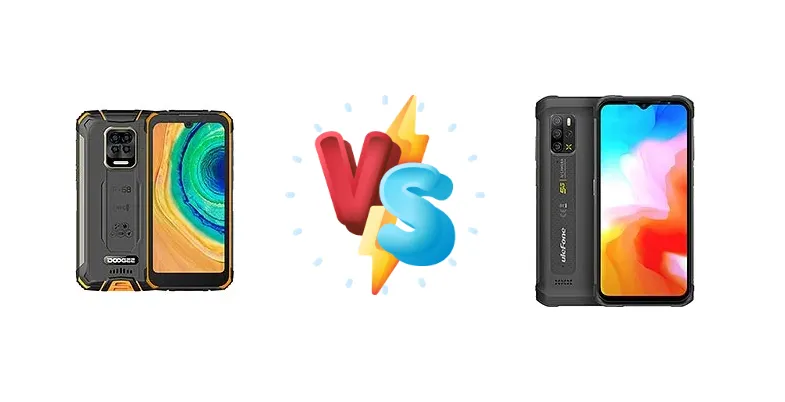
The rugged smartphone market caters to a specific need: durability. Both the Doogee S59 and Ulefone Armor 12 5G aim to deliver on that promise, but they diverge significantly in their internal hardware. The S59 focuses on affordability with a MediaTek Helio A25, while the Armor 12 5G steps up with the more powerful and 5G-enabled Dimensity 700. This comparison will dissect these differences to determine which phone best suits your needs.
🏆 Quick Verdict
For the average user prioritizing responsiveness and future-proofing, the Ulefone Armor 12 5G is the clear winner. Its Dimensity 700 chipset provides a substantial performance uplift over the Doogee S59’s Helio A25, enabling smoother multitasking and 5G connectivity. While the S59 offers a lower price point, the Armor 12 5G’s performance justifies the price difference.
| Network |
|---|
| 2G bands | GSM 850 / 900 / 1800 / 1900 | GSM 850 / 900 / 1800 / 1900 |
| 3G bands | HSDPA 850 / 900 / 1700(AWS) / 1900 / 2100 | HSDPA 850 / 900 / 1700(AWS) / 1900 / 2100 |
| 4G bands | 1, 3, 7, 8, 20 | 1, 2, 3, 4, 5, 7, 8, 12, 13, 17, 18, 19, 20, 25, 26, 28, 34, 38, 39, 40, 41, 66 |
| 5G bands | - | 1, 3, 28, 38, 41, 77, 78 SA/NSA |
| Speed | HSPA, LTE | HSPA, LTE, 5G |
| Technology | GSM / HSPA / LTE | GSM / CDMA / HSPA / EVDO / LTE / 5G |
| | - | CDMA2000 1xEV-DO |
| Launch |
|---|
| Announced | 2020, Q2. Released 2020, Q2 | 2021, August 14 |
| Status | Discontinued | Available. Released 2021, August 23 |
| Body |
|---|
| Build | - | Front glass, aluminum back with rubber, aluminum frame |
| Dimensions | 161 x 80.2 x 18.3 mm (6.34 x 3.16 x 0.72 in) | 175.9 x 82.5 x 14.3 mm (6.93 x 3.25 x 0.56 in) |
| SIM | Nano-SIM + Nano-SIM | Nano-SIM + Nano-SIM |
| Weight | 340 g (11.99 oz) | 296 g (10.44 oz) |
| | - | IP68 dust/water resistant (up to 1.5m for 30 min)
Drop-to-concrete resistance from up to 1.2m
MIL-STD-810G compliant |
| Display |
|---|
| Protection | Corning Gorilla Glass | - |
| Resolution | 720 x 1520 pixels, 19:9 ratio (~295 ppi density) | 720 x 1560 pixels, 19.5:9 ratio (~264 ppi density) |
| Size | 5.71 inches, 81.4 cm2 (~63.0% screen-to-body ratio) | 6.52 inches, 104.4 cm2 (~71.9% screen-to-body ratio) |
| Type | IPS LCD | IPS LCD |
| Platform |
|---|
| CPU | Octa-core (4x1.8 GHz Cortex-A53 & 4x1.5 GHz Cortex-A53) | Octa-core (2x2.2 GHz Cortex-A76 & 6x2.0 GHz Cortex-A55) |
| Chipset | Mediatek MT6762 Helio A25 (12 nm) | Mediatek Dimensity 700 (7 nm) |
| GPU | PowerVR GE8320 | Mali-G57 MC2 |
| OS | Android 10 | Android 11 |
| Memory |
|---|
| Card slot | microSDXC (uses shared SIM slot) | microSDXC |
| Internal | 64GB 4GB RAM | 128GB 8GB RAM |
| Main Camera |
|---|
| Features | Quad-LED flash, HDR, panorama | Dual-LED flash, HDR, panorama |
| Quad | 16 MP, f/2.0, (wide), PDAF
8 MP, f/2.2, 130˚ (wide), PDAF
8 MP, f/2.2, 130˚ (macro), PDAF
Auxiliary lens | 48 MP, f/1.8, 26mm (wide), 1/2.0", 0.8µm, PDAF
8 MP, f/2.2, (ultrawide)
2 MP (macro)
Auxiliary lens |
| Single | - | 16 MP, f/2.2 |
| Video | 1080p | 1440p@30fps |
| Selfie camera |
|---|
| Features | - | HDR, panorama |
| Single | 16 MP, f/2.0, (wide) | 16 MP, f/2.2 |
| Video | 1080p | 1080p@30fps |
| Sound |
|---|
| 3.5mm jack | - | No |
| 35mm jack | Yes | No |
| Loudspeaker | Yes | Yes, with dual speakers |
| Comms |
|---|
| Bluetooth | 5.0, A2DP, LE | 5.1, A2DP, LE |
| NFC | Yes | Yes |
| Positioning | GPS, GLONASS, GALILEO, BDS | GPS, GLONASS, GALILEO, BDS |
| Radio | FM radio | Wireless FM radio, RDS |
| USB | USB Type-C 2.0, OTG | USB Type-C 2.0, OTG |
| WLAN | Wi-Fi 802.11 a/b/g/n/ac, dual-band | Wi-Fi 802.11 a/b/g/n/ac, Wi-Fi Direct |
| Features |
|---|
| Sensors | Fingerprint (side-mounted), accelerometer, gyro, proximity, compass | Fingerprint (side-mounted), accelerometer, gyro, proximity, compass, coulombmeter |
| Battery |
|---|
| Charging | 24W wired | 18W wired
15W wireless |
| Type | 10050 mAh | Li-Po 5180 mAh |
| Misc |
|---|
| Colors | Black, Orange, Green | Black/Orange, Gray/Black |
| Price | About 180 EUR | About 370 EUR |
Doogee S59
- More affordable price point
- Potentially longer battery life due to less powerful chipset
- Rugged design for durability
- Significantly slower performance
- No 5G connectivity
- Limited multitasking capabilities
Ulefone Armor 12 5G
- Faster and more responsive performance
- 5G connectivity for faster data speeds
- Wireless charging convenience
- Higher price point
- Potentially shorter battery life under heavy load
- May experience more heat during intensive tasks
Display Comparison
Neither device’s display specifications are provided, so a direct comparison is limited. However, given the S59’s budget chipset, it likely features a lower-resolution panel and potentially lower brightness than the Armor 12 5G. The Armor 12 5G, benefiting from a more modern chipset, likely has a more vibrant and responsive display. Rugged phones often prioritize durability over display quality, so expect both to have robust glass protection, but color accuracy and viewing angles may be compromised.
Camera Comparison
Without detailed camera specifications, a precise comparison is difficult. However, the chipset difference indirectly impacts camera performance. The Dimensity 700 includes a more powerful Image Signal Processor (ISP), enabling faster image processing and potentially better low-light performance. While both phones likely feature multiple cameras, the S59’s Helio A25 will limit the ISP’s capabilities. Expect the Armor 12 5G to produce sharper, more detailed images and videos, especially in challenging conditions. The presence of a dedicated Night Mode is more likely to be effective on the Armor 12 5G.
Performance
The core difference lies in the chipsets. The Ulefone Armor 12 5G’s MediaTek Dimensity 700 (7nm) is a significant leap ahead of the Doogee S59’s Helio A25 (12nm). The Dimensity 700 utilizes Cortex-A76 performance cores clocked at 2.2 GHz, paired with efficient A55 cores, offering substantially better CPU and GPU performance. The Helio A25’s Cortex-A53 cores, while efficient, are older architecture and will struggle with demanding applications. The 7nm process node of the Dimensity 700 also translates to better thermal efficiency, reducing throttling during sustained workloads. This means the Armor 12 5G will handle multitasking, streaming, and light gaming far more smoothly than the S59.
Battery Life
Battery capacity isn’t specified for either device, but the charging capabilities offer insight. The Ulefone Armor 12 5G supports both 18W wired and 15W wireless charging, providing flexibility. The Doogee S59 is limited to 24W wired charging. While 24W appears faster, the Armor 12 5G’s wireless charging is a significant convenience feature. The Dimensity 700’s improved power efficiency may also contribute to longer battery life in real-world usage, offsetting any potential capacity difference.
Buying Guide
Buy the Doogee S59 if you need a highly affordable, basic rugged phone for essential communication and light tasks like calls, texts, and simple navigation. It’s ideal for users who prioritize cost above all else and don’t require demanding performance. Buy the Ulefone Armor 12 5G if you prefer a more capable device that can handle multitasking, streaming, and occasional gaming, alongside the benefits of 5G connectivity and wireless charging. This is the better choice for users who need a rugged phone that can keep up with a more active digital lifestyle.
Frequently Asked Questions
❓ Will the Ulefone Armor 12 5G’s Dimensity 700 handle demanding games like PUBG Mobile?
The Dimensity 700 is capable of running PUBG Mobile, but expect to use medium graphics settings for a smooth experience. While not a flagship gaming chip, it provides a substantial performance boost over the Helio A25, making it playable. The S59 would likely struggle even on the lowest settings.
❓ How much does the ruggedization on each phone affect their size and weight?
Both phones will be noticeably thicker and heavier than standard smartphones due to their rugged construction. Specific dimensions and weights aren't provided, but expect a substantial difference compared to slim, glass-backed devices. The Armor 12 5G may be slightly larger due to the inclusion of 5G components and a potentially larger battery.
❓ Is the 24W charging on the Doogee S59 significantly faster than the 18W on the Ulefone Armor 12 5G?
While 24W is numerically higher, the difference in charging speed won't be dramatic. Modern charging isn't solely about wattage; battery management and thermal throttling play a role. The Armor 12 5G’s wireless charging offers a convenience the S59 lacks, potentially making it a more appealing charging solution for some users.