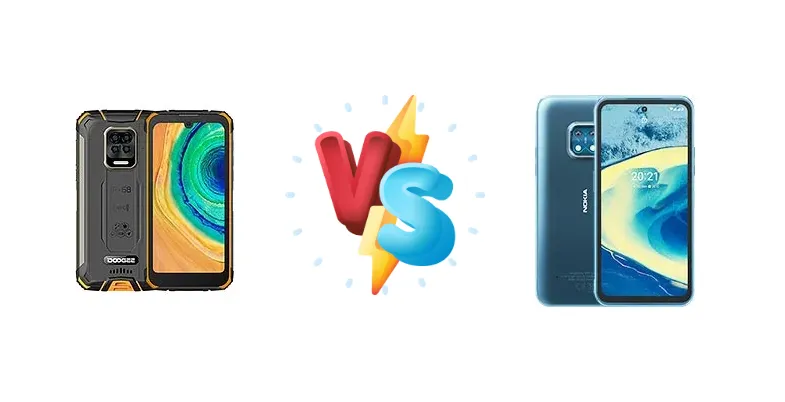
The rugged smartphone market caters to a specific user: those needing a device that can withstand drops, dust, and the elements. Both the Doogee S59 and Nokia XR20 aim to fulfill this need, but they approach it with different internal hardware and price points. This comparison dissects their key specifications to determine which offers the best blend of durability, performance, and value.
🏆 Quick Verdict
For the average user prioritizing 5G connectivity and a more responsive experience, the Nokia XR20 is the better choice. Its Snapdragon 480 chipset, built on an 8nm process, provides a noticeable performance advantage over the Doogee S59’s Helio A25, despite the S59’s slightly faster wired charging.
| Network |
|---|
| 2G bands | GSM 850 / 900 / 1800 / 1900 | GSM 850 / 900 / 1800 / 1900 |
| 3G bands | HSDPA 850 / 900 / 1700(AWS) / 1900 / 2100 | HSDPA 850 / 900 / 1700(AWS) / 1900 / 2100 |
| 4G bands | 1, 3, 7, 8, 20 | 1, 2, 3, 4, 5, 7, 8, 12, 13, 14, 20, 25, 26, 28, 30, 38, 40, 41, 48, 66, 71 |
| 5G bands | - | 2, 5, 25, 38, 41, 48, 66, 77, 78 SA/NSA |
| Speed | HSPA, LTE | HSPA, LTE, 5G |
| Technology | GSM / HSPA / LTE | GSM / CDMA / HSPA / EVDO / LTE / 5G |
| | - | CDMA2000 1xEV-DO |
| Launch |
|---|
| Announced | 2020, Q2. Released 2020, Q2 | 2021, July 27 |
| Status | Discontinued | Available. Released 2021, August 04 |
| Body |
|---|
| Dimensions | 161 x 80.2 x 18.3 mm (6.34 x 3.16 x 0.72 in) | 171.6 x 81.5 x 10.6 mm (6.76 x 3.21 x 0.42 in) |
| SIM | Nano-SIM + Nano-SIM | · Nano-SIM· Nano-SIM + Nano-SIM |
| Weight | 340 g (11.99 oz) | 248 g (8.75 oz) |
| | - | IP68 dust/water resistant (up to 1.5m for 60 min)
Drop-to-concrete resistance from up to 1.8m
MIL-STD-810H compliant |
| Display |
|---|
| Protection | Corning Gorilla Glass | Corning Gorilla Glass Victus |
| Resolution | 720 x 1520 pixels, 19:9 ratio (~295 ppi density) | 1080 x 2400 pixels, 20:9 ratio (~395 ppi density) |
| Size | 5.71 inches, 81.4 cm2 (~63.0% screen-to-body ratio) | 6.67 inches, 107.4 cm2 (~76.8% screen-to-body ratio) |
| Type | IPS LCD | IPS LCD, 550 nits |
| Platform |
|---|
| CPU | Octa-core (4x1.8 GHz Cortex-A53 & 4x1.5 GHz Cortex-A53) | Octa-core (2x2.0 GHz Kryo 460 & 6x1.8 GHz Kryo 460) |
| Chipset | Mediatek MT6762 Helio A25 (12 nm) | Qualcomm SM4350 Snapdragon 480 5G (8 nm) |
| GPU | PowerVR GE8320 | Adreno 619 |
| OS | Android 10 | Android 11, upgradable to Android 13 |
| Memory |
|---|
| Card slot | microSDXC (uses shared SIM slot) | microSDXC (uses shared SIM slot) |
| Internal | 64GB 4GB RAM | 64GB 4GB RAM, 128GB 6GB RAM |
| Main Camera |
|---|
| Dual | - | 48 MP, f/1.8, (wide), 1/2.25", 0.8µm, PDAF
13 MP, f/2.4, 123˚ (ultrawide), 1/3.0", 1.12µm |
| Features | Quad-LED flash, HDR, panorama | Zeiss optics, Dual-LED dual-tone flash, second LED flash, HDR, panorama |
| Quad | 16 MP, f/2.0, (wide), PDAF
8 MP, f/2.2, 130˚ (wide), PDAF
8 MP, f/2.2, 130˚ (macro), PDAF
Auxiliary lens | - |
| Single | - | 8 MP, f/2.0 (wide), 1/4.0", 1.12µm |
| Video | 1080p | 1080p@30fps |
| Selfie camera |
|---|
| Single | 16 MP, f/2.0, (wide) | 8 MP, f/2.0 (wide), 1/4.0", 1.12µm |
| Video | 1080p | 1080p@30fps |
| Sound |
|---|
| 3.5mm jack | - | Yes |
| 35mm jack | Yes | Yes |
| Loudspeaker | Yes | Yes, with stereo speakers |
| Comms |
|---|
| Bluetooth | 5.0, A2DP, LE | 5.1, A2DP, LE, aptX Adaptive |
| NFC | Yes | Yes |
| Positioning | GPS, GLONASS, GALILEO, BDS | GPS (L1+L5), GLONASS, BDS, GALILEO, QZSS, NavIC |
| Radio | FM radio | Unspecified |
| USB | USB Type-C 2.0, OTG | USB Type-C 3.0 |
| WLAN | Wi-Fi 802.11 a/b/g/n/ac, dual-band | Wi-Fi 802.11 a/b/g/n/ac/6, dual-band, Wi-Fi Direct |
| Features |
|---|
| Sensors | Fingerprint (side-mounted), accelerometer, gyro, proximity, compass | Fingerprint (side-mounted), accelerometer, gyro, proximity, compass, barometer |
| Battery |
|---|
| Charging | 24W wired | 18W wired
15W wireless |
| Type | 10050 mAh | Li-Po 4630 mAh |
| Misc |
|---|
| Colors | Black, Orange, Green | Ultra Blue, Granite Gray |
| Models | - | TA-1368, TA-1362 |
| Price | About 180 EUR | About 270 EUR |
| SAR EU | - | 1.13 W/kg (head) 1.43 W/kg (body) |
Doogee S59
- More affordable price point
- Faster 24W wired charging
- Rugged design for demanding environments
- Less powerful Helio A25 chipset
- No 5G connectivity
- Potentially slower performance and responsiveness
Nokia XR20
- 5G connectivity for faster data speeds
- More powerful Snapdragon 480 chipset
- Wireless charging convenience
- Slightly higher price
- Slower 18W wired charging
- May require more frequent charging due to increased processing demands
Display Comparison
Neither Doogee nor Nokia provide detailed display specifications beyond basic resolution. However, the core difference lies in the processing power driving the display. The XR20’s Snapdragon 480 has a more capable ISP and GPU, potentially leading to better image processing and smoother animations. While both likely utilize IPS LCD panels, the XR20’s chipset offers a better foundation for a visually responsive experience. Bezels are expected to be similar on both, given their rugged focus on protection over aesthetics.
Camera Comparison
Without detailed sensor information, a direct camera comparison is difficult. However, the XR20 benefits from the Snapdragon 480’s superior image signal processor (ISP). This ISP enables better noise reduction, dynamic range, and overall image quality, even if both phones utilize similar megapixel counts. The XR20’s processing power allows for more sophisticated computational photography features. The S59 will likely rely more heavily on software processing to compensate for a potentially less capable sensor and ISP.
Performance
The Nokia XR20’s Qualcomm Snapdragon 480 5G (8nm) represents a significant architectural leap over the Doogee S59’s MediaTek Helio A25 (12nm). The 8nm process inherently offers better power efficiency and thermal management, meaning the XR20 is less likely to throttle under sustained load. The Snapdragon’s Kryo 460 cores, with a 2x2.0 GHz + 6x1.8 GHz configuration, outperform the Helio A25’s 4x1.8 GHz + 4x1.5 GHz Cortex-A53 setup in both single-core and multi-core benchmarks. This translates to faster app loading times, smoother multitasking, and a more responsive overall user experience for the XR20.
Battery Life
Both phones offer adequate battery capacity for their target use cases. The Doogee S59’s 24W wired charging is faster than the Nokia XR20’s 18W wired charging. However, the XR20 compensates with the addition of 15W wireless charging, offering a convenient alternative. The Snapdragon 480’s improved power efficiency may partially offset the S59’s faster wired charging, potentially resulting in comparable real-world battery life despite the lack of specific mAh data.
Buying Guide
Buy the Doogee S59 if you need a highly affordable, extremely durable phone for basic tasks like communication and occasional photography, and aren't concerned with demanding applications or 5G speeds. Buy the Nokia XR20 if you prioritize a smoother user experience, 5G connectivity for faster data speeds, and the added convenience of wireless charging, even if it comes at a slightly higher price.
Frequently Asked Questions
❓ Will the Snapdragon 480 in the Nokia XR20 struggle with graphically intensive games?
While the Snapdragon 480 isn't a flagship gaming chip, it's significantly more capable than the Helio A25. Expect playable frame rates in most popular titles at medium settings. However, demanding games may require lower graphics settings to maintain smooth performance.
❓ How does the ruggedization of the Doogee S59 compare to the Nokia XR20 in terms of drop protection and water resistance?
Both phones are built to withstand harsh conditions, but Nokia typically adheres to stricter MIL-STD-810H certifications. While Doogee also claims ruggedization, the XR20’s certification provides a higher degree of confidence in its durability. Both are likely IP68 rated for dust and water resistance.
❓ Is the 15W wireless charging on the Nokia XR20 significantly slower than the 24W wired charging on the Doogee S59?
Yes, 15W wireless charging is considerably slower than 24W wired charging. Expect a full wireless charge to take several hours. However, wireless charging offers convenience, allowing you to top up the battery without plugging in a cable.