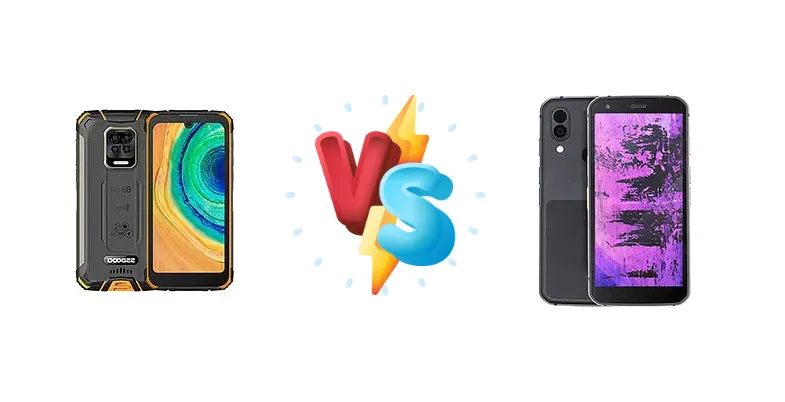
The rugged smartphone market caters to a specific user: those needing a device that can withstand drops, dust, and water. The Doogee S59 and Cat S62 Pro both aim to deliver this durability, but they differ significantly in their internal hardware. This comparison dives deep into the specifications to determine which phone offers the best balance of performance, features, and value for demanding environments.
🏆 Quick Verdict
For the average user prioritizing consistent performance and a more refined user experience, the Cat S62 Pro emerges as the better choice. Its Snapdragon 660 chipset, built on a 14nm process, provides a noticeable advantage over the Doogee S59’s Helio A25, despite the latter’s newer 12nm fabrication. While the S59 offers a lower price point, the S62 Pro’s superior processing power justifies the cost for those relying on their phone for work or demanding tasks.
| Network |
|---|
| 2G bands | GSM 850 / 900 / 1800 / 1900 | GSM 850 / 900 / 1800 / 1900 |
| 3G bands | HSDPA 850 / 900 / 1700(AWS) / 1900 / 2100 | HSDPA 850 / 900 / 1700(AWS) / 1900 / 2100 |
| 4G bands | 1, 3, 7, 8, 20 | 1, 2, 3, 4, 5, 7, 8, 20, 28, 38, 40 |
| Speed | HSPA, LTE | HSPA 42.2/5.76 Mbps, LTE (2CA) Cat13 400/150 Mbps |
| Technology | GSM / HSPA / LTE | GSM / HSPA / LTE |
| Launch |
|---|
| Announced | 2020, Q2. Released 2020, Q2 | 2020, June 28. Released 2020, August 17 |
| Status | Discontinued | Discontinued |
| Body |
|---|
| Build | - | Glass front (Gorilla Glass 6), plastic back, aluminum frame |
| Dimensions | 161 x 80.2 x 18.3 mm (6.34 x 3.16 x 0.72 in) | 158.5 x 76.7 x 11.9 mm (6.24 x 3.02 x 0.47 in) |
| SIM | Nano-SIM + Nano-SIM | · Nano-SIM· Nano-SIM + Nano-SIM |
| Weight | 340 g (11.99 oz) | 248 g (8.75 oz) |
| | - | IP68/IP69 dust/water resistant (up to 1.5m for 35 mins)
Drop-to-concrete resistance from up to 1.8m
MIL-STD-810H compliant |
| Display |
|---|
| Protection | Corning Gorilla Glass | Corning Gorilla Glass 6 |
| Resolution | 720 x 1520 pixels, 19:9 ratio (~295 ppi density) | 1080 x 2160 pixels, 18:9 ratio (~424 ppi density) |
| Size | 5.71 inches, 81.4 cm2 (~63.0% screen-to-body ratio) | 5.7 inches, 83.8 cm2 (~69.0% screen-to-body ratio) |
| Type | IPS LCD | IPS LCD |
| Platform |
|---|
| CPU | Octa-core (4x1.8 GHz Cortex-A53 & 4x1.5 GHz Cortex-A53) | Octa-core (4x2.2 GHz Kryo 260 Gold & 4x1.8 GHz Kryo 260 Silver) |
| Chipset | Mediatek MT6762 Helio A25 (12 nm) | Qualcomm SDM660 Snapdragon 660 (14 nm) |
| GPU | PowerVR GE8320 | Adreno 512 |
| OS | Android 10 | Android 10 |
| Memory |
|---|
| Card slot | microSDXC (uses shared SIM slot) | microSDXC (dedicated slot) |
| Internal | 64GB 4GB RAM | 128GB 6GB RAM |
| Main Camera |
|---|
| Dual | - | 12 MP, f/1.8, (wide), 1/2.55", 1.4µm, dual pixel PDAF
FLIR thermal camera (Lepton 3.5 module) |
| Features | Quad-LED flash, HDR, panorama | Thermal imaging, heat palettes, temp. spot meter, LED flash |
| Quad | 16 MP, f/2.0, (wide), PDAF
8 MP, f/2.2, 130˚ (wide), PDAF
8 MP, f/2.2, 130˚ (macro), PDAF
Auxiliary lens | - |
| Video | 1080p | 1080p@30fps, gyro-EIS |
| Selfie camera |
|---|
| Single | 16 MP, f/2.0, (wide) | 8 MP |
| Video | 1080p | 1080p@30fps |
| Sound |
|---|
| 3.5mm jack | - | No |
| 35mm jack | Yes | No |
| Loudspeaker | Yes | Yes |
| Comms |
|---|
| Bluetooth | 5.0, A2DP, LE | 5.0, A2DP, LE |
| NFC | Yes | Yes |
| Positioning | GPS, GLONASS, GALILEO, BDS | GPS, GLONASS, GALILEO, BDS |
| Radio | FM radio | FM radio |
| USB | USB Type-C 2.0, OTG | USB Type-C 2.0, OTG |
| WLAN | Wi-Fi 802.11 a/b/g/n/ac, dual-band | Wi-Fi 802.11 a/b/g/n/ac, dual-band, Wi-Fi Direct |
| Features |
|---|
| Sensors | Fingerprint (side-mounted), accelerometer, gyro, proximity, compass | Fingerprint (rear-mounted), accelerometer, gyro, proximity, compass |
| Battery |
|---|
| Charging | 24W wired | - |
| Type | 10050 mAh | Li-Ion 4000 mAh |
| Misc |
|---|
| Colors | Black, Orange, Green | Black |
| Price | About 180 EUR | About 530 EUR |
Doogee S59
- More affordable price point
- 24W fast charging
- Rugged design for durability
- Significantly weaker processor
- Less responsive user experience
- Potentially lower camera quality
Cat S62 Pro
- More powerful Snapdragon 660 processor
- Smoother multitasking and app performance
- Potentially better camera image processing
- Higher price tag
- Charging speed not specified
- May have a slightly shorter battery life due to higher performance
Display Comparison
Neither Doogee nor Cat provide detailed display specifications beyond basic resolution. However, the choice of panel technology and brightness are crucial for outdoor visibility. While both likely utilize IPS LCDs, the S62 Pro’s Qualcomm chipset may offer better image processing capabilities, potentially resulting in more accurate color reproduction. The lack of high refresh rate or advanced features like LTPO on either device suggests a focus on durability and battery life over visual fidelity.
Camera Comparison
Detailed camera specs are unavailable for both devices. However, given the target market, image quality is likely secondary to durability. The Cat S62 Pro, benefiting from the Snapdragon 660’s superior image signal processor (ISP), likely offers better image processing capabilities, resulting in more detailed and accurate photos, especially in challenging lighting conditions. The S59’s Helio A25 ISP is less sophisticated, potentially leading to softer images and less effective noise reduction. Without specific sensor details, it’s difficult to make a definitive judgment, but the chipset advantage favors the S62 Pro.
Performance
The core difference lies in the chipsets. The Cat S62 Pro’s Qualcomm Snapdragon 660 (14nm) boasts a significantly more powerful CPU and GPU compared to the Doogee S59’s MediaTek Helio A25 (12nm). The Snapdragon 660’s octa-core configuration, with 4x2.2 GHz Kryo 260 Gold and 4x1.8 GHz Kryo 260 Silver cores, delivers a substantial performance uplift over the Helio A25’s 4x1.8 GHz Cortex-A53 and 4x1.5 GHz Cortex-A53 cores. This translates to faster app loading times, smoother multitasking, and a more responsive user experience, particularly noticeable when running demanding applications. The 14nm process, while older, is a mature technology known for its stability, and the Snapdragon 660’s architecture is more efficient at handling sustained workloads.
Battery Life
Both phones prioritize battery life, essential for users in remote locations. The Doogee S59 features 24W wired charging, a reasonable speed for its price point. The Cat S62 Pro’s battery capacity and charging speed are not specified, but Cat phones generally prioritize longevity over rapid charging. The Snapdragon 660’s power efficiency, despite being built on a larger node, could offset a potentially smaller battery capacity in the S62 Pro, resulting in comparable real-world battery performance. The S59’s faster charging may be beneficial for quick top-ups, but the S62 Pro’s optimized power management could lead to longer overall usage times.
Buying Guide
Buy the Doogee S59 if you need a highly affordable, basic rugged phone for essential communication and light tasks. It’s ideal for users who prioritize cost above all else and don’t require demanding app performance. Buy the Cat S62 Pro if you prefer a more responsive and capable device for work in challenging conditions, or if you frequently use apps that require more processing power. The S62 Pro is better suited for professionals and users who need a reliable tool that won’t slow them down.
Frequently Asked Questions
❓ Will the Doogee S59 struggle with demanding apps like mapping or offline navigation?
Yes, the Helio A25 chipset in the Doogee S59 is an entry-level processor. While it can handle basic tasks, it will likely exhibit lag and slowdowns when running resource-intensive applications like detailed offline maps, augmented reality apps, or complex navigation software. The Cat S62 Pro’s Snapdragon 660 is far better equipped for these workloads.
❓ Is the Cat S62 Pro a good choice for construction workers who need to run multiple apps simultaneously?
Absolutely. The Snapdragon 660 in the Cat S62 Pro provides a significantly smoother multitasking experience. Construction workers often need to switch between communication apps, job management software, and potentially even CAD viewers. The S62 Pro’s processing power and potentially larger RAM capacity (specs not provided, but typical for this chipset) will handle these demands far more effectively than the Doogee S59.
❓ How does the 12nm process of the Helio A25 compare to the 14nm process of the Snapdragon 660 in terms of battery efficiency?
While a smaller process node generally indicates better efficiency, the Snapdragon 660’s architecture and optimizations are more significant. Qualcomm’s chipsets are renowned for their power management, and the 660 is no exception. Despite being on a 14nm process, it’s likely to offer comparable, or even better, battery life than the Doogee S59’s Helio A25, especially under sustained load.