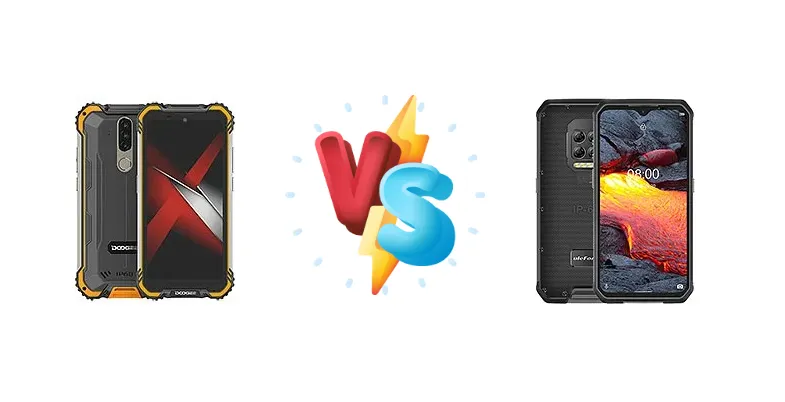
The rugged smartphone market caters to users needing durability, but performance varies greatly. We pit the Doogee S58 Pro, a more budget-focused option, against the Ulefone Armor 9E, which aims for a higher performance tier within the rugged category. This comparison focuses on how chipset choices impact real-world usability.
🏆 Quick Verdict
For the average user prioritizing responsiveness and multitasking, the Ulefone Armor 9E is the clear winner. Its Helio P90 chipset delivers a substantial performance advantage over the Doogee S58 Pro’s Helio P22. While the S58 Pro offers a slightly faster charging speed, the Armor 9E’s processing power justifies the trade-off.
| Network |
|---|
| 2G bands | GSM 850 / 900 / 1800 / 1900 | GSM 850 / 900 / 1800 / 1900 |
| 3G bands | HSDPA 850 / 900 / 1900 / 2100 | HSDPA 850 / 900 / 1700(AWS) / 1900 / 2100 |
| 4G bands | 1, 3, 7, 8, 20 | 1, 2, 3, 4, 5, 7, 8, 12, 13, 17, 18, 19, 20, 25, 26, 28, 34, 38, 39, 40, 41, 66 |
| Speed | HSPA, LTE | HSPA 42.2/11.5 Mbps, LTE Cat12 600/150 Mbps |
| Technology | GSM / HSPA / LTE | GSM / CDMA / HSPA / EVDO / LTE |
| | - | CDMA2000 1xEV-DO |
| Launch |
|---|
| Announced | 2020, August 07. Released 2020, August | 2020, September 08. Released 2020, September 08 |
| Status | Discontinued | Discontinued |
| Body |
|---|
| Build | - | Front glass, aluminum back with rubber, aluminum frame |
| Dimensions | 162.8 x 81 x 15.9 mm (6.41 x 3.19 x 0.63 in) | 168.2 x 82 x 15 mm (6.62 x 3.23 x 0.59 in) |
| SIM | Nano-SIM + Nano-SIM | Nano-SIM + Nano-SIM |
| Weight | 284 g (10.02 oz) | 324 g (11.43 oz) |
| | - | IP68/IP69K dust/water resistant (up to 1.5m for 30 min)
Drop-to-concrete resistance from up to 1.2m
MIL-STD-810G compliant |
| Display |
|---|
| Protection | Corning Gorilla Glass | Scratch-resistant glass, oleophobic coating |
| Resolution | 720 x 1520 pixels, 19:9 ratio (~295 ppi density) | 1080 x 2340 pixels, 19.5:9 ratio (~409 ppi density) |
| Size | 5.71 inches, 81.4 cm2 (~61.7% screen-to-body ratio) | 6.3 inches, 97.4 cm2 (~70.6% screen-to-body ratio) |
| Type | IPS LCD | IPS LCD |
| Platform |
|---|
| CPU | Octa-core 2.0 GHz Cortex-A53 | Octa-core (2x2.2 GHz Cortex-A75 & 6x2.0 GHz Cortex-A55) |
| Chipset | Mediatek MT6762V Helio P22 (12 nm) | Mediatek MT6779 Helio P90 (12 nm) |
| GPU | PowerVR GE8320 | PowerVR GM9446 |
| OS | Android 10 | Android 10 |
| Memory |
|---|
| Card slot | microSDXC (uses shared SIM slot) | microSDXC (uses shared SIM slot) |
| Internal | 64GB 6GB RAM | 128GB 8GB RAM |
| | - | UFS 2.1 |
| Main Camera |
|---|
| Features | LED flash, HDR, panorama | Quad-LED flash, HDR, panorama |
| Quad | - | 64 MP, f/1.9, 26mm (wide), 1/1.72", 0.8µm, PDAF
8 MP, f/2.4, 100˚ (ultrawide), 1/4.0", 1.12µm
2 MP (macro)
Auxiliary lens |
| Triple | 16 MP, f/2.0, (wide), PDAF
2 MP (macro)
Auxiliary lens | - |
| Video | 1080p | 4K@30fps, 1080p@30fps |
| Selfie camera |
|---|
| Features | - | HDR, panorama |
| Single | 16 MP, f/2.0, (wide) | 8 MP, f/2.2 |
| Video | 1080p | 1080p@30fps |
| Sound |
|---|
| 3.5mm jack | - | Yes |
| 35mm jack | Yes | Yes |
| Loudspeaker | Yes | Yes |
| Comms |
|---|
| Bluetooth | 5.0, A2DP, LE | 5.0, A2DP, LE |
| NFC | Yes | Yes |
| Positioning | GPS, GLONASS, GALILEO, BDS | GPS, GLONASS, GALILEO, BDS |
| Radio | FM radio | FM radio, RDS, recording |
| USB | USB Type-C 2.0, OTG | USB Type-C 2.0, OTG, accessory connector |
| WLAN | Wi-Fi 802.11 a/b/g/n | Wi-Fi 802.11 a/b/g/n/ac, Wi-Fi Direct |
| Features |
|---|
| Sensors | Fingerprint (rear-mounted), accelerometer, proximity, compass | Fingerprint (side-mounted), accelerometer, gyro, proximity, compass, coulombmeter |
| | - | Endoscope mount (camera sold separately) |
| Battery |
|---|
| Charging | 24W wired | 18W wired |
| Type | 5180 mAh | Li-Po 6600 mAh |
| Misc |
|---|
| Colors | Black, Orange, Green | Black |
| Price | About 170 EUR | About 290 EUR |
Doogee S58 Pro
- More affordable price point
- Faster wired charging (24W)
- Rugged design for durability
- Significantly weaker processor (Helio P22)
- Limited multitasking capabilities
- Potentially slower app loading times
Ulefone Armor 9E
- Much more powerful processor (Helio P90)
- Improved multitasking and app performance
- More efficient chipset for better battery life
- Slower wired charging (18W)
- Higher price compared to the S58 Pro
- May experience more heat under sustained load
Display Comparison
Neither device’s display specifications are provided, so a direct comparison is limited. However, given the Armor 9E’s positioning as a more premium device, it likely features a slightly higher quality panel. Both phones, being rugged, will prioritize durability over peak display performance, meaning expect standard LCD panels rather than OLED. Bezels are likely to be substantial on both to contribute to drop protection.
Camera Comparison
Without detailed camera specifications, a precise comparison is difficult. However, the Armor 9E’s higher overall performance suggests it likely benefits from a more capable image signal processor (ISP) within the Helio P90. This could lead to faster image processing, improved dynamic range, and better low-light performance. The presence of a more powerful chipset often allows for more sophisticated computational photography features. It's reasonable to assume the Armor 9E will offer a more refined camera experience, even if the sensor sizes are similar.
Performance
The Ulefone Armor 9E’s Mediatek Helio P90 chipset represents a significant leap in performance over the Doogee S58 Pro’s Helio P22. The P90 utilizes a dual-cluster configuration with 2x 2.2 GHz Cortex-A75 cores and 6x 2.0 GHz Cortex-A55 cores, offering substantially improved single-core and multi-core performance compared to the P22’s octa-core 2.0 GHz Cortex-A53 setup. This translates to faster app loading times, smoother multitasking, and a more responsive user experience. The P90’s architecture is better suited for demanding tasks like video editing or gaming. While both chipsets are built on a 12nm process, the P90’s more efficient core design will likely result in better sustained performance under load.
Battery Life
The Doogee S58 Pro supports 24W wired charging, while the Ulefone Armor 9E is limited to 18W. This suggests the S58 Pro *could* charge slightly faster, assuming similar battery capacities. However, the Armor 9E’s more efficient Helio P90 chipset may offset this difference by consuming less power during typical usage. Real-world battery life will depend heavily on usage patterns, but the P90’s efficiency gives the Armor 9E an advantage in sustained use scenarios.
Buying Guide
Buy the Doogee S58 Pro if you need a highly affordable, basic rugged phone for essential communication and light tasks. It’s ideal for users who prioritize cost above all else and don’t require demanding app performance. Buy the Ulefone Armor 9E if you prefer a rugged phone capable of handling more intensive applications, moderate gaming, and smoother multitasking. This is the better choice for users who need a phone that can keep up with their active lifestyle and work demands.
Frequently Asked Questions
❓ Will the Ulefone Armor 9E handle demanding games like PUBG Mobile smoothly?
The Helio P90 in the Armor 9E is capable of running PUBG Mobile, but expect to adjust graphics settings for optimal performance. While it won’t deliver flagship-level frame rates, the P90 provides a significantly better gaming experience than the Helio P22 in the S58 Pro, which would likely struggle with consistent performance.
❓ Is the difference in charging speed between 24W and 18W noticeable in real-world use?
The difference will be noticeable, but not dramatic. The Doogee S58 Pro’s 24W charging will likely shave off around 15-20 minutes from a full 0-100% charge compared to the Ulefone Armor 9E’s 18W charging, assuming similar battery capacities. However, the Armor 9E’s more efficient processor may reduce the overall time spent charging due to lower power consumption during use.
❓ Which phone is better for outdoor work requiring GPS navigation and map applications?
The Ulefone Armor 9E is better suited for outdoor work involving GPS and mapping. The Helio P90’s superior processing power will ensure smoother map rendering, faster route calculations, and more reliable GPS lock, especially in challenging environments.