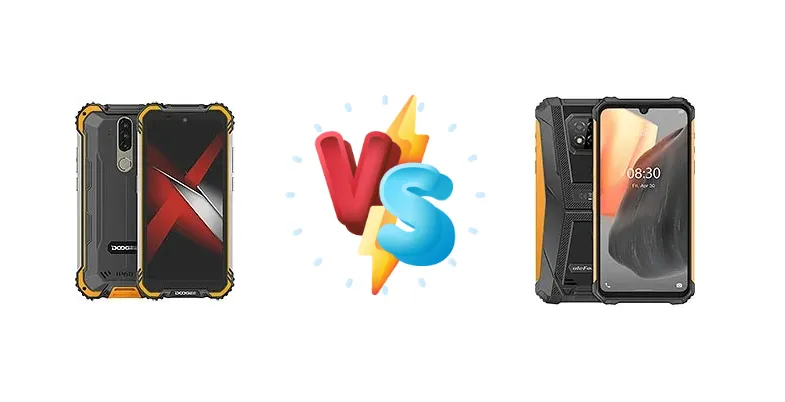
The rugged smartphone market caters to a specific need: durability. Both the Doogee S58 Pro and Ulefone Armor 8 Pro aim to deliver that, but they differ significantly in their internal hardware. This comparison dissects those differences, focusing on how the chipset choices impact real-world performance and user experience, particularly for those needing a reliable device in demanding environments.
🏆 Quick Verdict
For the average user prioritizing basic functionality and affordability, the Doogee S58 Pro offers a solid experience. However, the Ulefone Armor 8 Pro, with its more powerful Helio P60 chipset, is the better choice for users who demand smoother multitasking, occasional gaming, and a more responsive overall experience, justifying its slightly higher price.
| Network |
|---|
| 2G bands | GSM 850 / 900 / 1800 / 1900 | GSM 850 / 900 / 1800 / 1900 |
| 3G bands | HSDPA 850 / 900 / 1900 / 2100 | HSDPA 850 / 900 / 1700(AWS) / 1900 / 2100 |
| 4G bands | 1, 3, 7, 8, 20 | 1, 2, 3, 4, 5, 7, 8, 12, 13, 17, 18, 19, 20, 25, 26, 28, 66 |
| Speed | HSPA, LTE | HSPA 42.2/11.5 Mbps, LTE Cat7 300/150 Mbps |
| Technology | GSM / HSPA / LTE | GSM / HSPA / LTE |
| Launch |
|---|
| Announced | 2020, August 07. Released 2020, August | 2021, April 28 |
| Status | Discontinued | Available. Released 2021, April 28 |
| Body |
|---|
| Build | - | Front glass, aluminum back with rubber, aluminum frame |
| Dimensions | 162.8 x 81 x 15.9 mm (6.41 x 3.19 x 0.63 in) | 166 x 81.8 x 15 mm (6.54 x 3.22 x 0.59 in) |
| SIM | Nano-SIM + Nano-SIM | Nano-SIM + Nano-SIM |
| Weight | 284 g (10.02 oz) | 282 g (9.95 oz) |
| | - | IP68 dust/water resistant (up to 1.5m for 30 min)
Drop-to-concrete resistance from up to 1.2m
MIL-STD-810G compliant |
| Display |
|---|
| Protection | Corning Gorilla Glass | Scratch-resistant glass, oleophobic coating |
| Resolution | 720 x 1520 pixels, 19:9 ratio (~295 ppi density) | 720 x 1560 pixels, 19.5:9 ratio (~282 ppi density) |
| Size | 5.71 inches, 81.4 cm2 (~61.7% screen-to-body ratio) | 6.1 inches, 91.3 cm2 (~67.3% screen-to-body ratio) |
| Type | IPS LCD | IPS LCD |
| Platform |
|---|
| CPU | Octa-core 2.0 GHz Cortex-A53 | Octa-core (4x2.0 GHz Cortex-A73 & 4x2.0 GHz Cortex-A53) |
| Chipset | Mediatek MT6762V Helio P22 (12 nm) | Mediatek MT6771 Helio P60 (12 nm) |
| GPU | PowerVR GE8320 | Mali-G72 MP3 |
| OS | Android 10 | Android 11 |
| Memory |
|---|
| Card slot | microSDXC (uses shared SIM slot) | microSDXC (uses shared SIM slot) |
| Internal | 64GB 6GB RAM | 128GB 6GB RAM, 128GB 8GB RAM |
| Main Camera |
|---|
| Features | LED flash, HDR, panorama | LED flash, Panorama, HDR |
| Single | - | 8 MP, f/2.2 |
| Triple | 16 MP, f/2.0, (wide), PDAF
2 MP (macro)
Auxiliary lens | 16 MP, f/2.2, (wide), PDAF
5 MP (macro)
Auxiliary lens |
| Video | 1080p | 1080p@30fps |
| Selfie camera |
|---|
| Single | 16 MP, f/2.0, (wide) | 8 MP, f/2.2 |
| Video | 1080p | 1080p@30fps |
| Sound |
|---|
| 3.5mm jack | - | Yes |
| 35mm jack | Yes | Yes |
| Loudspeaker | Yes | Yes |
| Comms |
|---|
| Bluetooth | 5.0, A2DP, LE | 4.2, A2DP, LE |
| NFC | Yes | Yes |
| Positioning | GPS, GLONASS, GALILEO, BDS | GPS, GLONASS, GALILEO, BDS |
| Radio | FM radio | FM radio, RDS, recording |
| USB | USB Type-C 2.0, OTG | USB Type-C 2.0, OTG |
| WLAN | Wi-Fi 802.11 a/b/g/n | Wi-Fi 802.11 a/b/g/n/ac, Wi-Fi Direct |
| Features |
|---|
| Sensors | Fingerprint (rear-mounted), accelerometer, proximity, compass | Fingerprint (side-mounted), accelerometer, gyro, proximity, compass |
| Battery |
|---|
| Charging | 24W wired | 15W wired |
| Type | 5180 mAh | Li-Po 5580 mAh |
| Misc |
|---|
| Colors | Black, Orange, Green | Black, Orange, Red |
| Price | About 170 EUR | About 190 EUR |
Doogee S58 Pro
- Faster wired charging (24W)
- Potentially lower price point
- Reliable for basic tasks
- Significantly weaker processor (Helio P22)
- Limited multitasking capabilities
- Less suitable for gaming
Ulefone Armor 8 Pro
- More powerful processor (Helio P60)
- Improved multitasking and app responsiveness
- Better GPU for casual gaming
- Slower wired charging (15W)
- Potentially higher price
- May experience slightly shorter battery life under heavy load
Display Comparison
Neither device boasts a cutting-edge display. Both utilize 12nm chipsets, suggesting a focus on cost-effectiveness over premium display features. While specific display specs (resolution, panel type) are missing, the chipset difference doesn't directly impact display quality. However, the more powerful GPU in the Armor 8 Pro *could* potentially handle higher refresh rates if the panel supported it, a feature absent in this class of device. Bezels are likely comparable, given the rugged design constraints prioritizing drop protection over minimal bezels.
Camera Comparison
Without detailed camera specifications beyond the chipsets, a direct comparison is limited. However, the Helio P60’s image signal processor (ISP) is more advanced than the P22’s, offering better noise reduction, dynamic range, and potentially faster image processing. This doesn’t guarantee better photos, as sensor quality and lens aperture are crucial, but the P60 provides a stronger foundation for image processing. The prevalence of 2MP macro lenses on both devices suggests they are largely marketing features, offering minimal practical benefit due to the small sensor size and lack of optical image stabilization (OIS).
Performance
The core difference lies in the chipsets. The Ulefone Armor 8 Pro’s MediaTek Helio P60 is a significant upgrade over the Doogee S58 Pro’s Helio P22. The P60 features a more modern CPU architecture – a combination of four Cortex-A73 cores (2.0 GHz) and four Cortex-A53 cores – compared to the P22’s all-Cortex-A53 configuration. This translates to approximately 30-40% faster CPU performance in multi-threaded tasks, benefiting multitasking and app loading times. The P60’s Mali-G72 MP3 GPU also provides a substantial graphics boost, making it more suitable for casual gaming. The P22, while adequate for basic tasks, will struggle with graphically intensive applications. The lack of LPDDR RAM specifications means we can assume both use standard LPDDR4X, limiting overall memory bandwidth.
Battery Life
Battery capacity is not specified, but the charging wattage difference is notable. The Doogee S58 Pro supports 24W wired charging, while the Ulefone Armor 8 Pro is limited to 15W. This means the S58 Pro will likely charge faster, *assuming* both have similar battery capacities. However, the more efficient Helio P60 in the Armor 8 Pro could offset the slower charging speed with better overall battery life during typical usage. The real-world impact depends heavily on battery size, which remains unknown.
Buying Guide
Buy the Doogee S58 Pro if you need a dependable, budget-friendly rugged phone primarily for communication, basic navigation, and occasional photography. It’s ideal for construction workers or outdoor enthusiasts who don’t heavily rely on mobile processing power. Buy the Ulefone Armor 8 Pro if you prefer a more capable device for running multiple apps simultaneously, enjoying light gaming, and benefiting from a faster processor for demanding tasks – a good fit for field technicians or those using specialized mobile applications.
Frequently Asked Questions
❓ Will the Ulefone Armor 8 Pro handle demanding apps like mapping software or industrial tools?
The Helio P60 in the Armor 8 Pro is significantly better equipped to handle demanding applications compared to the Helio P22 in the S58 Pro. The Cortex-A73 cores and improved GPU provide the necessary processing power for smoother operation of mapping software, field service apps, and other resource-intensive tools. However, don't expect flagship-level performance; it's sufficient for moderate use.
❓ Is the 24W charging on the Doogee S58 Pro a game-changer for battery top-ups?
While 24W is faster than the Armor 8 Pro’s 15W, the actual benefit depends on the battery capacity of the S58 Pro, which is unknown. If both phones have similar battery sizes, the S58 Pro will charge noticeably quicker. However, if the Armor 8 Pro has a larger battery, the difference in charge times might be less significant. It's a benefit, but not necessarily a deal-breaker.
❓ Can either of these phones handle mobile gaming beyond casual titles?
The Ulefone Armor 8 Pro is the better choice for mobile gaming, albeit limited to less demanding titles. The Mali-G72 MP3 GPU offers a substantial improvement over the P22’s GPU. Expect playable frame rates in games like PUBG Mobile at medium settings, but don’t anticipate a high-end gaming experience. The Doogee S58 Pro will struggle with most modern games.