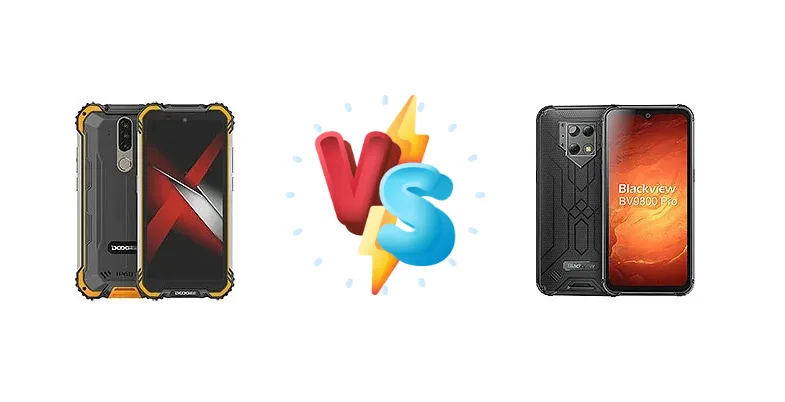
The rugged smartphone market caters to users needing durability and reliability in challenging environments. Both the Doogee S58 Pro and Blackview BV9800 Pro aim to deliver this, but they approach it with different internal hardware. This comparison dissects their key specifications to determine which device offers the best balance of performance and resilience for demanding users.
🏆 Quick Verdict
For the average user prioritizing responsiveness and smoother multitasking, the Blackview BV9800 Pro emerges as the better choice. Its Helio P70 chipset, featuring Cortex-A73 cores, provides a noticeable performance uplift over the Doogee S58 Pro’s Helio P22, despite the slower 18W charging.
| Network |
|---|
| 2G bands | GSM 850 / 900 / 1800 / 1900 | GSM 850 / 900 / 1800 / 1900 |
| 3G bands | HSDPA 850 / 900 / 1900 / 2100 | HSDPA 800 / 850 / 900 / 1700(AWS) / 1900 / 2100 |
| 4G bands | 1, 3, 7, 8, 20 | 1, 2, 3, 4, 5, 6, 7, 8, 12, 13, 17, 18, 19, 20, 25, 26, 28, 34, 38, 39, 40, 41, 66 |
| Speed | HSPA, LTE | HSPA, LTE |
| Technology | GSM / HSPA / LTE | GSM / CDMA / HSPA / CDMA2000 / LTE |
| Launch |
|---|
| Announced | 2020, August 07. Released 2020, August | 2019, October 28. Released 2019, November |
| Status | Discontinued | Discontinued |
| Body |
|---|
| Dimensions | 162.8 x 81 x 15.9 mm (6.41 x 3.19 x 0.63 in) | 168.5 x 81 x 14.8 mm (6.63 x 3.19 x 0.58 in) |
| SIM | Nano-SIM + Nano-SIM | Nano-SIM + Nano-SIM |
| Weight | 284 g (10.02 oz) | 322 g (11.36 oz) |
| Display |
|---|
| Protection | Corning Gorilla Glass | - |
| Resolution | 720 x 1520 pixels, 19:9 ratio (~295 ppi density) | 1080 x 2340 pixels, 19.5:9 ratio (~409 ppi density) |
| Size | 5.71 inches, 81.4 cm2 (~61.7% screen-to-body ratio) | 6.3 inches, 97.4 cm2 (~71.4% screen-to-body ratio) |
| Type | IPS LCD | IPS LCD |
| Platform |
|---|
| CPU | Octa-core 2.0 GHz Cortex-A53 | Octa-core (4x2.1 GHz Cortex-A73 & 4x2.0 GHz Cortex-A53) |
| Chipset | Mediatek MT6762V Helio P22 (12 nm) | Mediatek MT6771V/CT Helio P70 (12 nm) |
| GPU | PowerVR GE8320 | Mali-G72 MP3 |
| OS | Android 10 | Android 9.0 (Pie) |
| Memory |
|---|
| Card slot | microSDXC (uses shared SIM slot) | microSDXC |
| Internal | 64GB 6GB RAM | 128GB 6GB RAM |
| Main Camera |
|---|
| Features | LED flash, HDR, panorama | Thermal imaging, LED flash |
| Triple | 16 MP, f/2.0, (wide), PDAF
2 MP (macro)
Auxiliary lens | 48 MP, (wide), PDAF
5 MP, thermal assisted camera
FLIR thermal camera (Lepton module) |
| Video | 1080p | 1080p@30fps |
| Selfie camera |
|---|
| Single | 16 MP, f/2.0, (wide) | 16 MP, f/2.0, (wide) |
| Video | 1080p | 1080p@30fps |
| Sound |
|---|
| 35mm jack | Yes | Yes |
| Loudspeaker | Yes | Yes |
| Comms |
|---|
| Bluetooth | 5.0, A2DP, LE | 4.1, A2DP |
| NFC | Yes | Yes |
| Positioning | GPS, GLONASS, GALILEO, BDS | GPS, GLONASS, GALILEO |
| Radio | FM radio | FM radio |
| USB | USB Type-C 2.0, OTG | USB Type-C 2.0, OTG |
| WLAN | Wi-Fi 802.11 a/b/g/n | Wi-Fi 802.11 a/b/g/n/ac |
| Features |
|---|
| Sensors | Fingerprint (rear-mounted), accelerometer, proximity, compass | Fingerprint (side-mounted), accelerometer, gyro, proximity, compass, barometer |
| Battery |
|---|
| Charging | 24W wired | 18W wired |
| Type | 5180 mAh | 6580 mAh |
| Misc |
|---|
| Colors | Black, Orange, Green | Black, Orange |
| Price | About 170 EUR | About 340 EUR |
Doogee S58 Pro
- Faster 24W wired charging.
- Potentially more affordable price point.
- Rugged design for durability.
- Less powerful Helio P22 chipset.
- Slower app loading and multitasking.
- Limited gaming capabilities.
Blackview BV9800 Pro
- More powerful Helio P70 chipset.
- Smoother multitasking and app performance.
- Better suited for moderate gaming.
- Potentially more efficient power consumption.
- Slower 18W wired charging.
- May be slightly more expensive.
- Rugged design, but potentially bulkier.
Display Comparison
Neither device boasts a cutting-edge display. Both likely utilize IPS LCD panels, common in this price bracket. However, detailed display specs (resolution, brightness) are missing. The focus here is on ruggedness, not visual fidelity. Expect adequate outdoor visibility, but not flagship-level color accuracy or peak brightness. Bezels are likely substantial on both to contribute to drop protection.
Camera Comparison
Without detailed camera specifications beyond the chipsets, a direct comparison is limited. Both phones likely feature multiple rear cameras, but the quality will heavily depend on sensor size and image processing. The presence of a 2MP macro camera on either device is largely a marketing tactic, offering minimal practical benefit. The P70’s ISP (Image Signal Processor) in the BV9800 Pro *may* offer slightly better image processing capabilities, but this is speculative without further data. Expect adequate performance in good lighting conditions from both, but struggles in low-light scenarios.
Performance
The core difference lies in the chipsets. The Blackview BV9800 Pro’s MediaTek Helio P70 is a significant step up from the Doogee S58 Pro’s Helio P22. The P70 utilizes a dual-cluster configuration with four Cortex-A73 cores clocked at 2.1 GHz, providing a substantial boost in single-core and multi-core performance compared to the P22’s all-Cortex-A53 setup at 2.0 GHz. This translates to snappier app launches, smoother scrolling, and a more responsive overall experience. While both are 12nm chips, the architectural improvements in the P70 are key. Users who frequently switch between apps or engage in moderate gaming will find the BV9800 Pro far more capable.
Battery Life
Battery capacity is not specified, making a direct mAh comparison impossible. However, the charging speeds differ: the Doogee S58 Pro supports 24W wired charging, while the Blackview BV9800 Pro is limited to 18W. This means the S58 Pro will theoretically charge faster, *assuming* similar battery capacities. However, the P70’s more efficient architecture in the BV9800 Pro could offset some of this difference in real-world usage, potentially leading to comparable battery life despite the slower charging.
Buying Guide
Buy the Doogee S58 Pro if you need a highly affordable, basic rugged phone for essential communication and light tasks, and prioritize a slightly faster charging speed. Buy the Blackview BV9800 Pro if you prefer a more responsive user experience for moderate multitasking, streaming, and occasional gaming, and are willing to trade a bit of charging speed for improved processing power.
Frequently Asked Questions
❓ Will the Blackview BV9800 Pro handle demanding games like PUBG Mobile?
The Helio P70 in the BV9800 Pro is capable of running PUBG Mobile, but likely at medium settings to maintain a stable frame rate. The P22 in the Doogee S58 Pro will struggle with consistent performance in PUBG, even on the lowest settings.
❓ How much does the slower charging speed of the Blackview BV9800 Pro impact real-world usage?
While the BV9800 Pro charges slower at 18W, the more efficient Helio P70 chipset may result in comparable overall battery life. The difference in charging time will be noticeable, but the improved performance could offset this for many users.
❓ Are either of these phones likely to receive significant software updates?
Neither Doogee nor Blackview are known for extensive software support. Expect minimal updates beyond security patches, if any. Don't purchase these phones expecting long-term Android version upgrades.
❓ What level of water and dust resistance can I expect from these devices?
Both phones are marketed as rugged, likely adhering to an IP68 or IP69K rating. This means they should be resistant to dust ingress and submersion in water for a limited time. However, the specific level of protection can vary, and it's best to avoid prolonged exposure to extreme conditions.