
Doogee S51 vs. Ulefone Power Armor 13: A Deep Dive into Rugged Smartphone Performance
| Phones Images | |||||
|---|---|---|---|---|---|
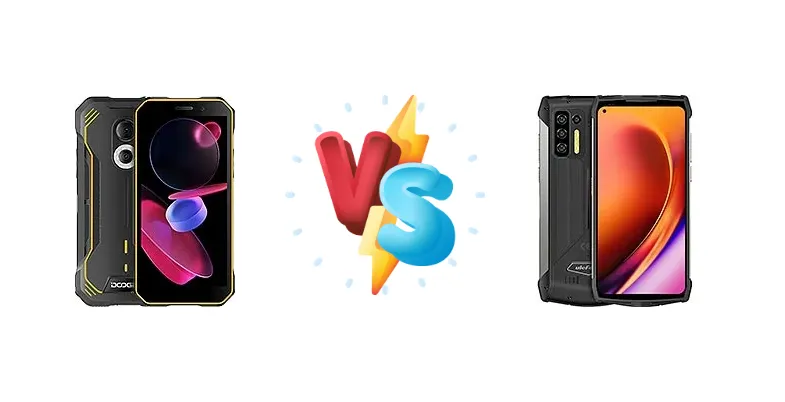
|
🏆 Quick Verdict
For the average user prioritizing value and basic functionality, the Doogee S51 offers a compelling entry point into the rugged phone world. However, the Ulefone Power Armor 13 is the superior choice for those needing more processing power for demanding tasks and faster charging capabilities, justifying its higher price point.
| PHONES | ||
|---|---|---|
| Phone Names | Doogee S51 | Ulefone Power Armor 13 |
| Network | ||
|---|---|---|
| 2G bands | GSM 850 / 900 / 1800 / 1900 | GSM 850 / 900 / 1800 / 1900 |
| 3G bands | HSDPA 800 / 850 / 900 / 1700(AWS) / 1900 / 2100 | HSDPA 850 / 900 / 1700(AWS) / 1900 / 2100 |
| 4G bands | 1, 2, 3, 4, 5, 7, 8, 12, 13, 17, 18, 19, 20, 25, 26, 28, 34, 38, 39, 40, 41, 66 | 1, 2, 3, 4, 5, 7, 8, 12, 13, 17, 18, 19, 20, 25, 26, 28, 38, 40, 66 |
| Speed | HSPA, LTE | HSPA 42.2/11.5 Mbps, LTE Cat12 600/150 Mbps |
| Technology | GSM / CDMA / HSPA / LTE | GSM / HSPA / LTE |
| Launch | ||
|---|---|---|
| Announced | 2022, September | 2021, July 22 |
| Status | Available. Released 2022, September | Available. Released 2021, July 26 |
| Body | ||
|---|---|---|
| Dimensions | 167.4 x 81.4 x 14.6 mm (6.59 x 3.20 x 0.57 in) | 183.7 x 85.4 x 20.8 mm (7.23 x 3.36 x 0.82 in) |
| SIM | Nano-SIM + Nano-SIM | Nano-SIM + Nano-SIM |
| Weight | - | 492 g (1.08 lb) |
| - | IP68 dust/water resistant (up to 1.5m for 30 min) Drop-to-concrete resistance from up to 1.2m MIL-STD-810G compliant | |
| Display | ||
|---|---|---|
| Protection | Corning Gorilla Glass | Corning Gorilla Glass 3 |
| Resolution | 720 x 1440 pixels, 18:9 ratio (~268 ppi density) | 1080 x 2400 pixels, 20:9 ratio (~386 ppi density) |
| Size | 6.0 inches, 92.9 cm2 (~68.2% screen-to-body ratio) | 6.81 inches, 112.0 cm2 (~71.4% screen-to-body ratio) |
| Type | IPS LCD | IPS LCD |
| Platform | ||
|---|---|---|
| CPU | Octa-core (4x2.0 GHz Cortex-A53 & 4x1.5 GHz Cortex-A53) | Octa-core (2x2.05 GHz Cortex-A76 & 6x2.0 GHz Cortex-A55) |
| Chipset | Mediatek Helio G25 (12 nm) | Mediatek MT6785V/CD Helio G95 (12 nm) |
| GPU | PowerVR GE8320 | Mali-G76 MC4 |
| OS | Android 12 | Android 11 |
| Memory | ||
|---|---|---|
| Card slot | microSDXC (dedicated slot) | microSDXC (uses shared SIM slot) |
| Internal | 64GB 4GB RAM | 256GB 8GB RAM |
| Main Camera | ||
|---|---|---|
| Dual | 12 MP, f/1.8, (wide), PDAF Auxiliary lens | - |
| Features | Quad-LED flash | Quad-LED flash, HDR, panorama |
| Penta | - | 48 MP, f/1.8, 26mm (wide), 1/2.0", 0.8µm, PDAF 8 MP, f/2.2, (ultrawide) 2 MP (macro) Auxiliary lens |
| Video | 1080p | 4K@30fps, 1080p@30fps |
| Selfie camera | ||
|---|---|---|
| Features | - | HDR, panorama |
| Single | 8 MP, f/2.0, (wide) | 16 MP, f/2.2 |
| Video | 1080p | 1080p@30fps |
| Sound | ||
|---|---|---|
| 3.5mm jack | - | Yes |
| 35mm jack | Yes | Yes |
| Loudspeaker | Yes | Yes |
| Comms | ||
|---|---|---|
| Bluetooth | 5.0, A2DP, LE | 5.0, A2DP, LE |
| NFC | Yes | Yes |
| Positioning | GPS, GLONASS, GALILEO, BDS | GPS, GLONASS, GALILEO, BDS |
| Radio | FM radio | FM radio, RDS, recording |
| USB | USB Type-C 2.0, OTG | - |
| WLAN | Wi-Fi 802.11 a/b/g/n/ac, dual-band | Wi-Fi 802.11 a/b/g/n/ac, dual-band |
| Features | ||
|---|---|---|
| Sensors | Accelerometer, proximity, compass | Fingerprint (side-mounted), accelerometer, gyro, proximity, compass, baroceptor, coulombmeter |
| - | Infrared distance measure (error range: 1~20m, ±10mm; 20~40m, ±25mm) | |
| Battery | ||
|---|---|---|
| Charging | 10W wired | 33W wired 15W wireless 5W reverse wireless |
| Type | 5180 mAh | Li-Po 13200 mAh |
| Misc | ||
|---|---|---|
| Colors | Black, Green, Orange | Black |
| Price | - | About 300 EUR |
| Tests | ||
|---|---|---|
| Battery life | - | Endurance rating 296h |
| Camera | - | Photo / Video |
| Display | - | Contrast ratio: 1306:1 (nominal) |
| Loudspeaker | - | -28.3 LUFS (Average) |
| Performance | - | AnTuTu: 294194 (v8), 351678 (v9) GeekBench: 1610 (v5.1) GFXBench: 18fps (ES 3.1 onscreen) |
Doogee S51
- More affordable price point
- Rugged design for durability
- Acceptable battery life for basic use
- Slow 10W charging
- Less powerful Helio G25 chipset
- Likely limited camera performance
Ulefone Power Armor 13
- Faster 33W wired and 15W wireless charging
- More powerful Helio G95 chipset
- Brighter display for outdoor visibility
- Higher price compared to the Doogee S51
- Similar battery endurance rating despite faster charging
- Rugged design adds bulk
Display Comparison
Both devices share a contrast ratio of 1306:1, suggesting similar visual depth. However, the Ulefone Power Armor 13 boasts a measured peak brightness of 401 nits, a crucial advantage for outdoor visibility compared to the Doogee S51, which lacks published brightness data. While both are likely to utilize IPS LCD panels given the price points, the higher brightness of the Ulefone provides a more usable experience in direct sunlight, a common scenario for rugged phone users.
Camera Comparison
Both phones list 'Photo / Video' capabilities, but lack specific details. Given the market segment, image quality is unlikely to be a primary focus. However, the Ulefone Power Armor 13’s chipset includes a more capable ISP (Image Signal Processor) within the Helio G95, potentially leading to better image processing and noise reduction, even with similar sensor configurations. The absence of sensor size information makes a definitive comparison impossible, but the G95’s processing power gives Ulefone an edge.
Performance
The Ulefone Power Armor 13’s Mediatek Helio G95 chipset represents a significant leap in performance over the Doogee S51’s Helio G25. The G95 features two Cortex-A76 cores clocked at 2.05 GHz alongside six Cortex-A55 cores, a configuration designed for more responsive multitasking and gaming. The S51’s G25 utilizes four Cortex-A53 cores at 2.0 GHz and another four at 1.5 GHz, which will struggle with more demanding applications. This architectural difference translates to a noticeably smoother user experience on the Ulefone, particularly when running multiple apps or playing graphically intensive games.
Battery Life
Both devices share an endurance rating of 296 hours, suggesting comparable battery life under similar usage conditions. However, the Ulefone Power Armor 13’s charging capabilities are vastly superior. It supports 33W wired charging, 15W wireless charging, and even 5W reverse wireless charging, allowing it to top up significantly faster than the Doogee S51’s limited 10W wired charging. This difference is critical for users who need to quickly recharge their device in the field, making the Ulefone a more practical choice for extended outdoor use.
Buying Guide
Buy the Doogee S51 if you need a dependable, budget-friendly rugged phone for essential communication and light tasks like navigation or basic photography. It’s ideal for construction workers, hikers on shorter trails, or anyone needing a durable secondary device. Buy the Ulefone Power Armor 13 if you prefer a more powerful device capable of handling demanding applications, extended gaming sessions, and benefit from significantly faster wired and wireless charging, making it suitable for professionals relying on their phone all day or those frequently venturing off-grid.