
Doogee S51 vs. Ulefone Armor 9E: A Deep Dive into Rugged Smartphone Performance
| Phones Images | |||||
|---|---|---|---|---|---|
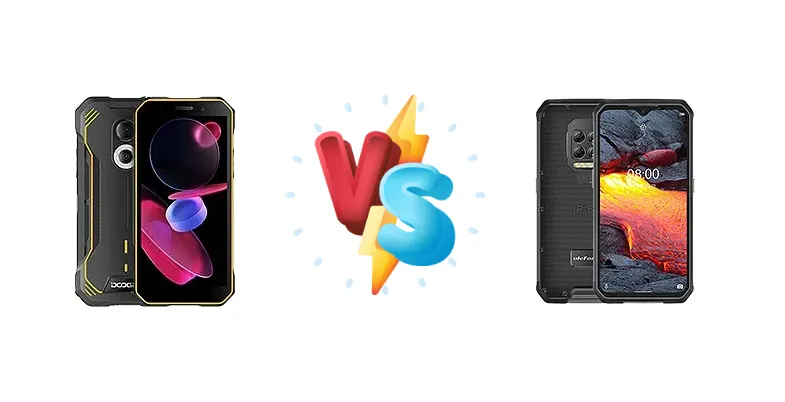
|
🏆 Quick Verdict
For the average user prioritizing a balance of affordability and usability, the Ulefone Armor 9E is the stronger choice. Its Helio P90 chipset provides a significant performance uplift over the Doogee S51’s Helio G25, translating to smoother multitasking and a more responsive user experience, despite the slower charging.
| PHONES | ||
|---|---|---|
| Phone Names | Doogee S51 | Ulefone Armor 9E |
| Network | ||
|---|---|---|
| 2G bands | GSM 850 / 900 / 1800 / 1900 | GSM 850 / 900 / 1800 / 1900 |
| 3G bands | HSDPA 800 / 850 / 900 / 1700(AWS) / 1900 / 2100 | HSDPA 850 / 900 / 1700(AWS) / 1900 / 2100 |
| 4G bands | 1, 2, 3, 4, 5, 7, 8, 12, 13, 17, 18, 19, 20, 25, 26, 28, 34, 38, 39, 40, 41, 66 | 1, 2, 3, 4, 5, 7, 8, 12, 13, 17, 18, 19, 20, 25, 26, 28, 34, 38, 39, 40, 41, 66 |
| Speed | HSPA, LTE | HSPA 42.2/11.5 Mbps, LTE Cat12 600/150 Mbps |
| Technology | GSM / CDMA / HSPA / LTE | GSM / CDMA / HSPA / EVDO / LTE |
| - | CDMA2000 1xEV-DO | |
| Launch | ||
|---|---|---|
| Announced | 2022, September | 2020, September 08. Released 2020, September 08 |
| Status | Available. Released 2022, September | Discontinued |
| Body | ||
|---|---|---|
| Build | - | Front glass, aluminum back with rubber, aluminum frame |
| Dimensions | 167.4 x 81.4 x 14.6 mm (6.59 x 3.20 x 0.57 in) | 168.2 x 82 x 15 mm (6.62 x 3.23 x 0.59 in) |
| SIM | Nano-SIM + Nano-SIM | Nano-SIM + Nano-SIM |
| Weight | - | 324 g (11.43 oz) |
| - | IP68/IP69K dust/water resistant (up to 1.5m for 30 min) Drop-to-concrete resistance from up to 1.2m MIL-STD-810G compliant | |
| Display | ||
|---|---|---|
| Protection | Corning Gorilla Glass | Scratch-resistant glass, oleophobic coating |
| Resolution | 720 x 1440 pixels, 18:9 ratio (~268 ppi density) | 1080 x 2340 pixels, 19.5:9 ratio (~409 ppi density) |
| Size | 6.0 inches, 92.9 cm2 (~68.2% screen-to-body ratio) | 6.3 inches, 97.4 cm2 (~70.6% screen-to-body ratio) |
| Type | IPS LCD | IPS LCD |
| Platform | ||
|---|---|---|
| CPU | Octa-core (4x2.0 GHz Cortex-A53 & 4x1.5 GHz Cortex-A53) | Octa-core (2x2.2 GHz Cortex-A75 & 6x2.0 GHz Cortex-A55) |
| Chipset | Mediatek Helio G25 (12 nm) | Mediatek MT6779 Helio P90 (12 nm) |
| GPU | PowerVR GE8320 | PowerVR GM9446 |
| OS | Android 12 | Android 10 |
| Memory | ||
|---|---|---|
| Card slot | microSDXC (dedicated slot) | microSDXC (uses shared SIM slot) |
| Internal | 64GB 4GB RAM | 128GB 8GB RAM |
| - | UFS 2.1 | |
| Main Camera | ||
|---|---|---|
| Dual | 12 MP, f/1.8, (wide), PDAF Auxiliary lens | - |
| Features | Quad-LED flash | Quad-LED flash, HDR, panorama |
| Quad | - | 64 MP, f/1.9, 26mm (wide), 1/1.72", 0.8µm, PDAF 8 MP, f/2.4, 100˚ (ultrawide), 1/4.0", 1.12µm 2 MP (macro) Auxiliary lens |
| Video | 1080p | 4K@30fps, 1080p@30fps |
| Selfie camera | ||
|---|---|---|
| Features | - | HDR, panorama |
| Single | 8 MP, f/2.0, (wide) | 8 MP, f/2.2 |
| Video | 1080p | 1080p@30fps |
| Sound | ||
|---|---|---|
| 3.5mm jack | - | Yes |
| 35mm jack | Yes | Yes |
| Loudspeaker | Yes | Yes |
| Comms | ||
|---|---|---|
| Bluetooth | 5.0, A2DP, LE | 5.0, A2DP, LE |
| NFC | Yes | Yes |
| Positioning | GPS, GLONASS, GALILEO, BDS | GPS, GLONASS, GALILEO, BDS |
| Radio | FM radio | FM radio, RDS, recording |
| USB | USB Type-C 2.0, OTG | USB Type-C 2.0, OTG, accessory connector |
| WLAN | Wi-Fi 802.11 a/b/g/n/ac, dual-band | Wi-Fi 802.11 a/b/g/n/ac, Wi-Fi Direct |
| Features | ||
|---|---|---|
| Sensors | Accelerometer, proximity, compass | Fingerprint (side-mounted), accelerometer, gyro, proximity, compass, coulombmeter |
| - | Endoscope mount (camera sold separately) | |
| Battery | ||
|---|---|---|
| Charging | 10W wired | 18W wired |
| Type | 5180 mAh | Li-Po 6600 mAh |
| Misc | ||
|---|---|---|
| Colors | Black, Green, Orange | Black |
| Price | - | About 290 EUR |
Doogee S51
- More affordable price point
- Rugged design for durability
- Simple and easy-to-use interface
- Significantly weaker processor
- Slow 10W charging
- Likely lower-quality display
Ulefone Armor 9E
- More powerful Helio P90 processor
- Faster 18W wired charging
- Potentially better camera performance
- Higher price compared to the S51
- May experience more heat under heavy load
- Rugged design may add bulk
Display Comparison
Neither device’s display specifications are provided, so a direct comparison is limited. However, given the S51’s positioning, it likely features a lower-resolution panel and potentially lower peak brightness. The Armor 9E, benefiting from its higher overall spec sheet, likely has a sharper and brighter display. The absence of details like refresh rate or panel technology (IPS vs. AMOLED) suggests both are targeting the budget end of the market, prioritizing durability over visual fidelity.
Camera Comparison
Without detailed camera specifications beyond the chipsets, a precise comparison is difficult. However, the Armor 9E’s more powerful processor allows for more sophisticated image processing, potentially resulting in better dynamic range and noise reduction. It’s reasonable to assume the Armor 9E will offer a more refined camera experience, even if the sensor sizes are similar. The S51’s Helio G25 will likely struggle with complex image processing tasks, leading to softer images and less detail in challenging lighting conditions. The presence of a dedicated Neural Processing Unit (NPU) in the P90 further enhances its image processing capabilities.
Performance
The Ulefone Armor 9E’s Mediatek Helio P90 chipset represents a substantial upgrade over the Doogee S51’s Helio G25. The P90 utilizes a more advanced CPU architecture – 2x2.2 GHz Cortex-A75 cores alongside 6x2.0 GHz Cortex-A55 cores – compared to the S51’s 4x2.0 GHz Cortex-A53 and 4x1.5 GHz Cortex-A53 configuration. This translates to significantly faster processing speeds and improved multitasking capabilities. The Cortex-A75 cores in the P90 are demonstrably more efficient and powerful than the Cortex-A53 cores found in the G25. While both chipsets are built on a 12nm process, the architectural improvements in the P90 provide a clear performance advantage for the Armor 9E.
Battery Life
Battery capacity isn’t specified for either device, but the Ulefone Armor 9E’s 18W wired charging is a clear advantage over the Doogee S51’s 10W charging. This means the Armor 9E will recharge significantly faster, minimizing downtime. While a larger battery capacity on the S51 could partially offset the slower charging, the faster charging speed of the Armor 9E is a more tangible benefit for users who rely on their phones throughout the day. The 18W charging allows for quicker top-ups, ensuring the phone is ready when needed.
Buying Guide
Buy the Doogee S51 if you need a highly affordable, basic rugged phone for essential communication and light tasks. It’s ideal for users who prioritize cost above all else and don’t require demanding app performance. Buy the Ulefone Armor 9E if you prefer a more capable device for moderate multitasking, occasional gaming, and a generally smoother user experience. It’s suited for users who need a rugged phone that can handle more than just calls and texts.