
Doogee S41T vs. Ulefone Power Armor 13: A Deep Dive into Rugged Smartphone Performance
| Phones Images | |||||
|---|---|---|---|---|---|
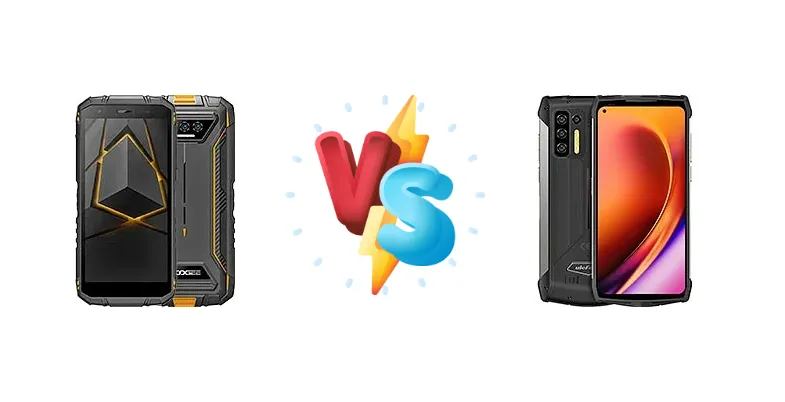
|
🏆 Quick Verdict
For the average user prioritizing raw performance and faster charging, the Ulefone Power Armor 13 is the better choice. Its Helio G95 chipset provides a noticeable boost over the S41T’s Unisoc T606. However, the Doogee S41T remains a compelling option for budget-conscious buyers who don't demand intensive processing power.
| PHONES | ||
|---|---|---|
| Phone Names | Doogee S41T | Ulefone Power Armor 13 |
| Network | ||
|---|---|---|
| 2G bands | GSM 850 / 900 / 1800 / 1900 | GSM 850 / 900 / 1800 / 1900 |
| 3G bands | HSDPA 850 / 900 / 1700(AWS) / 1900 / 2100 | HSDPA 850 / 900 / 1700(AWS) / 1900 / 2100 |
| 4G bands | 1, 2, 3, 4, 5, 7, 8, 18, 19, 20, 25, 26, 28, 34, 38, 39, 40, 41, 66 | 1, 2, 3, 4, 5, 7, 8, 12, 13, 17, 18, 19, 20, 25, 26, 28, 38, 40, 66 |
| Speed | HSPA, LTE | HSPA 42.2/11.5 Mbps, LTE Cat12 600/150 Mbps |
| Technology | GSM / HSPA / LTE | GSM / HSPA / LTE |
| Launch | ||
|---|---|---|
| Announced | 2023, December | 2021, July 22 |
| Status | Available. Released 2023, December | Available. Released 2021, July 26 |
| Body | ||
|---|---|---|
| Dimensions | 162.5 x 77.8 x 16.2 mm (6.40 x 3.06 x 0.64 in) | 183.7 x 85.4 x 20.8 mm (7.23 x 3.36 x 0.82 in) |
| SIM | Nano-SIM + Nano-SIM | Nano-SIM + Nano-SIM |
| Weight | 262 g (9.24 oz) | 492 g (1.08 lb) |
| - | IP68 dust/water resistant (up to 1.5m for 30 min) Drop-to-concrete resistance from up to 1.2m MIL-STD-810G compliant | |
| Display | ||
|---|---|---|
| Protection | - | Corning Gorilla Glass 3 |
| Resolution | 720 x 1440 pixels, 18:9 ratio (~293 ppi density) | 1080 x 2400 pixels, 20:9 ratio (~386 ppi density) |
| Size | 5.5 inches, 78.1 cm2 (~61.7% screen-to-body ratio) | 6.81 inches, 112.0 cm2 (~71.4% screen-to-body ratio) |
| Type | IPS LCD | IPS LCD |
| Platform | ||
|---|---|---|
| CPU | Octa-core (2x1.6 GHz Cortex-A75 & 6x1.6 GHz Cortex-A55) | Octa-core (2x2.05 GHz Cortex-A76 & 6x2.0 GHz Cortex-A55) |
| Chipset | Unisoc T606 (12 nm) | Mediatek MT6785V/CD Helio G95 (12 nm) |
| GPU | Mali-G57 MP1 | Mali-G76 MC4 |
| OS | Android 13 | Android 11 |
| Memory | ||
|---|---|---|
| Card slot | microSDXC (uses shared SIM slot) | microSDXC (uses shared SIM slot) |
| Internal | 64GB 4GB RAM | 256GB 8GB RAM |
| Main Camera | ||
|---|---|---|
| Features | Quad-LED flash, HDR | Quad-LED flash, HDR, panorama |
| Penta | - | 48 MP, f/1.8, 26mm (wide), 1/2.0", 0.8µm, PDAF 8 MP, f/2.2, (ultrawide) 2 MP (macro) Auxiliary lens |
| Triple | 13 MP, f/2.0, (wide), PDAF other unspecified cameras | - |
| Video | 1080p | 4K@30fps, 1080p@30fps |
| Selfie camera | ||
|---|---|---|
| Features | - | HDR, panorama |
| Single | 8 MP, f/2.0, (wide) | 16 MP, f/2.2 |
| Video | 1080p@30fps | 1080p@30fps |
| Sound | ||
|---|---|---|
| 3.5mm jack | - | Yes |
| 35mm jack | Yes | Yes |
| Loudspeaker | Yes | Yes |
| Comms | ||
|---|---|---|
| Bluetooth | 5.0, A2DP, LE | 5.0, A2DP, LE |
| NFC | Yes | Yes |
| Positioning | GPS, GLONASS, GALILEO, BDS | GPS, GLONASS, GALILEO, BDS |
| Radio | FM radio | FM radio, RDS, recording |
| USB | USB Type-C 2.0, OTG | - |
| WLAN | Wi-Fi 802.11 a/b/g/n/ac, dual-band | Wi-Fi 802.11 a/b/g/n/ac, dual-band |
| Features | ||
|---|---|---|
| Sensors | Accelerometer, proximity | Fingerprint (side-mounted), accelerometer, gyro, proximity, compass, baroceptor, coulombmeter |
| - | Infrared distance measure (error range: 1~20m, ±10mm; 20~40m, ±25mm) | |
| Battery | ||
|---|---|---|
| Charging | - | 33W wired 15W wireless 5W reverse wireless |
| Type | 6300 mAh | Li-Po 13200 mAh |
| Misc | ||
|---|---|---|
| Colors | Black, Orange, Green | Black |
| Price | About 230 EUR | About 300 EUR |
| Tests | ||
|---|---|---|
| Battery life | - | Endurance rating 296h |
| Camera | - | Photo / Video |
| Display | - | Contrast ratio: 1306:1 (nominal) |
| Loudspeaker | - | -28.3 LUFS (Average) |
| Performance | - | AnTuTu: 294194 (v8), 351678 (v9) GeekBench: 1610 (v5.1) GFXBench: 18fps (ES 3.1 onscreen) |
Doogee S41T
- More affordable price point
- Rugged design for demanding environments
- Decent battery life for basic usage
- Unisoc T606 chipset offers limited performance
- Likely slower charging speeds
- Camera performance likely inferior to the Ulefone
Ulefone Power Armor 13
- Powerful Mediatek Helio G95 chipset
- Faster 33W wired and 15W wireless charging
- Brighter display for outdoor visibility
- Higher price compared to the Doogee S41T
- Rugged design may be bulky for some users
- Battery life, while good, isn't dramatically better than the S41T
Display Comparison
Both devices share a contrast ratio of 1306:1, suggesting similar visual depth. However, the Ulefone Power Armor 13 boasts a measured peak brightness of 401 nits, which will translate to better visibility in direct sunlight compared to the Doogee S41T, whose brightness is not specified. While both are likely to use IPS LCD panels given the price points, the Armor 13’s higher brightness is a clear advantage for outdoor usability. Bezels are expected to be substantial on both, prioritizing durability over a sleek aesthetic.
Camera Comparison
Both phones list 'Photo / Video' capabilities, but lack specific details. Given the market segment, expect competent but not exceptional camera performance. The Ulefone Power Armor 13 likely benefits from the more powerful ISP within the Helio G95, potentially leading to better image processing and noise reduction. Without sensor size information, it’s difficult to make a definitive judgment, but the G95’s processing power gives it an edge. The inclusion of a 2MP macro camera on either device is largely a marketing tactic, offering minimal practical benefit.
Performance
The Ulefone Power Armor 13’s Mediatek Helio G95 (12nm) significantly outperforms the Doogee S41T’s Unisoc T606 (12nm). The G95 utilizes two Cortex-A76 cores clocked at 2.05 GHz, versus the S41T’s Cortex-A75 cores at 1.6 GHz. This architectural difference, combined with the higher clock speed, results in a demonstrably faster CPU performance for the Ulefone, particularly in multi-threaded tasks. The G95’s Mali-G76 MC4 GPU also provides a superior gaming experience. While both phones likely feature similar RAM configurations, the chipset difference is the dominant factor.
Battery Life
Both devices share an endurance rating of 296 hours, suggesting comparable battery life under similar usage conditions. However, the Ulefone Power Armor 13 offers significantly faster charging options: 33W wired, 15W wireless, and 5W reverse wireless. The Doogee S41T’s charging speed is not specified, but is likely considerably slower. This charging versatility is a major advantage for the Ulefone, allowing for quicker top-ups and convenient wireless charging.
Buying Guide
Buy the Doogee S41T if you need a highly affordable, genuinely rugged phone for basic communication, occasional photography, and light tasking – think construction work or outdoor adventures where phone loss is a risk. Buy the Ulefone Power Armor 13 if you prefer a more responsive experience for gaming, streaming, and demanding applications, alongside the convenience of faster wired and wireless charging, and don't mind paying a premium for the added power.