
Doogee S41 Pro vs Cat S42 H+: Which Rugged Phone Reigns Supreme?
| Phones Images | |||||
|---|---|---|---|---|---|
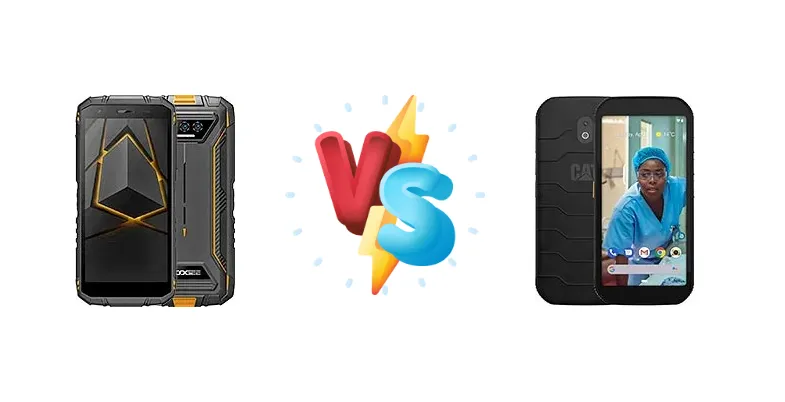
|
🏆 Quick Verdict
For most users prioritizing a slightly smoother experience, the Doogee S41 Pro emerges as the better choice. Its marginally faster 2.0 GHz CPU, built on the same 12nm process as the Cat S42 H+, provides a subtle but noticeable performance edge in everyday tasks, making it ideal for field work and basic productivity.
| PHONES | ||
|---|---|---|
| Phone Names | Doogee S41 Pro | Cat S42 H+ |
| Network | ||
|---|---|---|
| 2G bands | GSM 850 / 900 / 1800 / 1900 | GSM 850 / 900 / 1800 / 1900 - SIM 1 & SIM 2 |
| 3G bands | HSDPA 850 / 900 / 1700(AWS) / 1900 / 2100 | HSDPA 850 / 900 / 1700(AWS) / 1900 / 2100 |
| 4G bands | 1, 2, 3, 4, 5, 7, 8, 12, 13, 17, 18, 19, 20, 25, 26, 28, 38, 40, 41, 66 | 1, 2, 3, 4, 5, 7, 12, 13, 14, 17, 25, 26, 41, 66, 71 |
| Speed | HSPA, LTE | HSPA 42.2/5.76 Mbps, LTE-A (2CA) Cat6 300/50 Mbps |
| Technology | GSM / HSPA / LTE | GSM / HSPA / LTE |
| Launch | ||
|---|---|---|
| Announced | 2023, September | 2021, April 20 |
| Status | Available. Released 2023, September | Available. Released 2021, April 20 |
| Body | ||
|---|---|---|
| Dimensions | 162.5 x 77.8 x 16.2 mm (6.40 x 3.06 x 0.64 in) | 161.3 x 77.2 x 12.7 mm (6.35 x 3.04 x 0.5 in) |
| SIM | Nano-SIM + Nano-SIM | Dual SIM (Nano-SIM, dual stand-by) |
| Weight | 262 g (9.24 oz) | 220 g (7.76 oz) |
| Display | ||
|---|---|---|
| Protection | Corning Gorilla Glass | Corning Gorilla Glass 5 |
| Resolution | 720 x 1440 pixels, 18:9 ratio (~293 ppi density) | 720 x 1440 pixels, 18:9 ratio (~293 ppi density) |
| Size | 5.5 inches, 78.1 cm2 (~61.7% screen-to-body ratio) | 5.5 inches, 78.1 cm2 (~62.7% screen-to-body ratio) |
| Type | IPS LCD | IPS LCD |
| Platform | ||
|---|---|---|
| CPU | Quad-core 2.0 GHz Cortex-A53 | Quad-core 1.8 GHz Cortex-A53 |
| Chipset | Mediatek MT6761V/WAB Helio A22 (12 nm) | Mediatek MT6761D Helio A20 (12 nm) |
| GPU | PowerVR GE8320 | PowerVR GE8320 |
| OS | Android 12 | Android 10, planned upgrade to Android 11 |
| Memory | ||
|---|---|---|
| Card slot | microSDXC (uses shared SIM slot) | microSDXC (dedicated slot) |
| Internal | 64GB 4GB RAM | 32GB 3GB RAM |
| Main Camera | ||
|---|---|---|
| Features | Quad-LED flash, HDR | LED flash |
| Single | - | 13 MP, f/2.0, (wide), PDAF |
| Triple | 13 MP, f/2.0, (wide), PDAF other unspecified cameras | - |
| Video | 1080p | 1080p@30fps |
| Selfie camera | ||
|---|---|---|
| Single | 8 MP, f/2.0, (wide) | 5 MP |
| Video | 1080p@30fps | - |
| Sound | ||
|---|---|---|
| 3.5mm jack | - | Yes |
| 35mm jack | Yes | - |
| Loudspeaker | Yes | Yes |
| Comms | ||
|---|---|---|
| Bluetooth | 5.0, A2DP, LE | 5.0, A2DP, LE |
| NFC | Yes (market/region dependent) | Yes |
| Positioning | GPS, GLONASS, GALILEO, BDS | GPS, GLONASS, BDS |
| Radio | FM radio | FM radio |
| USB | USB Type-C 2.0, OTG | microUSB 2.0, OTG |
| WLAN | Wi-Fi 802.11 a/b/g/n/ac, dual-band | Wi-Fi 802.11 b/g/n |
| Features | ||
|---|---|---|
| Sensors | Accelerometer, proximity | Accelerometer, proximity, compass |
| Battery | ||
|---|---|---|
| Type | 6300 mAh | Li-Ion 4200 mAh, non-removable |
| Misc | ||
|---|---|---|
| Colors | Black, Orange, Green | Black |
| Price | - | $ 249.87 / C$ 298.00 / £ 182.00 / € 188.58 |
Doogee S41 Pro
- Slightly faster CPU (2.0 GHz vs 1.8 GHz)
- Potentially better app launch speeds
- More responsive user interface
- Brand recognition is lower than Cat
- Long-term software support is uncertain
Cat S42 H+
- Established brand in the rugged phone market
- Potentially better long-term software updates
- Solid build quality expected from Cat
- Slower CPU (1.8 GHz)
- Potentially less responsive user experience
- May struggle with multitasking
Display Comparison
Neither device boasts a cutting-edge display. Both likely utilize IPS LCD panels, common in this price bracket. Detailed display specs (resolution, brightness) are unavailable, but the focus here is durability, not visual fidelity. Expect adequate outdoor visibility, but not vibrant colors or high peak brightness. Bezels are likely substantial on both, prioritizing screen protection over a modern, edge-to-edge design.
Camera Comparison
Camera details are sparse. Both phones likely feature a basic camera setup geared towards functional documentation rather than photography. Without sensor size or aperture information, it’s difficult to make a direct comparison. Expect adequate performance in good lighting conditions, but poor low-light performance. The inclusion of a 2MP macro camera on either device is largely a marketing tactic, offering minimal practical benefit due to the small sensor size and limited resolution.
Performance
The core difference lies in the chipset: the Doogee S41 Pro features the Mediatek MT6761V/WAB Helio A22 with a 2.0 GHz quad-core Cortex-A53 CPU, while the Cat S42 H+ uses the MT6761D Helio A20 clocked at 1.8 GHz. While both are 12nm chips, the 200 MHz clock speed difference translates to a measurable, though not dramatic, performance boost for the Doogee. This will be most noticeable when launching apps or switching between tasks. Both are adequate for basic Android functionality, but struggle with demanding games or heavy multitasking. RAM configurations are unknown, but likely limited, further impacting performance.
Battery Life
Battery capacity is not specified for either device. However, given the low-power chipsets, both should offer all-day battery life with moderate use. Charging wattage is also unknown, but likely limited to 10W or 15W, resulting in relatively slow charging times. The focus is on longevity, not rapid replenishment. The efficiency of the 12nm process will contribute to reasonable battery performance on both devices.
Buying Guide
Buy the Doogee S41 Pro if you need a rugged phone for consistent, everyday use with a slight performance advantage for running apps and multitasking. It's best suited for users who frequently use navigation, communication, and basic productivity tools in challenging environments. Buy the Cat S42 H+ if you prioritize a brand with a longer history in the rugged phone space and potentially better long-term software support, even if it means sacrificing a small amount of processing power. It’s a solid choice for those needing a reliable, no-frills device for essential communication and task management.