
Doogee S41 Plus vs. Ulefone Armor X13: A Head-to-Head Rugged Smartphone Showdown
| Phones Images | |||||
|---|---|---|---|---|---|
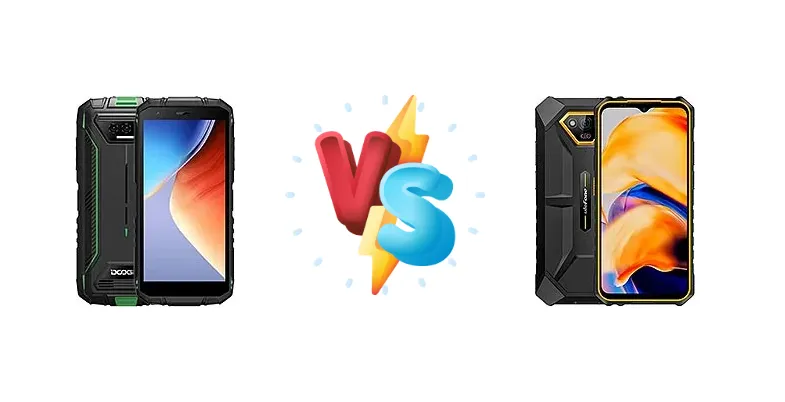
|
🏆 Quick Verdict
For most users prioritizing all-around usability, the Doogee S41 Plus emerges as the better choice. Its Unisoc T606 chipset, utilizing Cortex-A75 cores, offers a noticeable performance advantage over the Ulefone Armor X13’s Helio G36, making it more responsive for daily tasks and light multitasking. While the Ulefone boasts impressive battery life, the performance trade-off is significant.
| PHONES | ||
|---|---|---|
| Phone Names | Doogee S41 Plus | Ulefone Armor X13 |
| Network | ||
|---|---|---|
| 2G bands | GSM 850 / 900 / 1800 / 1900 | GSM 850 / 900 / 1800 / 1900 |
| 3G bands | HSDPA 850 / 900 / 1700(AWS) / 1900 / 2100 | HSDPA 850 / 900 / 1700(AWS) / 1900 / 2100 |
| 4G bands | 1, 2, 3, 4, 5, 7, 8, 18, 19, 20, 25, 26, 28, 34, 38, 39, 40, 41, 66 | 1, 2, 3, 4, 5, 7, 8, 12, 17, 19, 20, 28, 34, 38, 39, 40, 41, 66 |
| Speed | HSPA, LTE | HSPA, LTE |
| Technology | GSM / HSPA / LTE | GSM / HSPA / LTE |
| Launch | ||
|---|---|---|
| Announced | 2023, December | 2023, August |
| Status | Available. Released 2023, December | Available. Released 2023, August |
| Body | ||
|---|---|---|
| Dimensions | 162.5 x 77.8 x 16.2 mm (6.40 x 3.06 x 0.64 in) | 173 x 83 x 13.6 mm (6.81 x 3.27 x 0.54 in) |
| SIM | Nano-SIM + Nano-SIM | Nano-SIM + Nano-SIM |
| Weight | 262 g (9.24 oz) | 300 g (10.58 oz) |
| Display | ||
|---|---|---|
| Protection | - | Mohs level 4 |
| Resolution | 720 x 1440 pixels, 18:9 ratio (~293 ppi density) | 720 x 1600 pixels, 20:9 ratio (~269 ppi density) |
| Size | 5.5 inches, 78.1 cm2 (~61.7% screen-to-body ratio) | 6.52 inches, 102.6 cm2 (~71.5% screen-to-body ratio) |
| Type | IPS LCD | IPS LCD |
| Platform | ||
|---|---|---|
| CPU | Octa-core (2x1.6 GHz Cortex-A75 & 6x1.6 GHz Cortex-A55) | Octa-core (4x2.2 GHz Cortex-A53 & 4x1.7 GHz Cortex-A53) |
| Chipset | Unisoc T606 (12 nm) | Mediatek Helio G36 (12 nm) |
| GPU | Mali-G57 MP1 | PowerVR GE8320 |
| OS | Android 13 | Android 13 |
| Memory | ||
|---|---|---|
| Card slot | microSDXC (uses shared SIM slot) | microSDXC (dedicated slot) |
| Internal | 128GB 4GB RAM | 64GB 6GB RAM |
| Main Camera | ||
|---|---|---|
| Dual | - | 50 MP, f/1.8, (wide), 0.64µm, PDAF 24 MP, f/1.8, (night vision), 2 infrared night vision lights |
| Features | Quad-LED flash, HDR | LED flash |
| Triple | 13 MP, f/2.0, (wide), PDAF other unspecified cameras | - |
| Video | 1080p | 1080p@30fps |
| Selfie camera | ||
|---|---|---|
| Single | 8 MP, f/2.0, (wide) | 8 MP, f/2.0, (wide), 1.12µm |
| Video | 1080p@30fps | Yes |
| Sound | ||
|---|---|---|
| 35mm jack | Yes | Yes |
| Loudspeaker | Yes | Yes |
| Comms | ||
|---|---|---|
| Bluetooth | 5.0, A2DP, LE | 5.0, A2DP, LE |
| NFC | Yes | Yes |
| Positioning | GPS, GLONASS, GALILEO, BDS | GPS, GLONASS, GALILEO, BDS |
| Radio | FM radio | Wireless FM radio, RDS, recording |
| USB | USB Type-C 2.0, OTG | USB Type-C 2.0 |
| WLAN | Wi-Fi 802.11 a/b/g/n/ac, dual-band | Wi-Fi 802.11 a/b/g/n/ac, dual-band |
| Features | ||
|---|---|---|
| Sensors | Fingerprint (side-mounted), accelerometer, gyro, proximity, compass | Accelerometer, proximity |
| Battery | ||
|---|---|---|
| Charging | - | 10W wired |
| Type | 6300 mAh | Li-Po 6320 mAh |
| Misc | ||
|---|---|---|
| Colors | Black, Orange, Green | Black, Black/Orange |
| Price | About 110 EUR | About 130 EUR |
| EU LABEL | ||
|---|---|---|
| Battery | - | 83:15h endurance, 1000 cycles |
| Energy | - | Class A |
| Free fall | - | Class A (270 falls) |
| Repairability | - | Class C |
Doogee S41 Plus
- More modern processor architecture (Unisoc T606)
- Better single-core performance for smoother app usage
- Potentially better ISP for image processing
- Battery life likely shorter than Ulefone Armor X13
- Charging speed not specified, potentially slower
Ulefone Armor X13
- Exceptional battery endurance (83:15 hours)
- 1000 charge cycles for long-term battery health
- Lower price point (likely, given the chipset)
- Older processor architecture (Helio G36)
- Significantly lower single-core performance
- Slow 10W wired charging
Display Comparison
Neither device provides display specifications in the provided data. However, given their price points, we can expect both to utilize IPS LCD panels. The lack of information on resolution, brightness, or refresh rate suggests neither phone will excel in this area. Users should expect a functional, but not exceptional, viewing experience. Bezels are likely to be substantial on both models, typical of ruggedized designs prioritizing drop protection.
Camera Comparison
The provided data doesn’t detail camera specifications beyond the chipsets. Given the market segment, both phones likely feature basic camera setups. Expect a primary sensor, potentially accompanied by a depth or macro lens (the usefulness of a 2MP macro lens is minimal). Image processing will likely be basic on both devices. Without sensor size or aperture information, it’s difficult to assess image quality, but the chipset’s ISP (Image Signal Processor) capabilities will play a role – the Unisoc T606 likely offers a more capable ISP than the Helio G36.
Performance
The core difference lies in the chipsets. The Doogee S41 Plus’s Unisoc T606, built on a 12nm process, features two Cortex-A75 cores clocked at 1.6 GHz alongside six Cortex-A55 cores. This architecture provides a significant uplift in single-core performance compared to the Ulefone Armor X13’s MediaTek Helio G36. The Helio G36 utilizes four Cortex-A53 cores at 2.2 GHz and another four at 1.7 GHz. While the G36 has a higher clock speed, the older A53 architecture is less efficient and offers lower IPC (Instructions Per Clock) than the A75. This translates to a snappier experience on the Doogee for app launching and general navigation. The Unisoc T606’s architecture is better positioned for future Android updates and sustained performance.
Battery Life
The Ulefone Armor X13 clearly wins in stated battery endurance, boasting 83:15 hours. This is a substantial advantage. However, the 10W wired charging is a significant drawback. While the Doogee S41 Plus’s charging speed isn’t specified, the longer battery life of the Ulefone is offset by the slow charging. The Armor X13 also claims 1000 charge cycles, suggesting a focus on long-term battery health. Users prioritizing minimizing charge cycles will favor the Ulefone, but the slow charging will be a constant inconvenience.
Buying Guide
Buy the Doogee S41 Plus if you need a rugged phone that can handle everyday tasks smoothly and offers a more modern processor architecture for future software support. Buy the Ulefone Armor X13 if your absolute top priority is maximizing battery life above all else, and you primarily use your phone for basic communication and minimal app usage. The Armor X13 is ideal for extended trips off-grid where charging isn't an option.