
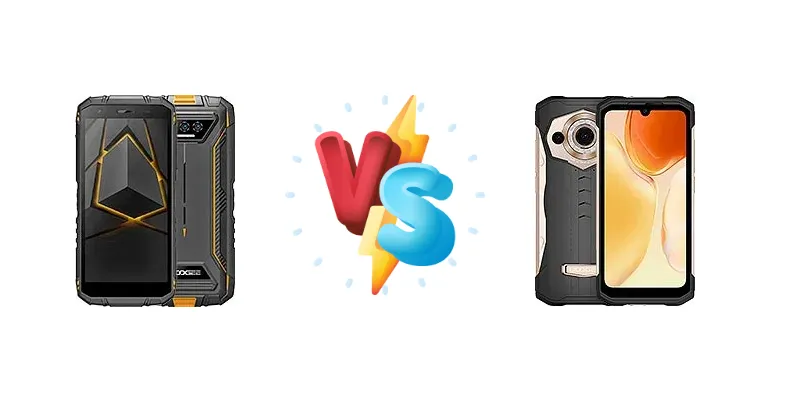
Doogee S41 Max vs Doogee S99: Which Rugged Phone Delivers More Power?
| Phones Images | |||||
|---|---|---|---|---|---|
|
🏆 Quick Verdict
For the average user prioritizing value and consistent performance for everyday tasks, the Doogee S41 Max is the better choice. However, the Doogee S99’s Helio G96 chipset and 33W charging offer a noticeable performance boost and quicker top-ups, making it ideal for users who demand more from their rugged device.
| PHONES | ||
|---|---|---|
| Phone Names | Doogee S41 Max | Doogee S99 |
| Network | ||
|---|---|---|
| 2G bands | GSM 850 / 900 / 1800 / 1900 | GSM 850 / 900 / 1800 / 1900 |
| 3G bands | HSDPA 850 / 900 / 1700(AWS) / 1900 / 2100 | HSDPA 800 / 850 / 900 / 1700(AWS) / 1900 / 2100 |
| 4G bands | 1, 2, 3, 4, 5, 7, 8, 18, 19, 20, 25, 26, 28, 34, 38, 39, 40, 41, 66 | 1, 2, 3, 4, 5, 7, 8, 12, 13, 17, 18, 19, 20, 25, 26, 28, 34, 38, 39, 40, 41, 66 |
| Speed | HSPA, LTE | HSPA, LTE |
| Technology | GSM / HSPA / LTE | GSM / CDMA / HSPA / LTE |
| Launch | ||
|---|---|---|
| Announced | 2023, December | 2022, December 05 |
| Status | Available. Released 2023, December | Available. Released 2022, December 05 |
| Body | ||
|---|---|---|
| Dimensions | 162.5 x 77.8 x 16.2 mm (6.40 x 3.06 x 0.64 in) | 172 x 82 x 15.5 mm (6.77 x 3.23 x 0.61 in) |
| SIM | Nano-SIM + Nano-SIM | Nano-SIM + Nano-SIM |
| Weight | 262 g (9.24 oz) | - |
| Display | ||
|---|---|---|
| Protection | - | Corning Gorilla Glass |
| Resolution | 720 x 1440 pixels, 18:9 ratio (~293 ppi density) | 1080 x 2340 pixels, 19.5:9 ratio (~409 ppi density) |
| Size | 5.5 inches, 78.1 cm2 (~61.7% screen-to-body ratio) | 6.3 inches, 97.4 cm2 (~69.1% screen-to-body ratio) |
| Type | IPS LCD | IPS LCD |
| Platform | ||
|---|---|---|
| CPU | Octa-core (2x1.6 GHz Cortex-A75 & 6x1.6 GHz Cortex-A55) | Octa-core (2x2.05 GHz Cortex-A76 & 6x2.0 GHz Cortex-A55) |
| Chipset | Unisoc T606 (12 nm) | Mediatek MT6781 Helio G96 (12 nm) |
| GPU | Mali-G57 MP1 | Mali-G57 MC2 |
| OS | Android 13 | Android 12 |
| Memory | ||
|---|---|---|
| Card slot | microSDXC (uses shared SIM slot) | microSDXC (dedicated slot) |
| Internal | 256GB 6GB RAM | 128GB 8GB RAM |
| Main Camera | ||
|---|---|---|
| Features | Quad-LED flash, HDR | Dual-LED flash, HDR, panorama |
| Triple | 13 MP, f/2.0, (wide), PDAF other unspecified cameras | 108 MP, f/1.9, (wide), 1/1.52", 0.7µm, PDAF 64 MP, f/1.8, (night vision), 2 infrared night vision lights 16 MP, f/1.8, 130˚ (ultrawide) |
| Video | 1080p | 1440p@30fps, 1080p@30fps |
| Selfie camera | ||
|---|---|---|
| Single | 8 MP, f/2.0, (wide) | 32 MP, f/2.0, (wide), 1/2.8", 0.8µm |
| Video | 1080p@30fps | 1080p@30fps |
| Sound | ||
|---|---|---|
| 35mm jack | Yes | No |
| Loudspeaker | Yes | Yes |
| Comms | ||
|---|---|---|
| Bluetooth | 5.0, A2DP, LE | 5.1, A2DP, LE |
| NFC | Yes | Yes (market/region dependent) |
| Positioning | GPS, GLONASS, GALILEO, BDS | GPS, GLONASS, GALILEO, BDS |
| Radio | FM radio | FM radio |
| USB | USB Type-C 2.0, OTG | USB Type-C 2.0, OTG |
| WLAN | Wi-Fi 802.11 a/b/g/n/ac, dual-band | Wi-Fi 802.11 a/b/g/n/ac, dual-band |
| Features | ||
|---|---|---|
| Sensors | Accelerometer, proximity | Fingerprint (side-mounted), accelerometer, gyro, proximity, compass |
| Battery | ||
|---|---|---|
| Charging | - | 33W wired, 45% in 30 min 15W wireless Reverse wired |
| Type | 6300 mAh | 6000 mAh |
| Misc | ||
|---|---|---|
| Colors | Black, Orange, Green | Gold, Black |
| Price | About 270 EUR | About 250 EUR |
Doogee S41 Max
- More affordable price point
- Reliable performance for basic tasks
- Potentially better battery life due to less powerful chipset (depending on battery capacity)
- Slower performance compared to the S99
- Lacks fast charging capabilities
- Less capable ISP for image processing
Doogee S99
- Faster and more responsive performance with Helio G96
- 33W fast charging and 15W wireless charging
- Improved image processing capabilities
- Higher price compared to the S41 Max
- Potentially shorter battery life due to more powerful chipset (depending on battery capacity)
- May generate more heat under heavy load
Display Comparison
Both devices utilize 12nm chipsets, suggesting similar power draw and potential for heat generation, impacting display performance. While specific display specs (resolution, panel type) are missing, the chipset difference will indirectly affect the smoothness of animations and responsiveness. The S99’s more powerful GPU will likely translate to better visual fidelity in games, assuming both phones have similar display panels.
Camera Comparison
Without detailed camera specifications beyond the chipsets, a direct comparison is limited. However, the S99’s more powerful ISP (Image Signal Processor) within the Helio G96 chipset will likely result in better image processing, particularly in low-light conditions. The G96 can handle more complex algorithms for noise reduction and dynamic range optimization. The S41 Max’s Unisoc T606 will still produce acceptable images, but the S99 will likely offer a more refined and detailed photographic experience.
Performance
The core difference lies in the chipsets. The Doogee S99’s MediaTek Helio G96, with its 2x2.05 GHz Cortex-A76 cores, represents a significant upgrade over the S41 Max’s Unisoc T606 (2x1.6 GHz Cortex-A75). The Cortex-A76 architecture is demonstrably more efficient and powerful than the A75, resulting in faster app loading times and smoother multitasking. The G96’s higher clock speeds further enhance performance. While both are 12nm chips, the architectural improvements in the G96 provide a tangible advantage. This benefits users who frequently use resource-intensive apps or play mobile games.
Battery Life
Battery capacity is not specified for either device, making a direct mAh comparison impossible. However, the S99’s 33W wired charging (45% in 30 minutes) and 15W wireless charging provide a significant advantage over the S41 Max, which lacks these fast charging capabilities. The S99’s reverse wired charging is also a useful feature for topping up accessories. Even with a similar battery capacity, the S99’s faster charging will minimize downtime, a crucial benefit for users who rely on their phone throughout the day.
Buying Guide
Buy the Doogee S41 Max if you need a dependable, long-lasting rugged phone for basic communication, navigation, and occasional photography, and prioritize affordability. Buy the Doogee S99 if you prefer a more responsive experience for gaming, multitasking, and demanding applications, and value faster charging speeds for minimal downtime.