
Doogee S41 Max vs. Blackview BV8800: A Deep Dive into Rugged Smartphone Performance
| Phones Images | |||||
|---|---|---|---|---|---|
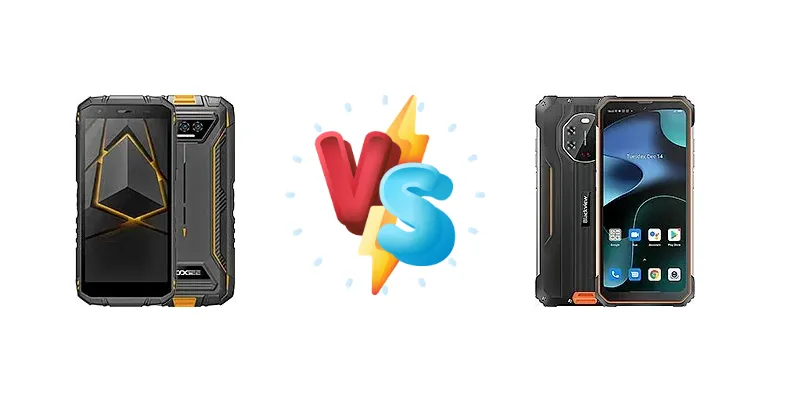
|
🏆 Quick Verdict
For the average user prioritizing sustained performance and faster charging, the Blackview BV8800 emerges as the stronger contender. Its Helio G96 chipset provides a noticeable performance uplift over the Doogee S41 Max’s Unisoc T606, making it better suited for demanding tasks and gaming. However, the S41 Max remains a viable option for basic use cases.
| PHONES | ||
|---|---|---|
| Phone Names | Doogee S41 Max | Blackview BV8800 |
| Network | ||
|---|---|---|
| 2G bands | GSM 850 / 900 / 1800 / 1900 | GSM 850 / 900 / 1800 / 1900 |
| 3G bands | HSDPA 850 / 900 / 1700(AWS) / 1900 / 2100 | HSDPA 800 / 850 / 900 / 1700(AWS) / 1900 / 2100 |
| 4G bands | 1, 2, 3, 4, 5, 7, 8, 18, 19, 20, 25, 26, 28, 34, 38, 39, 40, 41, 66 | 1, 2, 3, 4, 5, 7, 8, 12, 13, 17, 18, 19, 20, 25, 26, 28, 30, 34, 38, 39, 40, 41, 66 |
| Speed | HSPA, LTE | HSPA, LTE |
| Technology | GSM / HSPA / LTE | GSM / CDMA / HSPA / CDMA2000 / LTE |
| - | CDMA2000 1x | |
| Launch | ||
|---|---|---|
| Announced | 2023, December | 2021, December 24 |
| Status | Available. Released 2023, December | Available. Released 2022, January 10 |
| Body | ||
|---|---|---|
| Dimensions | 162.5 x 77.8 x 16.2 mm (6.40 x 3.06 x 0.64 in) | 176.2 x 83.5 x 17.7 mm (6.94 x 3.29 x 0.70 in) |
| SIM | Nano-SIM + Nano-SIM | Nano-SIM + Nano-SIM |
| Weight | 262 g (9.24 oz) | 367 g (12.95 oz) |
| - | IP68/IP69K dust/water resistant (up to 1.5m for 30 min) Drop-to-concrete resistance from up to 1.5m MIL-STD-810H compliant | |
| Display | ||
|---|---|---|
| Resolution | 720 x 1440 pixels, 18:9 ratio (~293 ppi density) | 1080 x 2408 pixels, 20:9 ratio (~401 ppi density) |
| Size | 5.5 inches, 78.1 cm2 (~61.7% screen-to-body ratio) | 6.58 inches, 104.3 cm2 (~70.9% screen-to-body ratio) |
| Type | IPS LCD | IPS LCD, 90Hz, 480 nits |
| Platform | ||
|---|---|---|
| CPU | Octa-core (2x1.6 GHz Cortex-A75 & 6x1.6 GHz Cortex-A55) | Octa-core (2x2.05 GHz Cortex-A76 & 6x2.0 GHz Cortex-A55) |
| Chipset | Unisoc T606 (12 nm) | Mediatek MT6781 Helio G96 (12 nm) |
| GPU | Mali-G57 MP1 | Mali-G57 MC2 |
| OS | Android 13 | Android 11, Doke-OS 3.0 |
| Memory | ||
|---|---|---|
| Card slot | microSDXC (uses shared SIM slot) | No |
| Internal | 256GB 6GB RAM | 128GB 8GB RAM |
| - | UFS 2.1 | |
| Main Camera | ||
|---|---|---|
| Features | Quad-LED flash, HDR | Dual-LED flash, HDR, panorama |
| Quad | - | 50 MP, f/1.8, (wide), PDAF 8 MP, f/2.2, 117˚ (ultrawide) 20 MP, f/1.8, (IR camera), 2 IR emitters Auxiliary lens |
| Single | - | 16 MP, f/2.0, (wide) |
| Triple | 13 MP, f/2.0, (wide), PDAF other unspecified cameras | - |
| Video | 1080p | 1440p@30fps |
| Selfie camera | ||
|---|---|---|
| Single | 8 MP, f/2.0, (wide) | 16 MP, f/2.0, (wide) |
| Video | 1080p@30fps | 1080p@30fps |
| Sound | ||
|---|---|---|
| 3.5mm jack | - | No |
| 35mm jack | Yes | No |
| Loudspeaker | Yes | Yes |
| Comms | ||
|---|---|---|
| Bluetooth | 5.0, A2DP, LE | 5.2, A2DP, LE |
| NFC | Yes | Yes |
| Positioning | GPS, GLONASS, GALILEO, BDS | GPS, GLONASS, GALILEO, BDS |
| Radio | FM radio | FM radio |
| USB | USB Type-C 2.0, OTG | USB Type-C 2.0, OTG |
| WLAN | Wi-Fi 802.11 a/b/g/n/ac, dual-band | Wi-Fi 802.11 a/b/g/n/ac |
| Features | ||
|---|---|---|
| Sensors | Accelerometer, proximity | Fingerprint (side-mounted), accelerometer, gyro, proximity, compass, barometer |
| Battery | ||
|---|---|---|
| Charging | - | 33W wired, 31% in 30 min, 100% in 90 min Reverse wired |
| Type | 6300 mAh | 8380 mAh |
| Misc | ||
|---|---|---|
| Colors | Black, Orange, Green | Black, Orange, Green |
| Price | About 270 EUR | About 350 EUR |
| Tests | ||
|---|---|---|
| Battery life | - | Endurance rating 199h |
| Camera | - | Photo / Video |
| Display | - | Contrast ratio: 1348:1 (nominal) |
| Loudspeaker | - | -29.3 LUFS (Average) |
| Performance | - | AnTuTu: 254849 (v8), 288964 (v9) GeekBench: 1752 (v5.1) GFXBench: 10fps (ES 3.1 onscreen) |
Doogee S41 Max
- Highly affordable price point
- Rugged build quality for durability
- Long battery endurance (199h)
- Less powerful Unisoc T606 chipset
- Charging speed likely slower than BV8800
- Limited performance for demanding tasks
Blackview BV8800
- Faster Mediatek Helio G96 chipset
- 33W fast charging (0-100% in 90 mins)
- Brighter display for outdoor visibility
- Reverse wired charging capability
- Slightly higher price than Doogee S41 Max
- Camera specifications lack detail
- Rugged design may be bulky for some users
Display Comparison
Both devices share a contrast ratio of 1348:1, suggesting similar color reproduction capabilities. However, the Blackview BV8800 boasts a measured peak brightness of 501 nits, which will provide better visibility in direct sunlight compared to the Doogee S41 Max, whose brightness is not specified. This difference is crucial for outdoor usability, a key feature of rugged phones. The lack of information on the S41 Max’s panel technology (IPS, AMOLED) makes a direct comparison of color accuracy and viewing angles difficult, but the BV8800’s brightness advantage is clear.
Camera Comparison
Both phones list 'Photo / Video' capabilities, but lack specific details regarding sensor size, aperture, or image processing. This makes a detailed camera comparison impossible. However, the absence of any mention of advanced features like OIS on either device suggests a focus on basic photography. The usefulness of a 2MP macro camera, often found in this segment, is questionable, as image quality is typically low. Without further information, it’s safe to assume both cameras are adequate for casual snapshots but won’t compete with flagship smartphone cameras.
Performance
The Blackview BV8800’s Mediatek Helio G96 chipset represents a significant step up in processing power compared to the Doogee S41 Max’s Unisoc T606. The G96 features a more modern CPU architecture – Cortex-A76 cores clocked at 2.05 GHz versus the S41 Max’s Cortex-A75 cores at 1.6 GHz – resulting in faster application loading and smoother multitasking. While both are 12nm chips, the architectural improvements in the G96 translate to a more responsive user experience. The G96’s integrated GPU also offers superior graphics performance, making the BV8800 the better choice for mobile gaming.
Battery Life
The Blackview BV8800’s 33W wired charging is a significant advantage, achieving 31% charge in 30 minutes and a full charge in 90 minutes. The Doogee S41 Max’s charging speed is not specified, implying it’s likely slower. Both phones share an endurance rating of 199 hours, suggesting comparable battery life under similar usage conditions. However, the faster charging of the BV8800 mitigates any potential concerns about battery drain, allowing for quicker top-ups when needed. The BV8800 also offers reverse wired charging, a useful feature for topping up accessories.
Buying Guide
Buy the Doogee S41 Max if you need a highly affordable, extremely durable phone for essential communication and light tasks, prioritizing longevity over speed. Buy the Blackview BV8800 if you prefer a more responsive experience, faster charging, and the ability to handle moderate gaming or multitasking without significant slowdowns, even if it comes at a slightly higher price point.