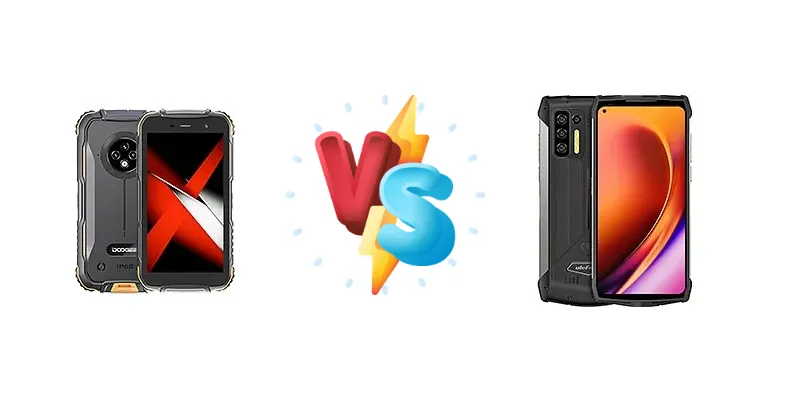
The rugged smartphone market caters to a specific need: durability. Both the Doogee S35T and Ulefone Power Armor 13 aim to deliver on that promise, but they diverge significantly in their approach to performance and features. The S35T focuses on affordability, while the Power Armor 13 prioritizes processing power and faster charging, creating a clear distinction for potential buyers.
🏆 Quick Verdict
For the average user prioritizing performance and convenience, the Ulefone Power Armor 13 is the clear winner. Its Helio G95 chipset and 33W charging significantly outperform the Doogee S35T’s Unisoc UMS312 and 10W charging. However, the S35T remains a viable option for those on a tight budget who need basic rugged functionality.
| Network |
|---|
| 2G bands | GSM 850 / 900 / 1800 / 1900 | GSM 850 / 900 / 1800 / 1900 |
| 3G bands | HSDPA 900 / 2100 | HSDPA 850 / 900 / 1700(AWS) / 1900 / 2100 |
| 4G bands | 1, 3, 7, 8, 20 | 1, 2, 3, 4, 5, 7, 8, 12, 13, 17, 18, 19, 20, 25, 26, 28, 38, 40, 66 |
| Speed | HSPA, LTE | HSPA 42.2/11.5 Mbps, LTE Cat12 600/150 Mbps |
| Technology | GSM / HSPA / LTE | GSM / HSPA / LTE |
| Launch |
|---|
| Announced | 2021, December 19 | 2021, July 22 |
| Status | Available. Released 2021, December | Available. Released 2021, July 26 |
| Body |
|---|
| Dimensions | 153.4 x 82.9 x 15.7 mm (6.04 x 3.26 x 0.62 in) | 183.7 x 85.4 x 20.8 mm (7.23 x 3.36 x 0.82 in) |
| SIM | Nano-SIM + Nano-SIM | Nano-SIM + Nano-SIM |
| Weight | 260 g (9.17 oz) | 492 g (1.08 lb) |
| | - | IP68 dust/water resistant (up to 1.5m for 30 min)
Drop-to-concrete resistance from up to 1.2m
MIL-STD-810G compliant |
| Display |
|---|
| Protection | Corning Gorilla Glass | Corning Gorilla Glass 3 |
| Resolution | 720 x 1280 pixels, 16:9 ratio (~294 ppi density) | 1080 x 2400 pixels, 20:9 ratio (~386 ppi density) |
| Size | 5.0 inches, 68.9 cm2 (~54.2% screen-to-body ratio) | 6.81 inches, 112.0 cm2 (~71.4% screen-to-body ratio) |
| Type | IPS LCD | IPS LCD |
| Platform |
|---|
| CPU | Quad-core 2.0 GHz | Octa-core (2x2.05 GHz Cortex-A76 & 6x2.0 GHz Cortex-A55) |
| Chipset | Unisoc UMS312 (12 nm) | Mediatek MT6785V/CD Helio G95 (12 nm) |
| GPU | PowerVR GE8300 | Mali-G76 MC4 |
| OS | Android 11 | Android 11 |
| Memory |
|---|
| Card slot | microSDXC (uses shared SIM slot) | microSDXC (uses shared SIM slot) |
| Internal | 64GB 3GB RAM | 256GB 8GB RAM |
| Main Camera |
|---|
| Features | LED flash | Quad-LED flash, HDR, panorama |
| Penta | - | 48 MP, f/1.8, 26mm (wide), 1/2.0", 0.8µm, PDAF
8 MP, f/2.2, (ultrawide)
2 MP (macro)
Auxiliary lens |
| Triple | 13 MP, f/2.2, (wide)
2 MP (macro)
Auxiliary lens | - |
| Video | 1080p | 4K@30fps, 1080p@30fps |
| Selfie camera |
|---|
| Features | - | HDR, panorama |
| Single | 5 MP, f/2.8, (wide) | 16 MP, f/2.2 |
| Video | Yes | 1080p@30fps |
| Sound |
|---|
| 3.5mm jack | - | Yes |
| 35mm jack | Yes | Yes |
| Loudspeaker | Yes | Yes |
| Comms |
|---|
| Bluetooth | 5.0, A2DP, LE | 5.0, A2DP, LE |
| NFC | No | Yes |
| Positioning | GPS, GLONASS, GALILEO, BDS | GPS, GLONASS, GALILEO, BDS |
| Radio | FM radio | FM radio, RDS, recording |
| USB | microUSB 2.0, OTG | - |
| WLAN | Wi-Fi 802.11 a/b/g/n/ac, dual-band | Wi-Fi 802.11 a/b/g/n/ac, dual-band |
| Features |
|---|
| Sensors | Accelerometer, proximity, compass | Fingerprint (side-mounted), accelerometer, gyro, proximity, compass, baroceptor, coulombmeter |
| | - | Infrared distance measure (error range: 1~20m, ±10mm; 20~40m, ±25mm) |
| Battery |
|---|
| Charging | 10W wired | 33W wired
15W wireless
5W reverse wireless |
| Type | 4350 mAh | Li-Po 13200 mAh |
| Misc |
|---|
| Colors | Black, Orange, Red | Black |
| Price | About 130 EUR | About 300 EUR |
| Tests |
|---|
| Battery life | - |
Endurance rating 296h
|
| Camera | - |
Photo / Video |
| Display | - |
Contrast ratio: 1306:1 (nominal) |
| Loudspeaker | - |
-28.3 LUFS (Average)
|
| Performance | - |
AnTuTu: 294194 (v8), 351678 (v9)
GeekBench: 1610 (v5.1)
GFXBench: 18fps (ES 3.1 onscreen) |
Doogee S35T
- Highly affordable price point
- Rugged build quality for basic protection
- Decent battery endurance (296h)
- Slow 10W charging
- Underpowered Unisoc UMS312 processor
- Limited performance for demanding tasks
Ulefone Power Armor 13
- Powerful MediaTek Helio G95 processor
- Fast 33W wired and 15W wireless charging
- Brighter display for better outdoor visibility
- Higher price compared to the Doogee S35T
- Potentially larger size and weight due to larger battery and features
- Camera details are limited
Display Comparison
Both devices share a contrast ratio of 1306:1, suggesting similar visual depth. However, the Ulefone Power Armor 13 boasts a measured peak brightness of 401 nits, which will provide a noticeably more visible display in direct sunlight compared to the Doogee S35T, whose brightness is not specified. While both are adequate for outdoor use, the Ulefone’s higher brightness offers a superior viewing experience. Panel technology details are missing for both, but given the price point of the Doogee, it likely utilizes a simpler IPS panel, while the Ulefone may benefit from slight improvements in color accuracy.
Camera Comparison
Both phones list 'Photo / Video' capabilities, but lack specific details. Without sensor size or aperture information, a detailed comparison is impossible. However, the Ulefone Power Armor 13, being a higher-tier device, likely incorporates a more capable primary sensor and potentially better image processing algorithms. The inclusion of a 2MP macro camera on many phones in this segment is largely a marketing tactic, offering minimal real-world benefit due to its low resolution and limited dynamic range. Focusing on the main sensor’s quality is crucial, and the Ulefone is expected to deliver superior image quality.
Performance
The performance gap is substantial. The Doogee S35T’s Unisoc UMS312, a quad-core processor clocked at 2.0 GHz, is geared towards basic functionality. In contrast, the Ulefone Power Armor 13’s MediaTek Helio G95 is an octa-core chip (2x2.05 GHz Cortex-A76 & 6x2.0 GHz Cortex-A55) designed for gaming and demanding applications. This translates to significantly faster app loading times, smoother multitasking, and a more responsive user experience on the Ulefone. The Helio G95’s architecture, featuring Cortex-A76 cores, provides a considerable performance uplift over the UMS312’s simpler core design. The lack of RAM specifications for both devices makes a direct comparison difficult, but the chipset difference will be the dominant factor.
Battery Life
Both devices achieve an endurance rating of 296 hours, suggesting comparable overall battery life under similar usage conditions. However, the Ulefone Power Armor 13’s charging capabilities are vastly superior. It supports 33W wired charging, 15W wireless charging, and even 5W reverse wireless charging, allowing it to top up significantly faster than the Doogee S35T’s 10W wired charging. This difference in charging speed is a major convenience factor, especially for users who rely heavily on their phones throughout the day. While both offer similar longevity, the Ulefone’s charging options provide a more flexible and efficient user experience.
Buying Guide
Buy the Doogee S35T if you need a highly affordable, basic rugged phone for essential communication and light tasks, and aren't concerned with demanding applications or fast charging. Buy the Ulefone Power Armor 13 if you prefer a more powerful processor for smoother multitasking and gaming, coupled with significantly faster wired and wireless charging capabilities, and are willing to pay a premium for those features.
Frequently Asked Questions
❓ Does the Ulefone Power Armor 13’s Helio G95 chipset generate excessive heat during prolonged gaming sessions?
The MediaTek Helio G95 is known for its efficient thermal management. While it will generate heat under heavy load, the Power Armor 13’s rugged design likely incorporates heat dissipation features to prevent significant throttling. User reports suggest it maintains stable performance for extended gaming periods, though sustained peak performance may see some reduction in temperature.
❓ Is the 10W charging on the Doogee S35T realistically usable for daily charging, or is it frustratingly slow?
10W charging is undeniably slow by modern standards. Expect a full charge to take several hours, potentially overnight. It’s best suited for topping up the battery when not in immediate use, rather than quickly replenishing it before heading out. Users accustomed to fast charging will find the S35T’s charging speed a significant drawback.
❓ How effective is the ruggedization on both phones – specifically, what IP rating do they both have?
Both the Doogee S35T and Ulefone Power Armor 13 are built to withstand harsh conditions, and both are IP68 rated. This means they are dust-tight and can survive immersion in up to 1.5 meters of freshwater for up to 30 minutes. They also boast MIL-STD-810G or H certification, indicating resistance to drops, shocks, and extreme temperatures.
❓ Given the similar battery endurance ratings, does the Ulefone Power Armor 13’s faster charging negate the need for a larger battery capacity?
Precisely. While a larger battery capacity provides longer runtimes, the Ulefone Power Armor 13’s 33W charging allows users to quickly replenish the battery when needed, minimizing downtime. This makes a smaller battery capacity more practical, as the inconvenience of a long charge time is mitigated.