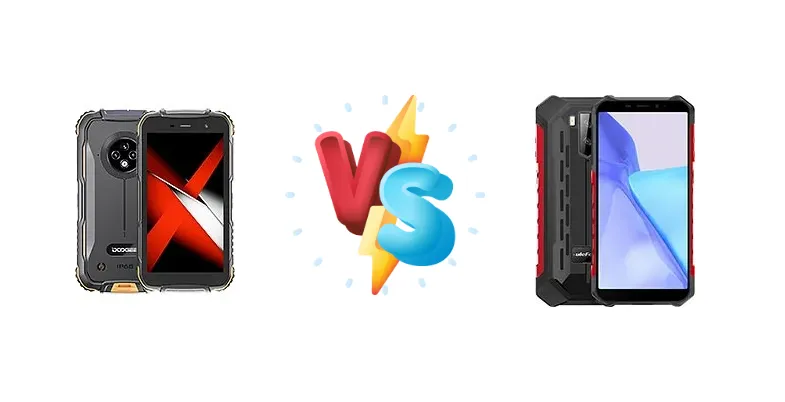
The Doogee S35 and Ulefone Armor X9 Pro represent the entry-level segment of the rugged smartphone market, catering to users who prioritize durability and affordability. Both phones aim to provide essential functionality in challenging environments, but differ in their underlying processing power. This comparison dissects those differences to help you choose the best option for your needs.
🏆 Quick Verdict
For most users, the Ulefone Armor X9 Pro offers a more compelling experience. Its octa-core Helio A25 chipset provides a noticeable performance boost over the Doogee S35’s quad-core Helio A20, translating to smoother multitasking and app responsiveness, despite both sharing the same 10W charging.
| Network |
|---|
| 2G bands | GSM 850 / 900 / 1800 / 1900 | GSM 850 / 900 / 1800 / 1900 |
| 3G bands | HSDPA 900 / 2100 | HSDPA 850 / 900 / 1700(AWS) / 1900 / 2100 |
| 4G bands | 1, 3, 7, 8, 20 | 1, 2, 3, 4, 5, 7, 8, 12, 17, 19, 20, 28 |
| Speed | HSPA, LTE | HSPA 21/5.76 Mbps, LTE Cat6 300/150 Mbps |
| Technology | GSM / HSPA / LTE | GSM / HSPA / LTE |
| Launch |
|---|
| Announced | 2021, July 27 | 2021, September 07 |
| Status | Available. Released 2021, August | Available. Released 2021, September 07 |
| Body |
|---|
| Dimensions | 153.4 x 82.9 x 15.7 mm (6.04 x 3.26 x 0.62 in) | 158 x 77.5 x 13.9 mm (6.22 x 3.05 x 0.55 in) |
| SIM | Nano-SIM + Nano-SIM | Nano-SIM + Nano-SIM |
| Weight | 260 g (9.17 oz) | 235 g (8.29 oz) |
| | - | IP68/IP69K dust/water resistant (up to 1.5m for 30 min)
Drop-to-concrete resistance from up to 1.2m
MIL-STD-810G compliant |
| Display |
|---|
| Resolution | 720 x 1280 pixels, 16:9 ratio (~294 ppi density) | 720 x 1440 pixels, 18:9 ratio (~293 ppi density) |
| Size | 5.0 inches, 68.9 cm2 (~54.2% screen-to-body ratio) | 5.5 inches, 78.1 cm2 (~63.8% screen-to-body ratio) |
| Type | IPS LCD | IPS LCD |
| Platform |
|---|
| CPU | Quad-core 1.8 GHz Cortex-A53 | Octa-core (4x1.8 GHz Cortex-A53 & 4x1.5 GHz Cortex-A53) |
| Chipset | Mediatek MT6761D Helio A20 (12 nm) | Mediatek MT6762D Helio A25 (12 nm) |
| GPU | PowerVR GE8320 | PowerVR GE8320 |
| OS | Android 11 | Android 11 |
| Memory |
|---|
| Card slot | microSDXC (uses shared SIM slot) | microSDXC (uses shared SIM slot) |
| Internal | 16GB 3GB RAM | 64GB 4GB RAM |
| | - | eMMC 5.1 |
| Main Camera |
|---|
| Dual | - | 13 MP, f/2.2, (wide), AF
Auxiliary lens |
| Features | LED flash | Dual-LED flash, HDR, panorama |
| Single | - | 5 MP |
| Triple | 13 MP, f/2.2, (wide), AF
2 MP (macro)
Auxiliary lens | - |
| Video | 1080p | 1080p@30fps |
| Selfie camera |
|---|
| Features | - | HDR |
| Single | 5 MP, f/2.8, (wide) | 5 MP |
| Video | Yes | 1080p@30fps |
| Sound |
|---|
| 3.5mm jack | - | Yes |
| 35mm jack | Yes | Yes |
| Loudspeaker | Yes | Yes |
| Comms |
|---|
| Bluetooth | 5.0, A2DP, LE | 5.0, A2DP, LE |
| NFC | No | Yes |
| Positioning | GPS, GLONASS, BDS | GPS, GLONASS, GALILEO, BDS |
| Radio | FM radio | FM radio, RDS, recording |
| USB | microUSB 2.0, OTG | microUSB 2.0, OTG |
| WLAN | Wi-Fi 802.11 a/b/g/n | Wi-Fi 802.11 a/b/g/n/ac, Wi-Fi Direct |
| Features |
|---|
| Sensors | Accelerometer, proximity | Accelerometer, proximity, compass |
| Battery |
|---|
| Charging | 10W wired | 10W wired |
| Type | 4350 mAh | Li-Po 5000 mAh |
| Misc |
|---|
| Colors | Black, Orange, Red | Red, Black, Green |
| Price | About 120 EUR | About 160 EUR |
Doogee S35
- Potentially lower price point.
- Rugged design for durability.
- Simple and straightforward user experience.
- Slower performance due to quad-core processor.
- Limited multitasking capabilities.
- May struggle with demanding apps.
Ulefone Armor X9 Pro
- Faster performance with octa-core processor.
- Improved multitasking and app responsiveness.
- Slightly better battery efficiency.
- Likely a slightly higher price.
- 10W charging remains slow.
- Camera quality likely similar to Doogee S35.
Display Comparison
Neither Doogee nor Ulefone provide detailed display specifications beyond resolution. Given their price points, both likely utilize IPS LCD panels. The real difference lies in the processing power driving the display; a smoother experience is expected on the X9 Pro due to its more capable chipset. Bezels are likely comparable, reflecting the focus on durability rather than maximizing screen real estate. Color accuracy is unlikely to be a strong point on either device.
Camera Comparison
Detailed camera specifications are absent, but given the market segment, expectations should be tempered. Both phones likely feature a primary camera alongside basic auxiliary lenses (potentially a depth or macro sensor). The image processing capabilities will be heavily reliant on the chipset, giving the Ulefone Armor X9 Pro a slight edge. However, the primary sensor quality will be the dominant factor, and without knowing the sensor sizes or apertures, it’s difficult to declare a clear winner. The presence of a 2MP macro camera on either device is largely a marketing tactic and unlikely to deliver significant image quality improvements.
Performance
The core distinction between these phones is the chipset. The Ulefone Armor X9 Pro’s MediaTek Helio A25, with its octa-core configuration (4x1.8 GHz Cortex-A53 & 4x1.5 GHz Cortex-A53), represents a significant upgrade over the Doogee S35’s Helio A20 (Quad-core 1.8 GHz Cortex-A53). While both utilize the same Cortex-A53 architecture, the additional cores in the A25 allow for better parallel processing, resulting in faster app launch times and improved multitasking. This benefits users who switch between apps frequently or use moderately demanding applications. The 12nm process node is shared, meaning thermal efficiency differences will be minimal, but the A25 will simply *do more* before encountering performance bottlenecks.
Battery Life
Both devices share the same 10W wired charging, meaning charging times will be comparable – expect several hours for a full charge. Battery capacity isn’t specified, but given the target market and the power efficiency of the Helio A20/A25, capacities are likely in the 4000-5000 mAh range. The Ulefone Armor X9 Pro’s more efficient chipset, due to its ability to distribute workload across eight cores, may result in slightly better battery life under moderate to heavy use, but the difference will likely be marginal.
Buying Guide
Buy the Doogee S35 if you absolutely need the lowest possible price point and your smartphone usage is limited to basic tasks like calls, texts, and light app usage. Buy the Ulefone Armor X9 Pro if you value a more responsive user experience, occasionally run multiple apps simultaneously, or anticipate using slightly more demanding applications – the extra processing cores justify the likely small price premium.
Frequently Asked Questions
❓ Will the Ulefone Armor X9 Pro handle basic mobile gaming like PUBG Mobile or Call of Duty Mobile?
While the Helio A25 can run these games, expect to play at low to medium settings with reduced frame rates. The chipset isn't designed for intensive gaming, and prolonged sessions may result in noticeable throttling. The Doogee S35 will struggle even more with these titles.
❓ Are these phones waterproof, or just water-resistant?
Both phones are marketed as 'rugged,' implying water resistance. However, the specific IP rating isn't consistently advertised. Expect them to withstand splashes and brief submersion, but avoid prolonged exposure to water or extreme conditions. Check the manufacturer's specifications for the exact IP rating before relying on water resistance.
❓ Can I expand the storage on either the Doogee S35 or Ulefone Armor X9 Pro with a microSD card?
Given the target market, both devices likely support microSD card expansion. However, confirm the maximum supported capacity in the phone's specifications, as it may be limited to 128GB or 256GB.
❓ How will the 10W charging affect daily use? Will I be able to top up quickly during short breaks?
10W charging is slow by modern standards. Expect a full charge to take several hours. 'Top-ups' during short breaks will provide only a minimal charge increase. Plan to charge these phones overnight for optimal battery levels.