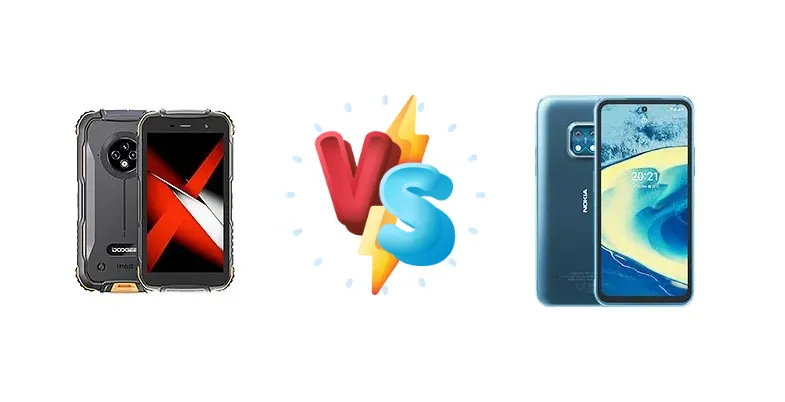
The rugged smartphone market caters to a specific user – those needing durability and reliability in challenging environments. The Doogee S35 and Nokia XR20 both aim to fulfill this need, but they approach it with vastly different internal hardware and price points. This comparison dissects their strengths and weaknesses to determine which device offers the best blend of toughness and functionality.
🏆 Quick Verdict
For the average user prioritizing future-proofing and smoother performance, the Nokia XR20 is the clear winner. Its Snapdragon 480 5G chipset and 18W charging provide a significantly better user experience than the Doogee S35’s aging Helio A20, despite the S35’s potentially lower price.
| Network |
|---|
| 2G bands | GSM 850 / 900 / 1800 / 1900 | GSM 850 / 900 / 1800 / 1900 |
| 3G bands | HSDPA 900 / 2100 | HSDPA 850 / 900 / 1700(AWS) / 1900 / 2100 |
| 4G bands | 1, 3, 7, 8, 20 | 1, 2, 3, 4, 5, 7, 8, 12, 13, 14, 20, 25, 26, 28, 30, 38, 40, 41, 48, 66, 71 |
| 5G bands | - | 2, 5, 25, 38, 41, 48, 66, 77, 78 SA/NSA |
| Speed | HSPA, LTE | HSPA, LTE, 5G |
| Technology | GSM / HSPA / LTE | GSM / CDMA / HSPA / EVDO / LTE / 5G |
| | - | CDMA2000 1xEV-DO |
| Launch |
|---|
| Announced | 2021, July 27 | 2021, July 27 |
| Status | Available. Released 2021, August | Available. Released 2021, August 04 |
| Body |
|---|
| Dimensions | 153.4 x 82.9 x 15.7 mm (6.04 x 3.26 x 0.62 in) | 171.6 x 81.5 x 10.6 mm (6.76 x 3.21 x 0.42 in) |
| SIM | Nano-SIM + Nano-SIM | · Nano-SIM· Nano-SIM + Nano-SIM |
| Weight | 260 g (9.17 oz) | 248 g (8.75 oz) |
| | - | IP68 dust/water resistant (up to 1.5m for 60 min)
Drop-to-concrete resistance from up to 1.8m
MIL-STD-810H compliant |
| Display |
|---|
| Protection | - | Corning Gorilla Glass Victus |
| Resolution | 720 x 1280 pixels, 16:9 ratio (~294 ppi density) | 1080 x 2400 pixels, 20:9 ratio (~395 ppi density) |
| Size | 5.0 inches, 68.9 cm2 (~54.2% screen-to-body ratio) | 6.67 inches, 107.4 cm2 (~76.8% screen-to-body ratio) |
| Type | IPS LCD | IPS LCD, 550 nits |
| Platform |
|---|
| CPU | Quad-core 1.8 GHz Cortex-A53 | Octa-core (2x2.0 GHz Kryo 460 & 6x1.8 GHz Kryo 460) |
| Chipset | Mediatek MT6761D Helio A20 (12 nm) | Qualcomm SM4350 Snapdragon 480 5G (8 nm) |
| GPU | PowerVR GE8320 | Adreno 619 |
| OS | Android 11 | Android 11, upgradable to Android 13 |
| Memory |
|---|
| Card slot | microSDXC (uses shared SIM slot) | microSDXC (uses shared SIM slot) |
| Internal | 16GB 3GB RAM | 64GB 4GB RAM, 128GB 6GB RAM |
| Main Camera |
|---|
| Dual | - | 48 MP, f/1.8, (wide), 1/2.25", 0.8µm, PDAF
13 MP, f/2.4, 123˚ (ultrawide), 1/3.0", 1.12µm |
| Features | LED flash | Zeiss optics, Dual-LED dual-tone flash, second LED flash, HDR, panorama |
| Single | - | 8 MP, f/2.0 (wide), 1/4.0", 1.12µm |
| Triple | 13 MP, f/2.2, (wide), AF
2 MP (macro)
Auxiliary lens | - |
| Video | 1080p | 1080p@30fps |
| Selfie camera |
|---|
| Single | 5 MP, f/2.8, (wide) | 8 MP, f/2.0 (wide), 1/4.0", 1.12µm |
| Video | Yes | 1080p@30fps |
| Sound |
|---|
| 3.5mm jack | - | Yes |
| 35mm jack | Yes | Yes |
| Loudspeaker | Yes | Yes, with stereo speakers |
| Comms |
|---|
| Bluetooth | 5.0, A2DP, LE | 5.1, A2DP, LE, aptX Adaptive |
| NFC | No | Yes |
| Positioning | GPS, GLONASS, BDS | GPS (L1+L5), GLONASS, BDS, GALILEO, QZSS, NavIC |
| Radio | FM radio | Unspecified |
| USB | microUSB 2.0, OTG | USB Type-C 3.0 |
| WLAN | Wi-Fi 802.11 a/b/g/n | Wi-Fi 802.11 a/b/g/n/ac/6, dual-band, Wi-Fi Direct |
| Features |
|---|
| Sensors | Accelerometer, proximity | Fingerprint (side-mounted), accelerometer, gyro, proximity, compass, barometer |
| Battery |
|---|
| Charging | 10W wired | 18W wired
15W wireless |
| Type | 4350 mAh | Li-Po 4630 mAh |
| Misc |
|---|
| Colors | Black, Orange, Red | Ultra Blue, Granite Gray |
| Models | - | TA-1368, TA-1362 |
| Price | About 120 EUR | About 270 EUR |
| SAR EU | - | 1.13 W/kg (head) 1.43 W/kg (body) |
Doogee S35
- Potentially lower price point
- Rugged design for durability
- Simple and straightforward user experience
- Outdated Helio A20 chipset
- Slow 10W charging
- Limited performance for demanding apps
Nokia XR20
- 5G connectivity with Snapdragon 480
- Faster 18W wired and 15W wireless charging
- More responsive user experience
- Higher price compared to Doogee S35
- Rugged design may not be as extreme as S35
- Software update support is uncertain beyond Android 12
Display Comparison
Neither device boasts a cutting-edge display. Details on panel type (IPS vs. LCD) and resolution are missing, but the focus here is durability. The absence of high refresh rates is expected in this segment. The real difference lies in processing power impacting UI smoothness, not display quality. Both will likely offer adequate outdoor visibility, but detailed color accuracy analysis is impossible without further specs.
Camera Comparison
Without detailed sensor information, a direct camera comparison is limited. However, the chipset difference indirectly impacts image processing capabilities. The Snapdragon 480’s ISP (Image Signal Processor) is far more advanced than the Helio A20’s, resulting in better noise reduction, dynamic range, and overall image quality. While both phones likely feature basic camera setups, the XR20 will produce superior photos and videos, particularly in challenging lighting conditions. We can assume both will have a primary sensor and potentially a depth or macro lens, but the XR20’s processing will elevate the results.
Performance
The performance gap is substantial. The Doogee S35’s MediaTek Helio A20, a quad-core processor built on a 12nm process, is significantly outmatched by the Nokia XR20’s Qualcomm Snapdragon 480 5G. The Snapdragon 480’s octa-core configuration (2x2.0 GHz Kryo 460 & 6x1.8 GHz Kryo 460) and 8nm fabrication process deliver a noticeable improvement in multi-tasking and app loading times. This translates to a more fluid user experience, especially for demanding applications. The XR20’s 5G capability is also a major advantage for future network compatibility.
Battery Life
Battery capacity details are missing for both devices, making a direct mAh comparison impossible. However, the charging capabilities reveal a key difference. The Nokia XR20 supports 18W wired charging *and* 15W wireless charging, offering greater convenience and flexibility. The Doogee S35 is limited to 10W wired charging, meaning significantly longer charge times. While a larger battery on the S35 could partially offset the slower charging, the XR20’s faster charging is a significant usability advantage.
Buying Guide
Buy the Doogee S35 if you need an extremely basic, ultra-affordable rugged phone for essential communication and minimal app usage, and are comfortable with slower performance. Buy the Nokia XR20 if you prioritize 5G connectivity, a more responsive user experience, faster charging, and the potential for software updates, even if it comes at a higher cost.
Frequently Asked Questions
❓ Will the Nokia XR20’s Snapdragon 480 handle modern mobile games like PUBG or Call of Duty?
While the Snapdragon 480 isn’t a flagship gaming chip, it’s capable of running PUBG and Call of Duty Mobile at medium settings with reasonable frame rates. Expect some occasional stuttering during intense scenes, but it’s a far more playable experience than the Doogee S35’s Helio A20, which would struggle significantly with these titles.
❓ How does the Nokia XR20’s software update policy compare to Doogee’s?
Nokia historically provides more consistent software updates than Doogee. The XR20 launched with a promise of at least three years of security updates and two major Android OS upgrades. Doogee’s update track record is less reliable, and the S35 is likely to receive limited or no software updates beyond its initial release.
❓ Is the 15W wireless charging on the Nokia XR20 significantly faster than wired charging?
No, 15W wireless charging is generally slower than 18W wired charging. However, it offers convenience – you can simply place the phone on a wireless charging pad without needing to plug in a cable. The XR20’s 18W wired charging is still the fastest way to replenish the battery.