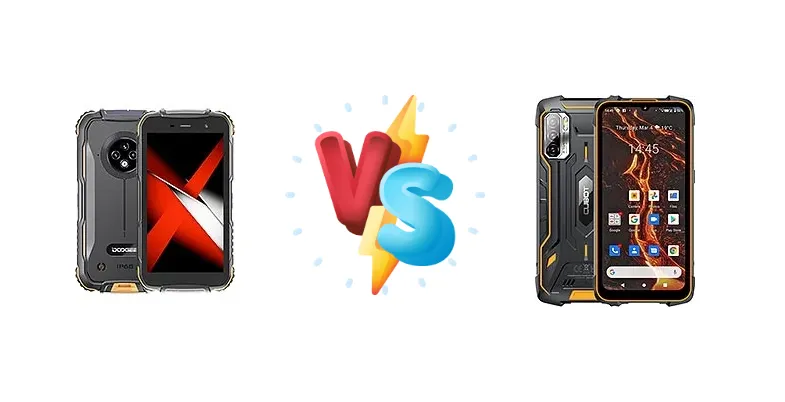
The Doogee S35 and Cubot KingKong 5 Pro represent the entry-level segment of the rugged smartphone market, catering to users needing durability without a flagship price tag. While both boast reinforced construction, a significant difference lies under the hood, impacting everyday performance and multitasking capabilities. This comparison dissects those differences to determine which phone delivers the best value for demanding users.
🏆 Quick Verdict
For the average user prioritizing basic functionality and extreme durability, the Doogee S35 is a solid choice. However, the Cubot KingKong 5 Pro emerges as the winner for those needing more responsive performance for apps and occasional gaming, thanks to its octa-core Helio P22 chipset.
| Network |
|---|
| 2G bands | GSM 850 / 900 / 1800 / 1900 | GSM 850 / 900 / 1800 / 1900 |
| 3G bands | HSDPA 900 / 2100 | HSDPA 850 / 900 / 1700(AWS) / 1900 / 2100 |
| 4G bands | 1, 3, 7, 8, 20 | 1, 2, 3, 4, 5, 7, 8, 12, 13, 17, 18, 19, 20, 25, 26, 28, 38, 40, 41, 66 |
| Speed | HSPA, LTE | HSPA, LTE |
| Technology | GSM / HSPA / LTE | GSM / HSPA / LTE |
| Launch |
|---|
| Announced | 2021, July 27 | 2021 |
| Status | Available. Released 2021, August | Available. Released 2021 |
| Body |
|---|
| Dimensions | 153.4 x 82.9 x 15.7 mm (6.04 x 3.26 x 0.62 in) | 165.8 x 81.4 x 18.8 mm (6.53 x 3.20 x 0.74 in) |
| SIM | Nano-SIM + Nano-SIM | Nano-SIM + Nano-SIM |
| Weight | 260 g (9.17 oz) | 319 g (11.25 oz) |
| Display |
|---|
| Resolution | 720 x 1280 pixels, 16:9 ratio (~294 ppi density) | 720 x 1560 pixels, 19.5:9 ratio (~286 ppi density) |
| Size | 5.0 inches, 68.9 cm2 (~54.2% screen-to-body ratio) | 6.01 inches, 88.7 cm2 (~65.7% screen-to-body ratio) |
| Type | IPS LCD | IPS LCD |
| Platform |
|---|
| CPU | Quad-core 1.8 GHz Cortex-A53 | Octa-core (4x2.0 GHz Cortex-A53 & 4x1.5 GHz Cortex-A53) |
| Chipset | Mediatek MT6761D Helio A20 (12 nm) | Mediatek MT6762D Helio P22 (12 nm) |
| GPU | PowerVR GE8320 | PowerVR GE8320 |
| OS | Android 11 | Android 11 |
| Memory |
|---|
| Card slot | microSDXC (uses shared SIM slot) | microSDXC (uses shared SIM slot) |
| Internal | 16GB 3GB RAM | 64GB 4GB RAM |
| Main Camera |
|---|
| Features | LED flash | LED flash |
| Triple | 13 MP, f/2.2, (wide), AF
2 MP (macro)
Auxiliary lens | 48 MP, (wide), AF
5 MP (macro), AF
Auxiliary lens |
| Video | 1080p | Yes |
| Selfie camera |
|---|
| Single | 5 MP, f/2.8, (wide) | 25 MP |
| Video | Yes | Yes |
| Sound |
|---|
| 35mm jack | Yes | Unspecified |
| Loudspeaker | Yes | Yes, with stereo speakers |
| Comms |
|---|
| Bluetooth | 5.0, A2DP, LE | 5.0, A2DP, LE |
| NFC | No | Yes |
| Positioning | GPS, GLONASS, BDS | GPS, GLONASS, BDS |
| Radio | FM radio | Unspecified |
| USB | microUSB 2.0, OTG | USB Type-C, OTG |
| WLAN | Wi-Fi 802.11 a/b/g/n | Wi-Fi 802.11 a/b/g/n/ac, dual-band |
| Features |
|---|
| Sensors | Accelerometer, proximity | Fingerprint (rear-mounted), accelerometer, gyro, proximity, compass |
| Battery |
|---|
| Charging | 10W wired | - |
| Type | 4350 mAh | 8000 mAh |
| Misc |
|---|
| Colors | Black, Orange, Red | Black |
| Price | About 120 EUR | - |
Doogee S35
- Potentially longer battery life due to the efficient Helio A20.
- Robust build quality expected from the Doogee S series.
- Lower price point likely makes it more accessible.
- Significantly slower performance compared to the Cubot KingKong 5 Pro.
- Limited multitasking capabilities.
- May struggle with modern app demands.
Cubot KingKong 5 Pro
- Faster and more responsive performance thanks to the Helio P22.
- Better multitasking capabilities.
- More suitable for light gaming and demanding apps.
- Potentially shorter battery life compared to the Doogee S35.
- May be slightly more expensive.
- Faster processor may generate more heat under sustained load.
Display Comparison
Neither Doogee nor Cubot provide detailed display specifications beyond the basic panel type. Given the price point, expect both to utilize IPS LCDs. The lack of information prevents a detailed comparison of brightness or color accuracy. However, the focus on ruggedness suggests both displays will feature reinforced glass, though the specific type (e.g., Gorilla Glass) is unknown. Bezels are likely to be substantial on both devices, prioritizing structural integrity over a modern, edge-to-edge design.
Camera Comparison
Detailed camera specifications are unavailable. Given the market segment, both phones likely feature a primary camera and potentially a secondary depth or macro sensor. However, the absence of information regarding sensor size, aperture, or image processing algorithms makes a meaningful comparison impossible. It’s reasonable to assume both cameras will perform adequately in good lighting conditions but struggle in low-light scenarios. The inclusion of a 2MP macro camera on either device is likely more for marketing than practical use, offering limited detail and image quality.
Performance
The core difference between these two phones lies in their chipsets. The Doogee S35 utilizes the Mediatek MT6761D Helio A20, a quad-core processor clocked at 1.8 GHz. This is a basic processor designed for efficiency and handling light tasks. Conversely, the Cubot KingKong 5 Pro features the Mediatek MT6762D Helio P22, an octa-core chip with a more complex configuration: four cores at 2.0 GHz and four at 1.5 GHz. This octa-core design provides a significant advantage in multitasking and handling more demanding applications. The P22’s higher clock speeds and additional cores translate to smoother app launches and a more responsive user interface. While neither chipset is a gaming powerhouse, the P22 will handle less graphically intensive games with greater ease.
Battery Life
Both phones likely feature large batteries, typical of rugged devices, to cater to users who may be away from power sources for extended periods. While specific mAh ratings are not provided, the Doogee S35’s less powerful Helio A20 processor will likely result in longer battery life under similar usage conditions. The Cubot KingKong 5 Pro, with its more demanding Helio P22, will consume more power. Both phones support 10W wired charging, indicating relatively slow charging speeds. Expect a full charge to take several hours.
Buying Guide
Buy the Doogee S35 if you need a supremely durable phone for essential tasks like calls, texts, and basic navigation, and prioritize long-term battery life over speed. Buy the Cubot KingKong 5 Pro if you prefer a more responsive user experience, frequently switch between apps, or occasionally engage in light gaming, accepting a potentially slightly shorter battery lifespan for the performance gain.
Frequently Asked Questions
❓ Will the Cubot KingKong 5 Pro struggle with demanding apps like Facebook or Chrome?
While the Helio P22 is an improvement over the Helio A20, it's still a budget chipset. Expect some slowdown or lag when running multiple browser tabs or using resource-intensive apps like Facebook. It will handle these apps, but not with the same fluidity as a phone with a more powerful processor.
❓ Is the 10W charging speed on either phone a significant drawback?
Yes, 10W charging is relatively slow by modern standards. Expect a full charge to take several hours, potentially overnight. This isn't ideal for users who need to quickly top up their battery, but it's common in this price range and won't significantly impact overnight charging.
❓ How durable are these phones likely to be in real-world conditions?
Both phones are designed to withstand drops, dust, and water exposure. However, the specific IP rating (e.g., IP68, IP69K) is not provided. Expect them to handle accidental drops onto concrete and exposure to rain, but avoid prolonged submersion unless the IP rating confirms waterproof capabilities.