
Doogee S200X vs. Doogee V30T: A Deep Dive into Rugged Performance and Endurance
| Phones Images | |||||
|---|---|---|---|---|---|
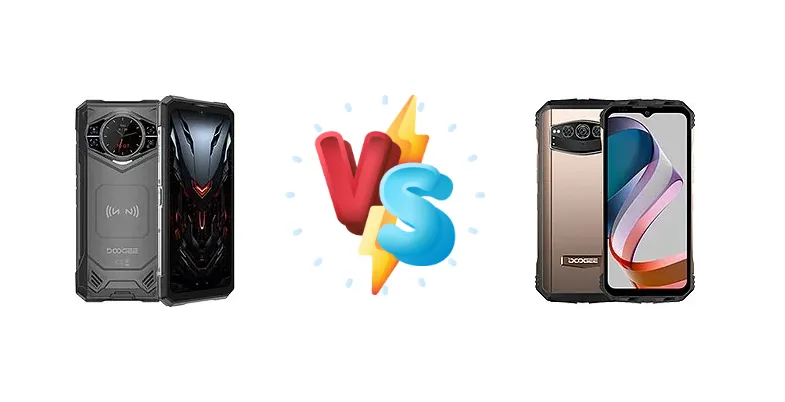
|
🏆 Quick Verdict
For the average user prioritizing sustained battery life and a lower price, the Doogee S200X emerges as the winner. Its exceptional 98.33-hour endurance outweighs the V30T’s faster charging, especially for those frequently away from power outlets. However, users demanding quicker charging and potentially slightly better overall performance will find the V30T a worthwhile upgrade.
| PHONES | ||
|---|---|---|
| Phone Names | Doogee S200X | Doogee V30T |
| Network | ||
|---|---|---|
| 2G bands | GSM 850 / 900 / 1800 / 1900 | GSM 850 / 900 / 1800 / 1900 |
| 3G bands | HSDPA 850 / 900 / 1700(AWS) / 1900 / 2100 | HSDPA 800 / 850 / 900 / 1700(AWS) / 1900 / 2100 |
| 4G bands | 1, 2, 3, 4, 5, 7, 8, 12, 17, 18, 19, 20, 25, 26, 28, 34, 38, 39, 40, 41, 66 | 1, 2, 3, 4, 5, 7, 8, 12, 17, 18, 19, 20, 25, 26, 28, 34, 38, 39, 40, 41, 66 |
| 5G bands | 1, 3, 7, 8, 28, 38, 41, 77, 78, 79 SA/NSA | 1, 3, 7, 28, 38, 41, 77, 78, 79 SA/NSA |
| Speed | HSPA, LTE, 5G | HSPA, LTE, 5G |
| Technology | GSM / HSPA / LTE / 5G | GSM / CDMA / HSPA / LTE / 5G |
| Launch | ||
|---|---|---|
| Announced | 2024, December | 2023, April 16 |
| Status | Available. Released 2024, December | Available. Released 2023, May |
| Body | ||
|---|---|---|
| Dimensions | 179.5 x 82.5 x 16 mm (7.07 x 3.25 x 0.63 in) | 178.4 x 83.1 x 17.8 mm (7.02 x 3.27 x 0.70 in) |
| SIM | Nano-SIM + Nano-SIM | Nano-SIM + Nano-SIM |
| Weight | - | 376 g (13.26 oz) |
| Display | ||
|---|---|---|
| Protection | Mohs level 5 | Corning Gorilla Glass 5 |
| Resolution | 1080 x 2400 pixels, 20:9 ratio (~392 ppi density) | 1080 x 2408 pixels, 20:9 ratio (~401 ppi density) |
| Size | 6.72 inches, 109.0 cm2 (~73.6% screen-to-body ratio) | 6.58 inches, 104.3 cm2 (~70.4% screen-to-body ratio) |
| Type | IPS LCD, 120Hz | IPS LCD, 120Hz |
| Platform | ||
|---|---|---|
| CPU | Octa-core (2x2.6 GHz Cortex-A78 & 6x2.0 GHz Cortex-A55) | Octa-core (2x2.6 GHz Cortex-A78 & 6x2.0 GHz Cortex-A55) |
| Chipset | Mediatek Dimensity 7050 (6 nm) | Mediatek Dimensity 1080 (6 nm) |
| GPU | Mali-G68 MC4 | Mali-G68 MC4 |
| OS | Android 14 | Android 12 |
| Memory | ||
|---|---|---|
| Card slot | microSDXC (uses shared SIM slot) | microSDXC (uses shared SIM slot) |
| Internal | 512GB 12GB RAM | 256GB 12GB RAM |
| Main Camera | ||
|---|---|---|
| Features | Dual-LED flash, HDR, panorama | Dual-LED flash, HDR, panorama |
| Triple | 100 MP, f/1.8, (wide), PDAF 20 MP, f/1.8, (night vision), infrared night vision light 2 MP (macro) | 108 MP, f/1.8, (wide), 1/1.52", 0.7µm, PDAF, OIS 20 MP, f/1.8, (night vision), 2 infrared night vision lights 16 MP, f/2.2, 130˚ (ultrawide), AF |
| Video | 4K, 1080p, gyro-EIS | 4K@30fps, 1080p@30fps |
| Selfie camera | ||
|---|---|---|
| Single | 20 MP, f/2.2, (wide) | 32 MP, f/1.8, (wide), 1/2.8", 0.8µm |
| Video | 1080p | 4K@30fps, 1080p@30fps |
| Sound | ||
|---|---|---|
| 35mm jack | No | No |
| Loudspeaker | Yes | Yes, with stereo speakers |
| Comms | ||
|---|---|---|
| Bluetooth | 5.2, A2DP, LE | 5.2, A2DP, LE |
| NFC | Yes | Yes (market/region dependent) |
| Positioning | GPS, GLONASS, BDS, GALILEO | GPS (L1+L5), GLONASS, GALILEO, BDS |
| Radio | FM radio | FM radio |
| USB | USB Type-C 2.0, OTG | USB Type-C 2.0, OTG |
| WLAN | Wi-Fi 802.11 a/b/g/n/ac/6, dual-band | Wi-Fi 802.11 a/b/g/n/ac/6, dual-band |
| Features | ||
|---|---|---|
| Sensors | Fingerprint (side-mounted), accelerometer, gyro, proximity, compass | Fingerprint (side-mounted), accelerometer, gyro, proximity, compass |
| Battery | ||
|---|---|---|
| Charging | 33W wired Reverse wired | 66W wired, 55% in 30 min 15W wireless Reverse wired |
| Type | 10100 mAh | 10800 mAh |
| Misc | ||
|---|---|---|
| Colors | Black, Yellow, Green | Marble Black, Rose Gold, Galaxy Gray |
| Price | About 370 EUR | About 420 EUR |
| EU LABEL | ||
|---|---|---|
| Battery | 98:33h endurance, 1000 cycles | - |
| Energy | Class B | - |
| Free fall | Class A (270 falls) | - |
| Repairability | Class C | - |
Doogee S200X
- Exceptional 98.33-hour battery endurance
- 1000 cycle battery lifespan for long-term reliability
- More affordable price point
- Reverse wired charging capability
- Slower 33W wired charging
- Potentially less powerful chipset for demanding tasks
Doogee V30T
- Faster 66W wired and 15W wireless charging
- Dimensity 1080 chipset offers a slight performance boost
- Potentially improved image processing
- Faster charging offsets smaller battery
- Shorter battery endurance compared to S200X
- Higher price point
Display Comparison
Display specifications are not provided, so a direct comparison is limited. However, given the market segment, both likely feature durable IPS LCD panels. The V30T’s higher price point *may* indicate a slightly higher peak brightness or improved color accuracy, but without specific data, this remains speculative. Both will likely prioritize durability over cutting-edge display technology.
Camera Comparison
Camera details are absent, making a thorough comparison impossible. However, Doogee typically focuses on megapixel count rather than sensor size. Assuming similar sensor sizes, the V30T’s potentially more advanced image signal processor (ISP) within the Dimensity 1080 chipset could result in slightly better image processing, particularly in low-light conditions. The inclusion of OIS (Optical Image Stabilization) on either device would be a significant advantage, but this is unconfirmed. The presence of a 2MP macro camera on either device is likely a marketing feature with limited practical utility.
Performance
Both the S200X and V30T utilize octa-core CPUs with the same core configuration (2x2.6 GHz Cortex-A78 & 6x2.0 GHz Cortex-A55). The key differentiator is the chipset: the S200X features the Mediatek Dimensity 7050 (6nm), while the V30T boasts the Dimensity 1080 (also 6nm). While both are 6nm chips, the Dimensity 1080 generally offers a slight performance edge in GPU-intensive tasks and sustained CPU loads due to architectural refinements. This translates to potentially smoother gaming and faster app loading times on the V30T, but the difference won’t be dramatic for everyday use. Both devices likely utilize LPDDR4X RAM, impacting multitasking performance.
Battery Life
The Doogee S200X shines with a remarkable 98.33-hour endurance rating, suggesting exceptional battery life. While the battery capacity isn’t specified, this endurance indicates efficient power management. The V30T counters with significantly faster charging: 66W wired (claiming 55% charge in 30 minutes) and 15W wireless charging. The S200X is limited to 33W wired charging and offers reverse wired charging. This means the V30T can top up much quicker, but the S200X will likely last considerably longer between charges. The S200X also boasts a 1000 cycle battery lifespan, suggesting long-term reliability.
Buying Guide
Buy the Doogee S200X if you need maximum battery life for extended outdoor adventures, prioritize value for money, and don't mind slightly slower charging speeds. Buy the Doogee V30T if you prefer faster 66W wired and 15W wireless charging, anticipate heavier multitasking, and are willing to pay a premium for the Dimensity 1080 chipset's incremental performance gains.