
Doogee S200 vs Ulefone Armor 8 Pro: A Deep Dive into Rugged Smartphone Performance
| Phones Images | |||||
|---|---|---|---|---|---|
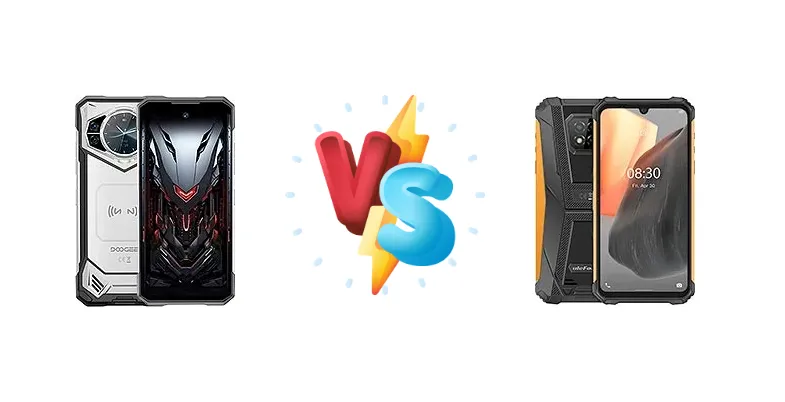
|
🏆 Quick Verdict
For the average user needing a rugged phone capable of handling demanding tasks, the Doogee S200 is the clear winner. Its Dimensity 7050 chipset provides a substantial performance advantage over the Ulefone Armor 8 Pro’s Helio P60, translating to smoother multitasking and gaming. While the Armor 8 Pro remains a viable option for basic use, the S200 offers a future-proofed experience.
| PHONES | ||
|---|---|---|
| Phone Names | Doogee S200 | Ulefone Armor 8 Pro |
| Network | ||
|---|---|---|
| 2G bands | GSM 850 / 900 / 1800 / 1900 | GSM 850 / 900 / 1800 / 1900 |
| 3G bands | HSDPA 850 / 900 / 1700(AWS) / 1900 / 2100 | HSDPA 850 / 900 / 1700(AWS) / 1900 / 2100 |
| 4G bands | 1, 2, 3, 4, 5, 7, 8, 12, 17, 18, 19, 20, 25, 26, 28, 34, 38, 39, 40, 41, 66 | 1, 2, 3, 4, 5, 7, 8, 12, 13, 17, 18, 19, 20, 25, 26, 28, 66 |
| 5G bands | 1, 3, 7, 8, 28, 38, 41, 77, 78, 79 SA/NSA | - |
| Speed | HSPA, LTE, 5G | HSPA 42.2/11.5 Mbps, LTE Cat7 300/150 Mbps |
| Technology | GSM / HSPA / LTE / 5G | GSM / HSPA / LTE |
| Launch | ||
|---|---|---|
| Announced | 2024, September | 2021, April 28 |
| Status | Available. Released 2024, September | Available. Released 2021, April 28 |
| Body | ||
|---|---|---|
| Build | - | Front glass, aluminum back with rubber, aluminum frame |
| Dimensions | 179.5 x 82.5 x 16 mm (7.07 x 3.25 x 0.63 in) | 166 x 81.8 x 15 mm (6.54 x 3.22 x 0.59 in) |
| SIM | Nano-SIM + Nano-SIM | Nano-SIM + Nano-SIM |
| Weight | - | 282 g (9.95 oz) |
| - | IP68 dust/water resistant (up to 1.5m for 30 min) Drop-to-concrete resistance from up to 1.2m MIL-STD-810G compliant | |
| Display | ||
|---|---|---|
| Protection | Mohs level 5 | Scratch-resistant glass, oleophobic coating |
| Resolution | 1080 x 2400 pixels, 20:9 ratio (~392 ppi density) | 720 x 1560 pixels, 19.5:9 ratio (~282 ppi density) |
| Size | 6.72 inches, 109.0 cm2 (~73.6% screen-to-body ratio) | 6.1 inches, 91.3 cm2 (~67.3% screen-to-body ratio) |
| Type | IPS LCD, 120Hz | IPS LCD |
| Platform | ||
|---|---|---|
| CPU | Octa-core (2x2.6 GHz Cortex-A78 & 6x2.0 GHz Cortex-A55) | Octa-core (4x2.0 GHz Cortex-A73 & 4x2.0 GHz Cortex-A53) |
| Chipset | Mediatek Dimensity 7050 (6 nm) | Mediatek MT6771 Helio P60 (12 nm) |
| GPU | Mali-G68 MC4 | Mali-G72 MP3 |
| OS | Android 14 | Android 11 |
| Memory | ||
|---|---|---|
| Card slot | microSDXC (uses shared SIM slot) | microSDXC (uses shared SIM slot) |
| Internal | 256GB 12GB RAM | 128GB 6GB RAM, 128GB 8GB RAM |
| Main Camera | ||
|---|---|---|
| Features | Dual-LED flash, HDR, panorama | LED flash, Panorama, HDR |
| Single | - | 8 MP, f/2.2 |
| Triple | 100 MP, f/1.8, (wide), 1/1.8", PDAF 20 MP, f/1.8, (night vision), infrared night vision light 2 MP (macro) | 16 MP, f/2.2, (wide), PDAF 5 MP (macro) Auxiliary lens |
| Video | 4K, 1080p, gyro-EIS | 1080p@30fps |
| Selfie camera | ||
|---|---|---|
| Single | 20 MP, (wide) | 8 MP, f/2.2 |
| Video | Yes | 1080p@30fps |
| Sound | ||
|---|---|---|
| 3.5mm jack | - | Yes |
| 35mm jack | No | Yes |
| Loudspeaker | Yes | Yes |
| Comms | ||
|---|---|---|
| Bluetooth | 5.2, A2DP, LE | 4.2, A2DP, LE |
| NFC | Yes | Yes |
| Positioning | GPS, GLONASS, BDS, GALILEO | GPS, GLONASS, GALILEO, BDS |
| Radio | FM radio | FM radio, RDS, recording |
| USB | USB Type-C 2.0, OTG | USB Type-C 2.0, OTG |
| WLAN | Wi-Fi 802.11 a/b/g/n/ac/6, dual-band | Wi-Fi 802.11 a/b/g/n/ac, Wi-Fi Direct |
| Features | ||
|---|---|---|
| Sensors | Fingerprint (side-mounted), accelerometer, gyro, proximity, compass | Fingerprint (side-mounted), accelerometer, gyro, proximity, compass |
| Battery | ||
|---|---|---|
| Charging | 33W wired Reverse wired | 15W wired |
| Type | 10100 mAh | Li-Po 5580 mAh |
| Misc | ||
|---|---|---|
| Colors | Gray, Silver | Black, Orange, Red |
| Price | About 370 EUR | About 190 EUR |
| EU LABEL | ||
|---|---|---|
| Battery | 98:33h endurance, 1000 cycles | - |
| Energy | Class B | - |
| Free fall | Class A (270 falls) | - |
| Repairability | Class C | - |
Doogee S200
- Significantly faster processor for smooth performance
- Faster 33W charging reduces downtime
- Excellent battery endurance (98:33h)
- Price likely higher than the Armor 8 Pro
- Rugged design may add bulk
Ulefone Armor 8 Pro
- Lower price point makes it accessible
- Rugged design provides durability
- Suitable for basic smartphone tasks
- Outdated Helio P60 chipset limits performance
- Slower 15W charging
- Likely shorter battery life compared to S200
Display Comparison
Neither device's display specifications are provided, so a direct comparison is limited. However, given the Armor 8 Pro's age, it likely utilizes an older IPS LCD panel. The S200, being a newer device, may benefit from advancements in display technology, potentially offering better color accuracy and viewing angles. Rugged phones often prioritize durability over display quality, so expect both to have robust glass protection, but don't anticipate flagship-level brightness or resolution.
Camera Comparison
Camera specifications are not provided for either device. However, given the Armor 8 Pro’s age, it’s likely equipped with older sensor technology. The S200, as a newer model, may incorporate more advanced image processing algorithms and potentially larger sensor sizes. Rugged phones often prioritize practicality over camera excellence, so expect competent but not exceptional image quality from both. The presence of OIS (Optical Image Stabilization) would be a significant advantage, but this information is unavailable.
Performance
The performance disparity is the most significant difference. The Doogee S200’s Mediatek Dimensity 7050 (6nm) is a substantial upgrade over the Ulefone Armor 8 Pro’s Helio P60 (12nm). The Dimensity 7050 features a modern CPU architecture – Octa-core (2x2.6 GHz Cortex-A78 & 6x2.0 GHz Cortex-A55) – compared to the Helio P60’s Octa-core (4x2.0 GHz Cortex-A73 & 4x2.0 GHz Cortex-A53). The Cortex-A78 cores in the S200 offer significantly higher single-core performance, crucial for responsive app launches and smooth UI navigation. The 6nm process node also translates to improved power efficiency and reduced thermal throttling under sustained load. Users who intend to game or run demanding applications will experience a dramatically better experience on the S200.
Battery Life
The Doogee S200 boasts a 98:33h endurance rating, indicating excellent battery life. While the Armor 8 Pro’s battery capacity isn’t specified, its older, less efficient chipset suggests it will require more frequent charging. The S200’s 33W wired charging is also considerably faster than the Armor 8 Pro’s 15W charging, reducing downtime. The S200 also supports reverse wired charging, a useful feature for topping up accessories in the field.
Buying Guide
Buy the Doogee S200 if you need a rugged phone for demanding applications like mobile gaming, running multiple apps simultaneously, or utilizing resource-intensive work tools. Its superior processing power and faster charging will significantly improve your workflow. Buy the Ulefone Armor 8 Pro if you prioritize a lower price point and only require basic smartphone functionality – calls, texts, and light app usage – and aren't concerned with future performance demands.