
Doogee S200 Ultra vs Nokia XR21: A Deep Dive into Rugged Smartphone Performance
| Phones Images | |||||
|---|---|---|---|---|---|
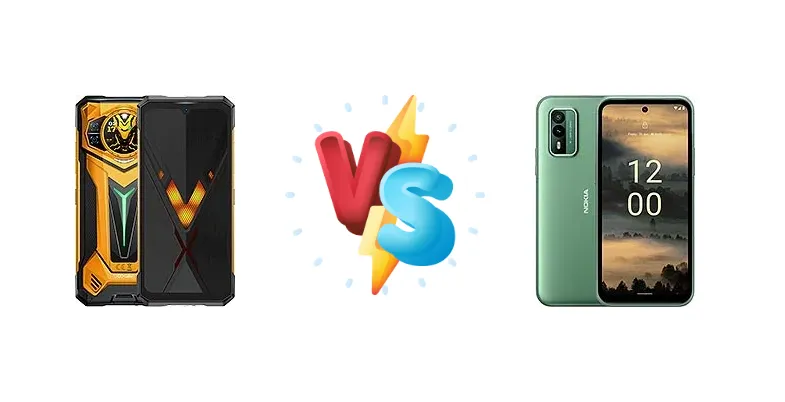
|
🏆 Quick Verdict
For users prioritizing performance and extended battery life, the Doogee S200 Ultra is the clear winner. Its Dimensity 7400 chipset and 98:33h endurance significantly outperform the Nokia XR21's Snapdragon 695. However, the Nokia XR21 remains a viable option for those seeking a more balanced experience with Qualcomm's established software support.
| PHONES | ||
|---|---|---|
| Phone Names | Doogee S200 Ultra | Nokia XR21 |
| Network | ||
|---|---|---|
| 2G bands | GSM 850 / 900 / 1800 / 1900 | GSM 850 / 900 / 1800 / 1900 |
| 3G bands | HSDPA 850 / 900 / 1700(AWS) / 1900 / 2100 | HSDPA 850 / 900 / 1700(AWS) / 1900 / 2100 |
| 4G bands | 1, 2, 3, 4, 5, 7, 8, 12, 17, 18, 19, 20, 25, 26, 28, 34, 38, 39, 40, 41, 66 | 1, 2, 3, 4, 5, 7, 8, 12, 13, 17, 20, 25, 26, 28, 32, 38, 39, 40, 41, 42, 43, 48, 66, 71 |
| 5G bands | 1, 3, 7, 8, 28, 38, 41, 77, 78, 79 SA/NSA | 1, 2, 3, 5, 7, 20, 25, 28, 40, 41, 66, 71, 77, 78, 79 SA/NSA |
| Speed | HSPA, LTE, 5G | HSPA, LTE, 5G |
| Technology | GSM / HSPA / LTE / 5G | GSM / HSPA / LTE / 5G |
| Launch | ||
|---|---|---|
| Announced | 2025, September | 2023, May 03 |
| Status | Available. Released 2025, October | Available. Released 2023, June 11 |
| Body | ||
|---|---|---|
| Build | - | Glass front (Gorilla Glass Victus), plastic back, plastic frame |
| Dimensions | 179.5 x 82.5 x 19.1 mm (7.07 x 3.25 x 0.75 in) | 168 x 78.6 x 10.5 mm (6.61 x 3.09 x 0.41 in) |
| SIM | Nano-SIM + Nano-SIM | Nano-SIM + Nano-SIM + eSIM (max 2 at a time) |
| Weight | 383 g (13.51 oz) | 231 g (8.15 oz) |
| - | IP68/IP69K dust/water resistant (up to 1.5m for 60 min) Drop-to-concrete resistance from up to 1.8m MIL-STD-810H compliant | |
| Display | ||
|---|---|---|
| Protection | Corning Gorilla Glass, Mohs level 5 | Corning Gorilla Glass Victus |
| Resolution | 1080 x 2400 pixels, 20:9 ratio (~392 ppi density) | 1080 x 2400 pixels, 20:9 ratio (~406 ppi density) |
| Size | 6.72 inches, 109.0 cm2 (~73.6% screen-to-body ratio) | 6.49 inches, 101.7 cm2 (~77.0% screen-to-body ratio) |
| Type | IPS LCD, 120Hz | IPS LCD, 120Hz, 450 nits (typ), 550 nits (HBM) |
| Platform | ||
|---|---|---|
| CPU | Octa-core (4x2.6 GHz Cortex-A78 & 4x2.0 GHz Cortex-A55) | Octa-core (2x2.2 GHz Kryo 660 Gold & 6x1.7 GHz Kryo 660 Silver) |
| Chipset | Mediatek Dimensity 7400 (4 nm) | Qualcomm SM6375 Snapdragon 695 5G (6 nm) |
| GPU | Mali-G615 MC2 | Adreno 619 |
| OS | Android 15 | Android 12 |
| Memory | ||
|---|---|---|
| Card slot | microSDXC (uses shared SIM slot) | Unspecified |
| Internal | 1TB 12GB RAM | 128GB 6GB RAM |
| Main Camera | ||
|---|---|---|
| Dual | - | 64 MP, f/1.8, (wide), 1/2.0", PDAF 8 MP, f/2.2, (ultrawide), 1/4.0", 1.12µm |
| Features | Dual-LED flash, HDR, panorama | Dual-LED dual-tone flash, second LED flash, HDR, panorama |
| Triple | 100 MP, f/1.8, (wide), 1/1.8", PDAF 20 MP, f/1.8, (night vision), infrared night vision light 2 MP (macro) | - |
| Video | 4K@30fps, 1080p@30fps, gyro-EIS | 1080p@30fps |
| Selfie camera | ||
|---|---|---|
| Single | 32 MP, f/2.2, (wide), 1/2.8" | 16 MP, f/2.4 (wide) |
| Video | 1080p@30fps | 1080p@30fps |
| Sound | ||
|---|---|---|
| 3.5mm jack | - | Yes |
| 35mm jack | No | Yes |
| Loudspeaker | Yes | Yes, with stereo speakers |
| Comms | ||
|---|---|---|
| Bluetooth | 5.4, A2DP, LE | 5.1, A2DP, LE, aptX Adaptive |
| NFC | Yes | Yes (market/region dependent) |
| Positioning | GPS, GLONASS, BDS, GALILEO | GPS (L1+L5), GLONASS (G1), BDS (B1I+B1c+B2a), GALILEO (E1+E5a), QZSS (L1+L5), NavIC (L5) |
| Radio | FM radio | Unspecified |
| USB | USB Type-C 2.0, OTG | USB Type-C 2.0, OTG |
| WLAN | Wi-Fi 802.11 a/b/g/n/ac/6, dual-band | Wi-Fi 802.11 a/b/g/n/ac/6, dual-band |
| Features | ||
|---|---|---|
| Sensors | Fingerprint (side-mounted), accelerometer, gyro, proximity, compass | Fingerprint (side-mounted), accelerometer, gyro, proximity, compass, barometer |
| Battery | ||
|---|---|---|
| Charging | 66W wired 10W reverse wired | 33W wired, PD2.0, QC3 |
| Type | Si/C Li-Ion 11000 mAh | Li-Po 4800 mAh |
| Misc | ||
|---|---|---|
| Colors | Black, Yellow, Green | Midnight Black, Pine Green |
| Price | € 479.99 / $ 399.28 / £ 419.99 | About 570 EUR |
| EU LABEL | ||
|---|---|---|
| Battery | 98:33h endurance, 1000 cycles | - |
| Energy | Class B | - |
| Free fall | Class A (270 falls) | - |
| Repairability | Class C | - |
Doogee S200 Ultra
- Exceptional battery life (98:33h endurance)
- Significantly faster charging (66W)
- More powerful processor (Dimensity 7400)
- Software support may be less frequent than Nokia
- Potential for higher price point
Nokia XR21
- Reliable Qualcomm chipset (Snapdragon 695)
- Guaranteed software updates from Nokia
- PD2.0 and QC3 fast charging support
- Inferior processor performance
- Shorter battery life
Display Comparison
Display specifications are absent from the provided data, but considering the market positioning, we can infer differences. The Doogee S200 Ultra, targeting a more performance-oriented user, likely features a higher refresh rate panel for smoother visuals. The Nokia XR21, focusing on practicality, may prioritize power efficiency with a standard 60Hz display. Bezels are likely similar given the rugged design constraints, but color accuracy and peak brightness will be key differentiators, with the Doogee potentially offering a more vibrant experience.
Camera Comparison
Camera details are limited, but the chipset difference hints at superior image processing capabilities within the Doogee S200 Ultra. While both phones likely feature multi-camera setups, the Dimensity 7400’s ISP (Image Signal Processor) will likely deliver better dynamic range, noise reduction, and overall image quality. The absence of sensor details prevents a definitive judgment, but the Doogee’s more powerful chipset suggests a more capable camera system. We can expect the Nokia XR21 to focus on reliable, consistent image capture, while the Doogee aims for higher fidelity.
Performance
The core difference lies in the chipsets. The Doogee S200 Ultra’s Mediatek Dimensity 7400 (4nm) is a significant leap ahead of the Nokia XR21’s Qualcomm Snapdragon 695 5G (6nm). The Dimensity 7400’s Cortex-A78 cores, clocked at 2.6 GHz, provide substantially more processing power than the Snapdragon 695’s Kryo 660 Gold cores at 2.2 GHz. The 4nm process node further enhances efficiency, translating to better thermal management and sustained performance under load. This means the Doogee will handle demanding games and applications with greater ease, while the Nokia XR21 may exhibit more throttling during prolonged use. The Snapdragon 695 is adequate for everyday tasks, but the Dimensity 7400 offers a future-proofed experience.
Battery Life
Battery life is where the Doogee S200 Ultra truly shines. Its 98:33h endurance is exceptional, indicating significantly longer usage between charges compared to what we’d expect from the Nokia XR21. While the Nokia XR21 offers 33W wired charging with PD2.0 and QC3, the Doogee S200 Ultra’s 66W wired charging will replenish the battery much faster. The Doogee also includes 10W reverse wired charging, a convenient feature for topping up accessories. The combination of superior endurance and faster charging makes the Doogee the clear winner in this category.
Buying Guide
Buy the Doogee S200 Ultra if you need uncompromising performance for demanding tasks like gaming or video editing, and require multi-day battery life. This phone is ideal for outdoor professionals, adventurers, or anyone who frequently finds themselves away from a power outlet. Buy the Nokia XR21 if you prefer a more streamlined software experience with guaranteed updates, and prioritize a balance between performance and battery life for everyday tasks. It's a solid choice for users who value reliability and ease of use.