
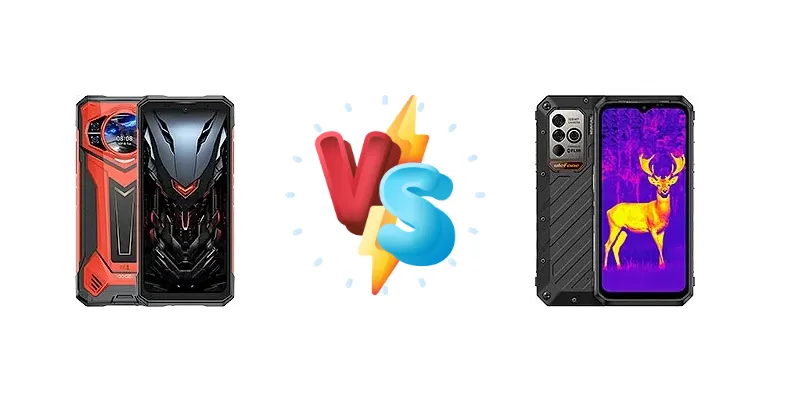
Doogee S200 Plus vs Ulefone Power Armor 18T Ultra: Which Rugged Phone Delivers More?
| Phones Images | |||||
|---|---|---|---|---|---|
|
🏆 Quick Verdict
For most users, the Doogee S200 Plus emerges as the stronger choice. Its Dimensity 7300 chipset, built on a more efficient 4nm process, provides a performance edge, while its impressive 98:33h battery endurance ensures all-day usability. The Ulefone 18T Ultra’s faster charging is a compelling feature, but doesn’t fully offset the performance and efficiency gap.
| PHONES | ||
|---|---|---|
| Phone Names | Doogee S200 Plus | Ulefone Power Armor 18T Ultra |
| Network | ||
|---|---|---|
| 2G bands | GSM 850 / 900 / 1800 / 1900 | GSM 850 / 900 / 1800 / 1900 |
| 3G bands | HSDPA 850 / 900 / 1700(AWS) / 1900 / 2100 | HSDPA 800 / 850 / 900 / 1700(AWS) / 1900 / 2100 |
| 4G bands | 1, 2, 3, 4, 5, 7, 8, 12, 17, 18, 19, 20, 25, 26, 28, 34, 38, 39, 40, 41, 66 | 1, 2, 3, 4, 5, 7, 8, 12, 13, 17, 18, 19, 20, 25, 26, 28, 34, 38, 39, 40, 41, 66, 71 |
| 5G bands | 1, 3, 7, 8, 28, 38, 41, 77, 78, 79 SA/NSA | 1, 2, 3, 5, 7, 8, 12, 20, 25, 28, 38, 40, 41, 66, 71, 77, 78, 79 SA/NSA/Sub6 |
| Speed | HSPA, LTE, 5G | HSPA, LTE, 5G |
| Technology | GSM / HSPA / LTE / 5G | GSM / CDMA / HSPA / CDMA2000 / LTE / 5G |
| Launch | ||
|---|---|---|
| Announced | 2025, March | 2023, October |
| Status | Available. Released 2025, March | Available. Released 2023, November |
| Body | ||
|---|---|---|
| Dimensions | 179.5 x 82.5 x 19.1 mm (7.07 x 3.25 x 0.75 in) | 175.2 x 83.4 x 18.8 mm (6.90 x 3.28 x 0.74 in) |
| SIM | Nano-SIM + Nano-SIM | Nano-SIM + Nano-SIM |
| Weight | 379 g (13.37 oz) | 409 g (14.43 oz) |
| Display | ||
|---|---|---|
| Protection | Mohs level 5 | Corning Gorilla Glass 5, Mohs level 4 |
| Resolution | 1080 x 2400 pixels, 20:9 ratio (~392 ppi density) | 1080 x 2408 pixels, 20:9 ratio (~401 ppi density) |
| Size | 6.72 inches, 109.0 cm2 (~73.6% screen-to-body ratio) | 6.58 inches, 104.3 cm2 (~71.4% screen-to-body ratio) |
| Type | IPS LCD, 120Hz | IPS LCD, 120Hz |
| Platform | ||
|---|---|---|
| CPU | Octa-core (4x2.5 GHz Cortex-A78 & 4x2.0 GHz Cortex-A55) | Octa-core (2x2.6 GHz Cortex-A78 & 6x2.0 GHz Cortex-A55) |
| Chipset | Mediatek Dimensity 7300 (4 nm) | Mediatek Dimensity 7050 (6 nm) |
| GPU | Mali-G615 MC2 | Mali-G68 MC4 |
| OS | Android 14 | Android 13, upgradable to Android 14 |
| Memory | ||
|---|---|---|
| Card slot | microSDXC (uses shared SIM slot) | microSDXC (uses shared SIM slot) |
| Internal | 512GB 12GB RAM | 512GB 12GB RAM |
| Main Camera | ||
|---|---|---|
| Features | Dual-LED flash, HDR, panorama | Hexa-LED flash, HDR, panorama |
| Triple | 100 MP, f/1.8, (wide), 1/1.8", PDAF 20 MP, f/1.8, (night vision), infrared night vision light 2 MP (macro) | 108 MP, f/1.9, (wide), 1/1.52", 0.7µm, PDAF 5 MP (macro) 5 MP, f/2.2, (FLIR thermal camera, Lepton module) |
| Video | 4K@30fps, 1080p@30fps, gyro-EIS | 4K@30fps, 1080p@30fps |
| Selfie camera | ||
|---|---|---|
| Single | 32 MP, f/2.3, (wide), 1/2.8" | 32 MP, f/2.0, (wide), 1.2µm |
| Video | 1080p@30fps | 1080p@30fps |
| Sound | ||
|---|---|---|
| 35mm jack | No | Yes |
| Loudspeaker | Yes | Yes |
| Comms | ||
|---|---|---|
| Bluetooth | 5.4, A2DP, LE | 5.0, A2DP, LE |
| NFC | Yes | Yes |
| Positioning | GPS, GLONASS, BDS, GALILEO | GPS (L1+L5), GLONASS, GALILEO, BDS, NavIC |
| Radio | FM radio | Wireless FM radio, RDS, recording |
| USB | USB Type-C 2.0, OTG | USB Type-C 2.0, OTG, magnetic connector |
| WLAN | Wi-Fi 802.11 a/b/g/n/ac/6e, dual-band | Wi-Fi 802.11 a/b/g/n/ac/6, dual-band |
| Features | ||
|---|---|---|
| Sensors | Fingerprint (side-mounted), accelerometer, gyro, proximity, compass | Fingerprint (side-mounted), accelerometer, gyro, proximity, compass |
| Battery | ||
|---|---|---|
| Charging | 33W wired 18W reverse wired | 66W wired, 52% in 30 min 15W wireless 5W wireless reversed |
| Type | 10100 mAh | Li-Po 9600 mAh |
| Misc | ||
|---|---|---|
| Colors | Black, Red, Gold | Black |
| Price | About 400 EUR | About 700 EUR |
| EU LABEL | ||
|---|---|---|
| Battery | 98:33h endurance, 1000 cycles | 88:30h endurance, 1000 cycles |
| Energy | Class B | Class B |
| Free fall | Class A (270 falls) | Class A (270 falls) |
| Repairability | Class C | Class C |
Doogee S200 Plus
- Superior chipset performance with Dimensity 7300
- More efficient 4nm process for better thermal management
- Longer battery endurance (98:33h)
- Slower charging speed (33W)
- Lacks wireless charging
Ulefone Power Armor 18T Ultra
- Faster 66W wired charging with 52% in 30 minutes
- Wireless charging support (15W)
- Reverse wireless charging (5W)
- Less efficient 6nm Dimensity 7050 chipset
- Shorter battery endurance (88:30h)
Display Comparison
While both devices are rugged, display details are absent in the provided data. However, considering the price points, we can infer both likely utilize IPS LCD panels. The focus here shifts to durability – both will prioritize scratch resistance and visibility in direct sunlight. The absence of LTPO or high refresh rate specs suggests neither phone is geared towards display-intensive experiences.
Camera Comparison
Camera specifications are not provided, so analysis relies on typical configurations for this market segment. Both phones likely feature a primary sensor, ultrawide, and potentially a macro lens. The absence of detailed sensor information makes a direct comparison impossible. However, the focus for both will be on durability and usability in challenging conditions rather than high-end photography.
Performance
The Doogee S200 Plus boasts the Mediatek Dimensity 7300 (4nm), featuring an octa-core CPU configuration with 4x2.5 GHz Cortex-A78 and 4x2.0 GHz Cortex-A55 cores. The Ulefone Power Armor 18T Ultra utilizes the Dimensity 7050 (6nm) with 2x2.6 GHz Cortex-A78 and 6x2.0 GHz Cortex-A55 cores. The 4nm fabrication process of the Dimensity 7300 offers a significant advantage in thermal efficiency, translating to less throttling under sustained load. While the 18T Ultra’s slightly higher clocked A78 cores offer a marginal single-core boost, the S200 Plus’s architecture and process node will likely deliver superior multi-core and GPU performance, benefiting gamers and power users.
Battery Life
The Doogee S200 Plus delivers an impressive 98:33h endurance, while the Ulefone Power Armor 18T Ultra achieves 88:30h. This difference, despite the Ulefone’s faster charging, highlights the efficiency gains of the Dimensity 7300. The 18T Ultra compensates with 66W wired charging (52% in 30 minutes), 15W wireless, and 5W reverse wireless, a significant advantage over the S200 Plus’s 33W wired and 18W reverse wired. Users prioritizing quick top-ups will favor the Ulefone, but the Doogee offers longer overall usage between charges.
Buying Guide
Buy the Doogee S200 Plus if you prioritize sustained performance for demanding tasks like gaming or video editing, and value long-term battery health with its 1000 charge cycles. Buy the Ulefone Power Armor 18T Ultra if rapid charging is paramount, and you frequently find yourself needing to top up quickly, even if it means slightly less overall performance and efficiency.