
Doogee S200 Max vs. Ulefone Power Armor 16 Pro: A Deep Dive into Rugged Performance
| Phones Images | |||||
|---|---|---|---|---|---|
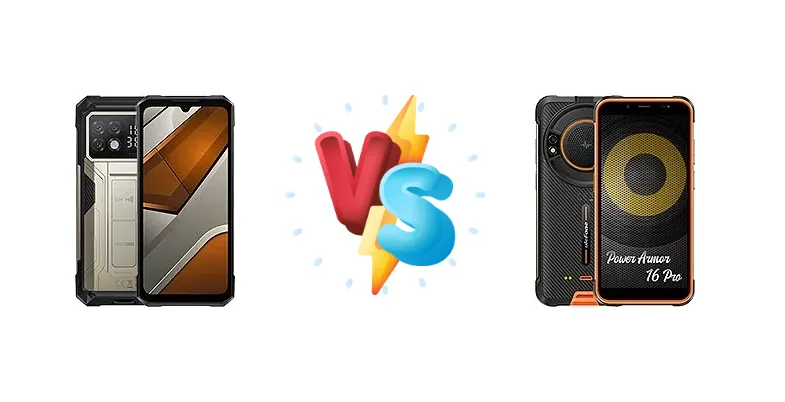
|
🏆 Quick Verdict
For the average user prioritizing performance and future-proofing, the Doogee S200 Max is the clear winner. Its Dimensity 7050 chipset offers a substantial leap in processing power over the Ulefone’s Helio G25, translating to smoother multitasking and gaming. While the Ulefone offers a more affordable entry point, the S200 Max provides a significantly better user experience.
| PHONES | ||
|---|---|---|
| Phone Names | Doogee S200 Max | Ulefone Power Armor 16 Pro |
| Network | ||
|---|---|---|
| 2G bands | GSM 850 / 900 / 1800 / 1900 | GSM 850 / 900 / 1800 / 1900 |
| 3G bands | HSDPA 850 / 900 / 1700(AWS) / 1900 / 2100 | HSDPA 800 / 850 / 900 / 1700(AWS) / 1900 / 2100 |
| 4G bands | 1, 2, 3, 4, 5, 7, 8, 12, 17, 18, 19, 20, 25, 26, 28, 34, 38, 39, 40, 41, 66 | 1, 2, 3, 4, 5, 7, 8, 12, 13, 17, 18, 19, 20, 25, 26, 28, 66 |
| 5G bands | 1, 3, 7, 8, 28, 38, 41, 77, 78, 79 SA/NSA | - |
| Speed | HSPA, LTE, 5G | HSPA, LTE |
| Technology | GSM / HSPA / LTE / 5G | GSM / HSPA / LTE |
| - | eMMC 5.1 | |
| Launch | ||
|---|---|---|
| Announced | 2025, August | 2022, September 16 |
| Status | Available. Released 2025, August | Available. Released 2022, September 16 |
| Body | ||
|---|---|---|
| Dimensions | 179.5 x 82.5 x 25.5 mm (7.07 x 3.25 x 1.00 in) | 173.4 x 83.4 x 18.3 mm (6.83 x 3.28 x 0.72 in) |
| SIM | Nano-SIM + Nano-SIM | Nano-SIM + Nano-SIM |
| Weight | 535 g (1.18 lb) | 405 g (14.29 oz) |
| - | IP68/IP69K dust/water resistant (up to 1.5m for 30 min) Drop-to-concrete resistance from up to 1.5m MIL-STD-810G compliant Flashlight with a dedicated button Accessory connector (ulefone endoscope, microscope) | |
| Display | ||
|---|---|---|
| Protection | Mohs level 6 | - |
| Resolution | 1080 x 2400 pixels, 20:9 ratio (~392 ppi density) | 720 x 1440 pixels, 18:9 ratio (~271 ppi density) |
| Size | 6.72 inches, 109.0 cm2 (~73.6% screen-to-body ratio) | 5.93 inches, 90.7 cm2 (~62.8% screen-to-body ratio) |
| Type | IPS LCD, 120Hz | IPS LCD |
| Platform | ||
|---|---|---|
| CPU | Octa-core (2x2.6 GHz Cortex-A78 & 6x2.0 GHz Cortex-A55) | Octa-core (4x2.0 GHz Cortex-A53 & 4x1.5 GHz Cortex-A53) |
| Chipset | Mediatek Dimensity 7050 (6 nm) | Mediatek MT6762G Helio G25 (12 nm) |
| GPU | Mali-G68 MC4 | PowerVR GE8320 |
| OS | Android 15 | Android 12 |
| Memory | ||
|---|---|---|
| Card slot | microSDXC (uses shared SIM slot) | microSDXC (dedicated slot) |
| Internal | 512GB 16GB RAM | 64GB 4GB RAM |
| Main Camera | ||
|---|---|---|
| Dual | - | 16 MP, f/1.8, (wide), 1.12µm, PDAF 2 MP (macro) |
| Features | Dual-LED flash, HDR, panorama | LED flash, HDR, panorama |
| Single | - | 8 MP, f/2.0, (wide), 1.12µm |
| Triple | 100 MP, f/1.9, (wide), 1/1.8", PDAF 20 MP, f/1.8, (night vision), infrared night vision light 2 MP (macro) | - |
| Video | 4K@30fps, 1080p@30fps, gyro-EIS | 1080p@30fps |
| Selfie camera | ||
|---|---|---|
| Single | 32 MP, f/2.3, (wide), 1/2.8" | 8 MP, f/2.0, (wide), 1.12µm |
| Video | 1080p@30fps | 1080p@30fps |
| Sound | ||
|---|---|---|
| 3.5mm jack | - | Yes |
| 35mm jack | No | Yes |
| Loudspeaker | Yes | Yes (122-decibel) |
| Comms | ||
|---|---|---|
| Bluetooth | 5.2, A2DP, LE | 5.0, A2DP, LE |
| NFC | Yes | Yes |
| Positioning | GPS, GLONASS, BDS, GALILEO | GPS, GLONASS, GALILEO, BDS |
| Radio | FM radio | Wireless FM radio, RDS, recording |
| USB | USB Type-C 2.0, OTG | USB Type-C 2.0, OTG, magnetic connector |
| WLAN | Wi-Fi 802.11 a/b/g/n/ac/6, dual-band | Wi-Fi 802.11 a/b/g/n/ac, dual-band |
| Features | ||
|---|---|---|
| Sensors | Fingerprint (side-mounted), accelerometer, gyro, proximity, compass | Fingerprint (side-mounted), accelerometer, proximity, compass |
| Battery | ||
|---|---|---|
| Charging | 66W wired 18W reverse wired | 18W wired 5W reverse wired |
| Type | 22000 mAh | Li-Po 9600 mAh |
| Misc | ||
|---|---|---|
| Colors | Gray, Gold | Black, Black/Orange |
| Price | $ 350.76 / £ 474.99 / € 429.99 | About 220 EUR |
| EU LABEL | ||
|---|---|---|
| Battery | 117:35h endurance, 1300 cycles | - |
| Energy | Class E | - |
| Free fall | Class A (270 falls) | - |
| Repairability | Class C | - |
Doogee S200 Max
- Significantly faster processor for smooth performance
- 66W fast charging for quick top-ups
- Longer battery endurance (117:35h)
- Likely higher price point
- May be slightly larger/heavier due to more powerful components
Ulefone Power Armor 16 Pro
- More affordable price
- Rugged design for durability
- Acceptable for basic smartphone tasks
- Slow Helio G25 processor limits performance
- Slow 18W charging
- Lower overall user experience
Display Comparison
Display specifications are not provided, but given the market segment, both likely feature LCD panels. However, the performance gap in the chipsets suggests the S200 Max could potentially drive a higher resolution or refresh rate display without significant performance impact. The Ulefone, constrained by the Helio G25, would struggle with anything beyond a standard 60Hz, 1080p panel. Bezels are likely similar, prioritizing durability over slim designs.
Camera Comparison
Camera details are absent, but the chipset disparity suggests a significant difference in image processing capabilities. The Dimensity 7050 includes a more powerful ISP (Image Signal Processor) allowing for faster image capture, better noise reduction, and more advanced features. While both phones likely feature multiple cameras, the S200 Max will be able to leverage its processing power to deliver superior image quality, especially in low-light conditions. We can assume the Ulefone will rely heavily on software processing, which may introduce artifacts.
Performance
The core difference lies in the chipsets. The Doogee S200 Max’s Mediatek Dimensity 7050 (6nm) is a significant upgrade over the Ulefone Power Armor 16 Pro’s Helio G25 (12nm). The Dimensity 7050’s Cortex-A78 cores, clocked at 2.6 GHz, provide substantially more processing power than the G25’s Cortex-A53 cores at 2.0 GHz. The 6nm process node also translates to improved thermal efficiency, meaning the S200 Max is less likely to throttle under sustained load. This difference is critical for gaming and demanding applications. The G25 is adequate for basic tasks, but will struggle with anything beyond light usage.
Battery Life
The Doogee S200 Max boasts a remarkable 117:35h endurance, indicating excellent battery optimization alongside its capacity. Coupled with 66W wired charging, it offers a rapid recharge time. The Ulefone Power Armor 16 Pro’s 18W charging is significantly slower. While battery capacity isn’t specified, the S200 Max’s endurance suggests a larger battery or more efficient power management. The 18W reverse wired charging on both is useful for topping up accessories, but the S200 Max’s 66W wired charging provides a much faster path to a full charge.
Buying Guide
Buy the Doogee S200 Max if you need a rugged phone capable of handling demanding tasks like gaming, video editing, or running multiple apps simultaneously. Its superior chipset and faster charging will be invaluable for power users. Buy the Ulefone Power Armor 16 Pro if you prioritize extreme affordability and only require basic smartphone functionality – calls, texts, and light app usage – and are willing to accept significantly slower performance.