
Doogee S118 vs. Ulefone Power Armor 16 Pro: A Deep Dive into Rugged Smartphone Performance
| Phones Images | |||||
|---|---|---|---|---|---|
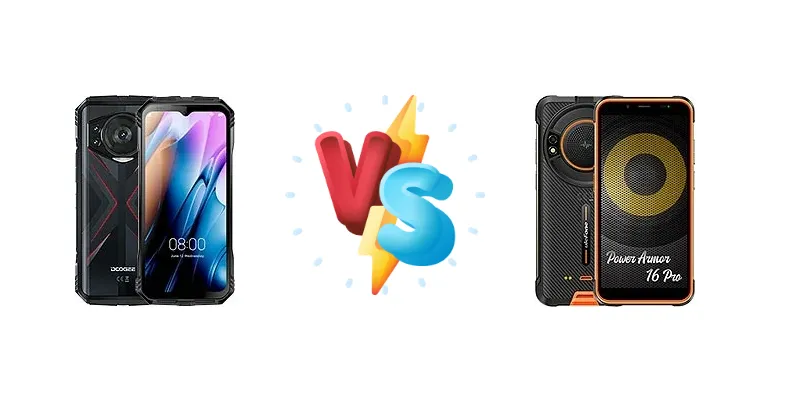
|
🏆 Quick Verdict
For the average user prioritizing performance and longevity, the Doogee S118 is the clear winner. Its Mediatek Helio G99 chipset provides a substantial performance uplift over the Ulefone Power Armor 16 Pro’s Helio G25, translating to smoother multitasking and gaming. While the Ulefone offers a rugged build, it compromises heavily on processing power.
| PHONES | ||
|---|---|---|
| Phone Names | Doogee S118 | Ulefone Power Armor 16 Pro |
| Network | ||
|---|---|---|
| 2G bands | GSM 850 / 900 / 1800 / 1900 | GSM 850 / 900 / 1800 / 1900 |
| 3G bands | HSDPA 800 / 850 / 900 / 1700(AWS) / 1900 / 2100 | HSDPA 800 / 850 / 900 / 1700(AWS) / 1900 / 2100 |
| 4G bands | 1, 2, 3, 4, 5, 7, 8, 12, 13, 17, 18, 19, 20, 25, 26, 28, 34, 38, 39, 40, 41, 66, 71 | 1, 2, 3, 4, 5, 7, 8, 12, 13, 17, 18, 19, 20, 25, 26, 28, 66 |
| Speed | HSPA, LTE | HSPA, LTE |
| Technology | GSM / CDMA / HSPA / LTE | GSM / HSPA / LTE |
| - | eMMC 5.1 | |
| Launch | ||
|---|---|---|
| Announced | 2024, June | 2022, September 16 |
| Status | Available. Released 2024, June | Available. Released 2022, September 16 |
| Body | ||
|---|---|---|
| Dimensions | 178.5 x 83.1 x 17.9 mm (7.03 x 3.27 x 0.70 in) | 173.4 x 83.4 x 18.3 mm (6.83 x 3.28 x 0.72 in) |
| SIM | Nano-SIM + Nano-SIM | Nano-SIM + Nano-SIM |
| Weight | - | 405 g (14.29 oz) |
| - | IP68/IP69K dust/water resistant (up to 1.5m for 30 min) Drop-to-concrete resistance from up to 1.5m MIL-STD-810G compliant Flashlight with a dedicated button Accessory connector (ulefone endoscope, microscope) | |
| Display | ||
|---|---|---|
| Protection | Corning Gorilla Glass, Mohs level 5 | - |
| Resolution | 1080 x 2408 pixels, 20:9 ratio (~401 ppi density) | 720 x 1440 pixels, 18:9 ratio (~271 ppi density) |
| Size | 6.58 inches, 104.3 cm2 (~70.3% screen-to-body ratio) | 5.93 inches, 90.7 cm2 (~62.8% screen-to-body ratio) |
| Type | IPS LCD, 120Hz | IPS LCD |
| Platform | ||
|---|---|---|
| CPU | Octa-core (2x2.2 GHz Cortex-A76 & 6x2.0 GHz Cortex-A55) | Octa-core (4x2.0 GHz Cortex-A53 & 4x1.5 GHz Cortex-A53) |
| Chipset | Mediatek Helio G99 (6 nm) | Mediatek MT6762G Helio G25 (12 nm) |
| GPU | Mali-G57 MC2 | PowerVR GE8320 |
| OS | Android 14 | Android 12 |
| Memory | ||
|---|---|---|
| Card slot | microSDXC (uses shared SIM slot) | microSDXC (dedicated slot) |
| Internal | 512GB 8GB RAM | 64GB 4GB RAM |
| Main Camera | ||
|---|---|---|
| Dual | - | 16 MP, f/1.8, (wide), 1.12µm, PDAF 2 MP (macro) |
| Features | Dual-LED flash, HDR, panorama | LED flash, HDR, panorama |
| Single | - | 8 MP, f/2.0, (wide), 1.12µm |
| Triple | 50 MP, f/1.8, (wide), 1/2.76", PDAF 12 MP, f/1.8, (night vision), 2 infrared night vision lights 8 MP, f/2.2, 121˚ (ultrawide) | - |
| Video | 1440p, 1080p | 1080p@30fps |
| Selfie camera | ||
|---|---|---|
| Single | 32 MP, f/2.0, (wide), 1/2.74" | 8 MP, f/2.0, (wide), 1.12µm |
| Video | 1080p | 1080p@30fps |
| Sound | ||
|---|---|---|
| 3.5mm jack | - | Yes |
| 35mm jack | No | Yes |
| Loudspeaker | Yes, with dual speakers | Yes (122-decibel) |
| Comms | ||
|---|---|---|
| Bluetooth | 5.2, A2DP, LE | 5.0, A2DP, LE |
| NFC | Yes (market/region dependent) | Yes |
| Positioning | GPS, GLONASS, BDS, GALILEO | GPS, GLONASS, GALILEO, BDS |
| Radio | FM radio | Wireless FM radio, RDS, recording |
| USB | USB Type-C 2.0, OTG | USB Type-C 2.0, OTG, magnetic connector |
| WLAN | Wi-Fi 802.11 a/b/g/n/ac, dual-band | Wi-Fi 802.11 a/b/g/n/ac, dual-band |
| Features | ||
|---|---|---|
| Sensors | Fingerprint (side-mounted), accelerometer, gyro, proximity, compass | Fingerprint (side-mounted), accelerometer, proximity, compass |
| Battery | ||
|---|---|---|
| Charging | 33W wired Reverse wired | 18W wired 5W reverse wired |
| Type | 10800 mAh | Li-Po 9600 mAh |
| Misc | ||
|---|---|---|
| Colors | Silver, Red | Black, Black/Orange |
| Price | - | About 220 EUR |
| EU LABEL | ||
|---|---|---|
| Battery | 87:10h endurance, 1100 cycles | - |
| Energy | Class C | - |
| Free fall | Class A (270 falls) | - |
| Repairability | Class C | - |
Doogee S118
- Significantly faster processor for smoother performance
- Faster 33W charging for quicker top-ups
- Longer battery endurance (87:10h)
- Potentially higher price point
- Rugged design may be slightly less emphasized than Ulefone
Ulefone Power Armor 16 Pro
- More affordable price point
- Rugged design focused on durability
- Reverse wired charging capability
- Substantially slower processor
- Slower 18W charging
- Lower overall performance
Display Comparison
Neither device's display specifications are provided, so a direct comparison is limited. However, given the S118's focus on overall performance, it's reasonable to assume it may feature a slightly higher quality panel. The Ulefone, targeting a lower price point, likely utilizes a more basic display. Both will likely prioritize durability and visibility in direct sunlight, common traits of rugged phones.
Camera Comparison
Without specific camera sensor details, a detailed comparison is impossible. However, the chipset difference suggests the S118 will have a more powerful image signal processor (ISP), enabling faster image processing and potentially better low-light performance. The Ulefone’s G25 chipset is likely to struggle with complex image processing tasks. It's safe to assume both phones will feature a multi-camera setup geared towards outdoor photography, but the S118 will likely deliver superior image quality.
Performance
The performance gap between these two devices is substantial. The Doogee S118’s Mediatek Helio G99, built on a 6nm process, significantly outperforms the Ulefone Power Armor 16 Pro’s Helio G25 (12nm). The G99’s octa-core configuration (2x2.2 GHz Cortex-A76 & 6x2.0 GHz Cortex-A55) is far more capable than the G25’s (4x2.0 GHz Cortex-A53 & 4x1.5 GHz Cortex-A53). The Cortex-A76 cores in the S118 offer a significant architectural advantage, resulting in faster application loading and smoother multitasking. The 6nm process also contributes to better thermal efficiency, reducing the likelihood of performance throttling under sustained load. Users who intend to play graphically intensive games or use demanding applications will find the S118 a far more responsive experience.
Battery Life
The Doogee S118 boasts an impressive 87:10h endurance and supports 33W wired charging, while the Ulefone Power Armor 16 Pro offers 18W charging and 5W reverse wired charging. While the exact battery capacity isn't specified, the S118’s endurance rating suggests a larger battery or more efficient power management. The 33W charging will significantly reduce charging times compared to the Ulefone’s 18W, allowing users to quickly top up their battery. The S118’s 1100 charge cycles also indicate a longer lifespan for the battery itself.
Buying Guide
Buy the Doogee S118 if you need a rugged phone capable of handling demanding tasks like gaming, video editing, or running multiple apps simultaneously. Its superior chipset and faster charging will appeal to power users. Buy the Ulefone Power Armor 16 Pro if your primary concern is absolute budget-friendliness and basic smartphone functionality, accepting a noticeable performance trade-off. It's suitable for users who primarily make calls, send texts, and use light apps.