
Doogee S118 vs Oukitel WP210: A Deep Dive into Rugged Smartphone Performance
| Phones Images | |||||
|---|---|---|---|---|---|
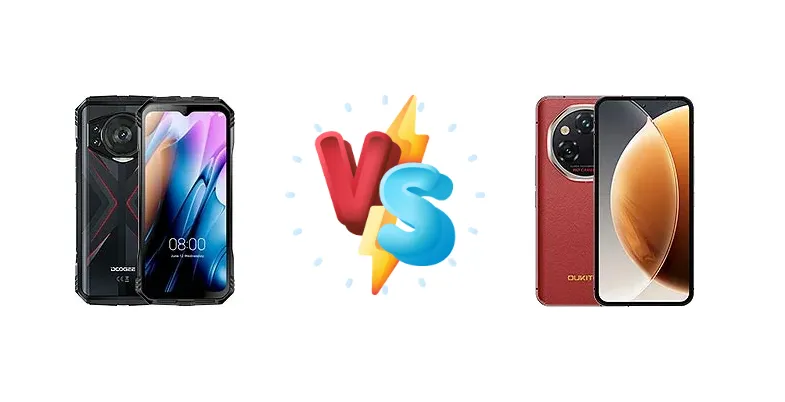
|
🏆 Quick Verdict
For the average user prioritizing sustained performance and future-proofing, the Oukitel WP210 is the clear winner. Its Dimensity 8200 chipset delivers significantly more processing power than the Doogee S118’s Helio G99. However, the S118 remains a strong contender for those who value exceptional battery endurance and a more budget-friendly price point.
| PHONES | ||
|---|---|---|
| Phone Names | Doogee S118 | Oukitel WP210 |
| Network | ||
|---|---|---|
| 2G bands | GSM 850 / 900 / 1800 / 1900 | GSM 850 / 900 / 1800 / 1900 |
| 3G bands | HSDPA 800 / 850 / 900 / 1700(AWS) / 1900 / 2100 | HSDPA 800 / 850 / 900 / 1700(AWS) / 1900 / 2100 |
| 4G bands | 1, 2, 3, 4, 5, 7, 8, 12, 13, 17, 18, 19, 20, 25, 26, 28, 34, 38, 39, 40, 41, 66, 71 | 1, 2, 3, 4, 5, 7, 8, 12, 13, 17, 18, 19, 20, 25, 26, 28, 34, 38, 39, 40, 41, 66, 71 |
| 5G bands | - | 1, 2, 3, 5, 7, 8, 12, 20, 25, 28, 34, 38, 39, 40, 41, 48, 66, 71, 77, 78 SA/NSA |
| Speed | HSPA, LTE | HSPA, LTE, 5G |
| Technology | GSM / CDMA / HSPA / LTE | GSM / HSPA / LTE / 5G |
| Launch | ||
|---|---|---|
| Announced | 2024, June | 2025, July |
| Status | Available. Released 2024, June | Available. Released 2025, July 15 |
| Body | ||
|---|---|---|
| Dimensions | 178.5 x 83.1 x 17.9 mm (7.03 x 3.27 x 0.70 in) | 163.6 x 77.9 x 13.7 mm (6.44 x 3.07 x 0.54 in) |
| SIM | Nano-SIM + Nano-SIM | Nano-SIM + Nano-SIM |
| Weight | - | 311 g (10.97 oz) |
| Display | ||
|---|---|---|
| Protection | Corning Gorilla Glass, Mohs level 5 | Corning Gorilla Glass 5, Mohs level 5 |
| Resolution | 1080 x 2408 pixels, 20:9 ratio (~401 ppi density) | 1080 x 2408 pixels, 20:9 ratio (~394 ppi density) |
| Size | 6.58 inches, 104.3 cm2 (~70.3% screen-to-body ratio) | 6.7 inches, 108.1 cm2 (~84.9% screen-to-body ratio) |
| Type | IPS LCD, 120Hz | IPS LCD, 120Hz, 500 nits |
| Platform | ||
|---|---|---|
| CPU | Octa-core (2x2.2 GHz Cortex-A76 & 6x2.0 GHz Cortex-A55) | Octa-core (1x3.1 GHz Cortex-A78 & 3x3.0 GHz Cortex-A78 & 4x2.0 GHz Cortex-A55) |
| Chipset | Mediatek Helio G99 (6 nm) | Mediatek Dimensity 8200 (4 nm) |
| GPU | Mali-G57 MC2 | Mali-G610 MC6 |
| OS | Android 14 | Android 15 |
| Memory | ||
|---|---|---|
| Card slot | microSDXC (uses shared SIM slot) | microSDXC (uses shared SIM slot) |
| Internal | 512GB 8GB RAM | 512GB 12GB RAM |
| Main Camera | ||
|---|---|---|
| Features | Dual-LED flash, HDR, panorama | LED flash, HDR, panorama |
| Triple | 50 MP, f/1.8, (wide), 1/2.76", PDAF 12 MP, f/1.8, (night vision), 2 infrared night vision lights 8 MP, f/2.2, 121˚ (ultrawide) | 108 MP, f/1.9, (wide), 1/1.8", PDAF 2 MP (macro) Auxiliary lens |
| Video | 1440p, 1080p | 4K@30fps |
| Selfie camera | ||
|---|---|---|
| Single | 32 MP, f/2.0, (wide), 1/2.74" | 32 MP, f/2.2, (wide), 1/2.74" |
| Video | 1080p | 1080p@30fps |
| Sound | ||
|---|---|---|
| 35mm jack | No | No |
| Loudspeaker | Yes, with dual speakers | Yes |
| Comms | ||
|---|---|---|
| Bluetooth | 5.2, A2DP, LE | 5.3, A2DP, LE |
| NFC | Yes (market/region dependent) | Yes |
| Positioning | GPS, GLONASS, BDS, GALILEO | GPS (L1+L5), GLONASS, GALILEO, BDS |
| Radio | FM radio | FM radio |
| USB | USB Type-C 2.0, OTG | USB Type-C 2.0 |
| WLAN | Wi-Fi 802.11 a/b/g/n/ac, dual-band | Wi-Fi 802.11 a/b/g/n/ac/6, dual-band |
| Features | ||
|---|---|---|
| Sensors | Fingerprint (side-mounted), accelerometer, gyro, proximity, compass | Fingerprint (side-mounted), accelerometer, gyro, proximity, compass |
| Battery | ||
|---|---|---|
| Charging | 33W wired Reverse wired | 45W wired |
| Type | 10800 mAh | Li-Po 8800 mAh |
| Misc | ||
|---|---|---|
| Colors | Silver, Red | Gray, Black, Red |
| EU LABEL | ||
|---|---|---|
| Battery | 87:10h endurance, 1100 cycles | 86:17h endurance, 1000 cycles |
| Energy | Class C | Class B |
| Free fall | Class A (270 falls) | Class A (270 falls) |
| Repairability | Class C | Class C |
Doogee S118
- Exceptional battery life (87:10h endurance)
- High battery cycle count (1100 cycles)
- More affordable price point (likely)
- Efficient Helio G99 chipset
- Less powerful processor compared to the WP210
- Slower charging speed (33W)
Oukitel WP210
- Significantly faster processor (Dimensity 8200)
- Faster charging (45W wired)
- Reverse wired charging capability
- More future-proof performance
- Slightly shorter battery life (86:17h endurance)
- Lower battery cycle count (1000 cycles)
- Potentially higher price
Display Comparison
While display specifications aren't provided, both phones likely feature durable, outdoor-optimized panels. The core difference lies beneath the surface. The WP210, benefiting from its higher-end chipset, likely has access to a more sophisticated display controller, potentially offering better color accuracy and viewing angles. The S118, with its focus on efficiency, may prioritize power saving over peak display performance.
Camera Comparison
Without detailed camera specs, it’s difficult to make a definitive judgment. However, the WP210’s more powerful ISP (Image Signal Processor), integrated within the Dimensity 8200, likely provides superior image processing capabilities. This could result in better dynamic range, noise reduction, and overall image quality, especially in challenging lighting conditions. The S118’s G99 chipset, while capable, will likely struggle to match the WP210’s image processing prowess. We can assume both phones will feature a main camera, but the WP210’s chipset allows for more advanced features like 4K video recording and potentially better stabilization.
Performance
The Oukitel WP210’s Mediatek Dimensity 8200 (4nm) represents a substantial leap in performance over the Doogee S118’s Helio G99 (6nm). The Dimensity 8200 boasts a prime Cortex-A78 core clocked at 3.1 GHz, alongside three additional A78 cores at 3.0 GHz, offering significantly faster single-core and multi-core performance. The G99’s configuration of two Cortex-A76 cores at 2.2 GHz and six A55 cores at 2.0 GHz is geared towards efficiency, not outright speed. This translates to smoother multitasking, faster app loading times, and a more responsive user experience on the WP210, particularly noticeable in graphically intensive games. The 4nm process node of the Dimensity 8200 also contributes to better thermal efficiency, reducing the likelihood of performance throttling during prolonged use.
Battery Life
Both devices offer impressive battery endurance, with the Doogee S118 achieving 87:10h and the Oukitel WP210 at 86:17h. The S118’s Helio G99 chipset is inherently more power-efficient, contributing to its slightly longer endurance. However, the WP210 compensates with faster 45W wired charging, significantly reducing recharge times compared to the S118’s 33W charging. The WP210 also boasts reverse wired charging, a convenient feature for topping up accessories. While the S118 offers 1100 battery cycles versus the WP210’s 1000, the faster charging of the WP210 mitigates the impact of slightly fewer cycles for most users.
Buying Guide
Buy the Doogee S118 if you need a smartphone that can reliably last through multi-day expeditions without needing a charge, and if your primary use cases don't heavily tax the processor. Buy the Oukitel WP210 if you prefer a smoother experience with demanding applications, enjoy mobile gaming, and want a device that will remain performant for years to come, even with software updates.