
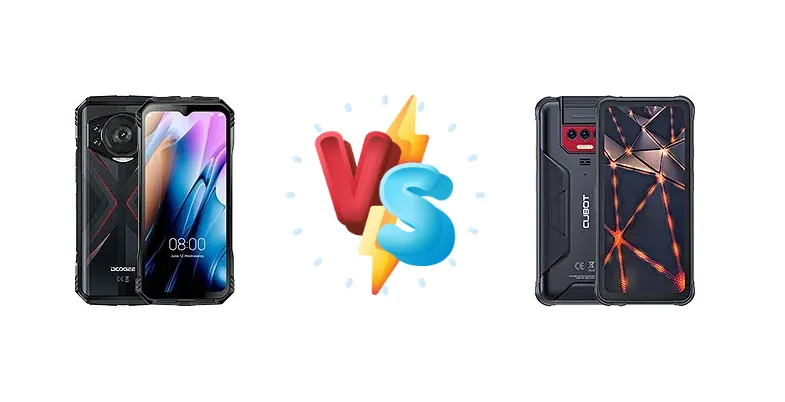
Doogee S118 vs Cubot KingKong 8: A Deep Dive into Rugged Smartphone Performance
| Phones Images | |||||
|---|---|---|---|---|---|
|
🏆 Quick Verdict
For most users, the Doogee S118 emerges as the stronger choice. Its modern Mediatek Helio G99 chipset, built on a 6nm process, provides a significant performance advantage over the Cubot KingKong 8’s older 12nm MT8788V, translating to smoother multitasking and better gaming. The S118’s impressive 87-hour endurance further solidifies its position.
| PHONES | ||
|---|---|---|
| Phone Names | Doogee S118 | Cubot KingKong 8 |
| Network | ||
|---|---|---|
| 2G bands | GSM 850 / 900 / 1800 / 1900 | GSM 850 / 900 / 1800 / 1900 |
| 3G bands | HSDPA 800 / 850 / 900 / 1700(AWS) / 1900 / 2100 | HSDPA 850 / 900 / 1700(AWS) / 1900 / 2100 |
| 4G bands | 1, 2, 3, 4, 5, 7, 8, 12, 13, 17, 18, 19, 20, 25, 26, 28, 34, 38, 39, 40, 41, 66, 71 | 1, 2, 3, 4, 5, 7, 8, 12, 17, 20, 28, 41 |
| Speed | HSPA, LTE | HSPA, LTE |
| Technology | GSM / CDMA / HSPA / LTE | GSM / HSPA / LTE |
| Launch | ||
|---|---|---|
| Announced | 2024, June | 2023, October 23 |
| Status | Available. Released 2024, June | Available. Released 2023, October 23 |
| Body | ||
|---|---|---|
| Dimensions | 178.5 x 83.1 x 17.9 mm (7.03 x 3.27 x 0.70 in) | 169.9 x 80.2 x 20 mm (6.69 x 3.16 x 0.79 in) |
| SIM | Nano-SIM + Nano-SIM | Nano-SIM + Nano-SIM |
| Weight | - | 382 g (13.47 oz) |
| Display | ||
|---|---|---|
| Protection | Corning Gorilla Glass, Mohs level 5 | - |
| Resolution | 1080 x 2408 pixels, 20:9 ratio (~401 ppi density) | 720 x 1612 pixels, 20:9 ratio (~270 ppi density) |
| Size | 6.58 inches, 104.3 cm2 (~70.3% screen-to-body ratio) | 6.53 inches, 102.4 cm2 (~75.2% screen-to-body ratio) |
| Type | IPS LCD, 120Hz | IPS LCD |
| Platform | ||
|---|---|---|
| CPU | Octa-core (2x2.2 GHz Cortex-A76 & 6x2.0 GHz Cortex-A55) | Octa-core (4x2.0 GHz Cortex-A73 & 4x2.0 GHz Cortex-A53) |
| Chipset | Mediatek Helio G99 (6 nm) | Mediatek MT8788V/WA (12 nm) |
| GPU | Mali-G57 MC2 | - |
| OS | Android 14 | Android 13 |
| Memory | ||
|---|---|---|
| Card slot | microSDXC (uses shared SIM slot) | microSDXC (uses shared SIM slot) |
| Internal | 512GB 8GB RAM | 256GB 12GB RAM |
| Main Camera | ||
|---|---|---|
| Features | Dual-LED flash, HDR, panorama | LED flash |
| Triple | 50 MP, f/1.8, (wide), 1/2.76", PDAF 12 MP, f/1.8, (night vision), 2 infrared night vision lights 8 MP, f/2.2, 121˚ (ultrawide) | 48 MP, (wide), PDAF 2 MP (macro) 0.3 MP |
| Video | 1440p, 1080p | Yes |
| Selfie camera | ||
|---|---|---|
| Single | 32 MP, f/2.0, (wide), 1/2.74" | 16 MP |
| Video | 1080p | Yes |
| Sound | ||
|---|---|---|
| 35mm jack | No | Unspecified |
| Loudspeaker | Yes, with dual speakers | Yes |
| Comms | ||
|---|---|---|
| Bluetooth | 5.2, A2DP, LE | 4.2, A2DP |
| NFC | Yes (market/region dependent) | Yes |
| Positioning | GPS, GLONASS, BDS, GALILEO | GPS, GLONASS, GALILEO |
| Radio | FM radio | Unspecified |
| USB | USB Type-C 2.0, OTG | USB Type-C, OTG |
| WLAN | Wi-Fi 802.11 a/b/g/n/ac, dual-band | Wi-Fi 802.11 a/b/g/n/ac, dual-band |
| Features | ||
|---|---|---|
| Sensors | Fingerprint (side-mounted), accelerometer, gyro, proximity, compass | Fingerprint (side-mounted), accelerometer, gyro, proximity, compass |
| Battery | ||
|---|---|---|
| Charging | 33W wired Reverse wired | Wired Reverse wired |
| Type | 10800 mAh | 10600 mAh |
| Misc | ||
|---|---|---|
| Colors | Silver, Red | Black, Red, Green |
| Price | - | About 170 EUR |
| EU LABEL | ||
|---|---|---|
| Battery | 87:10h endurance, 1100 cycles | - |
| Energy | Class C | - |
| Free fall | Class A (270 falls) | - |
| Repairability | Class C | - |
Doogee S118
- Superior performance with the Mediatek Helio G99 chipset.
- Excellent battery life with 87-hour endurance.
- Faster 33W wired charging.
- More efficient 6nm process node.
- Potentially higher price point.
- Rugged design may add bulk.
Cubot KingKong 8
- Potentially lower price point.
- Rugged design for durability.
- Reverse wired charging.
- Suitable for basic smartphone tasks.
- Older and less efficient MT8788V chipset.
- Likely shorter battery life.
- Slower performance for demanding applications.
Display Comparison
While both phones are likely to feature durable displays given their rugged nature, the provided data focuses on internal components. We can infer that both will prioritize visibility in direct sunlight, a common requirement for outdoor use. However, without display specs like resolution, brightness, or panel type, a direct comparison is impossible. The chipset differences suggest the S118 could potentially drive a higher resolution or refresh rate display without significant performance impact.
Camera Comparison
The provided data doesn’t offer camera specifics, making a detailed comparison impossible. However, given the market segment, both phones likely feature a multi-camera setup geared towards outdoor photography. We can expect a primary sensor, potentially an ultrawide, and possibly a macro lens. Without knowing sensor sizes, apertures, or image processing capabilities, it’s difficult to assess which phone offers superior image quality. The S118’s more powerful chipset *could* enable more sophisticated image processing algorithms.
Performance
The core difference lies in the chipsets. The Doogee S118’s Mediatek Helio G99 (6nm) is a substantial upgrade over the Cubot KingKong 8’s MT8788V (12nm). The 6nm process node allows for greater transistor density and improved power efficiency, meaning the G99 delivers more performance per watt. The CPU architecture also favors the S118; its Cortex-A76 cores (2x2.2 GHz) are significantly more powerful than the KingKong 8’s Cortex-A73 cores (4x2.0 GHz). This translates to faster app loading times, smoother multitasking, and a more responsive user experience. The G99’s integrated GPU will also provide a noticeable advantage in gaming.
Battery Life
The Doogee S118 boasts an impressive 87-hour endurance, a testament to the efficiency of the Helio G99 chipset and likely optimized software. While the Cubot KingKong 8’s battery capacity isn’t specified, its less efficient MT8788V chipset will likely result in shorter battery life. Both phones offer reverse wired charging, a useful feature for topping up accessories. The S118’s 33W wired charging is faster than the KingKong 8’s unspecified charging speed, reducing downtime.
Buying Guide
Buy the Doogee S118 if you prioritize performance for gaming, demanding applications, or future-proofing. Its newer chipset and longer battery life make it ideal for users who push their phones to the limit. Buy the Cubot KingKong 8 if you are on a tighter budget and primarily need a durable phone for basic communication and light tasks. It offers a rugged build at a potentially lower price point, but sacrifices processing power.